
Archaeology
4,000 year-old teeth found in Andalucía reveal gendered division of labour
A study reveals that only women used their mouths as a tool for making thread and cordage
María Paredes Moya
Almería
The analysis of everyday life in prehistoric times has taken a significant turn thanks to the biological remains that have survived the passage of milennia. ... Recent research has shed light on the social organisation of the culture of El Argar (Almería), which flourished in the southeast of the Iberian Peninsula between 2200 and 1550 BC.
The discovery confirms that almost four millennia ago there was already a strong gender-based labour specialisation, placing women as the only ones responsible for the handicraft production of thread, rope and basketry.
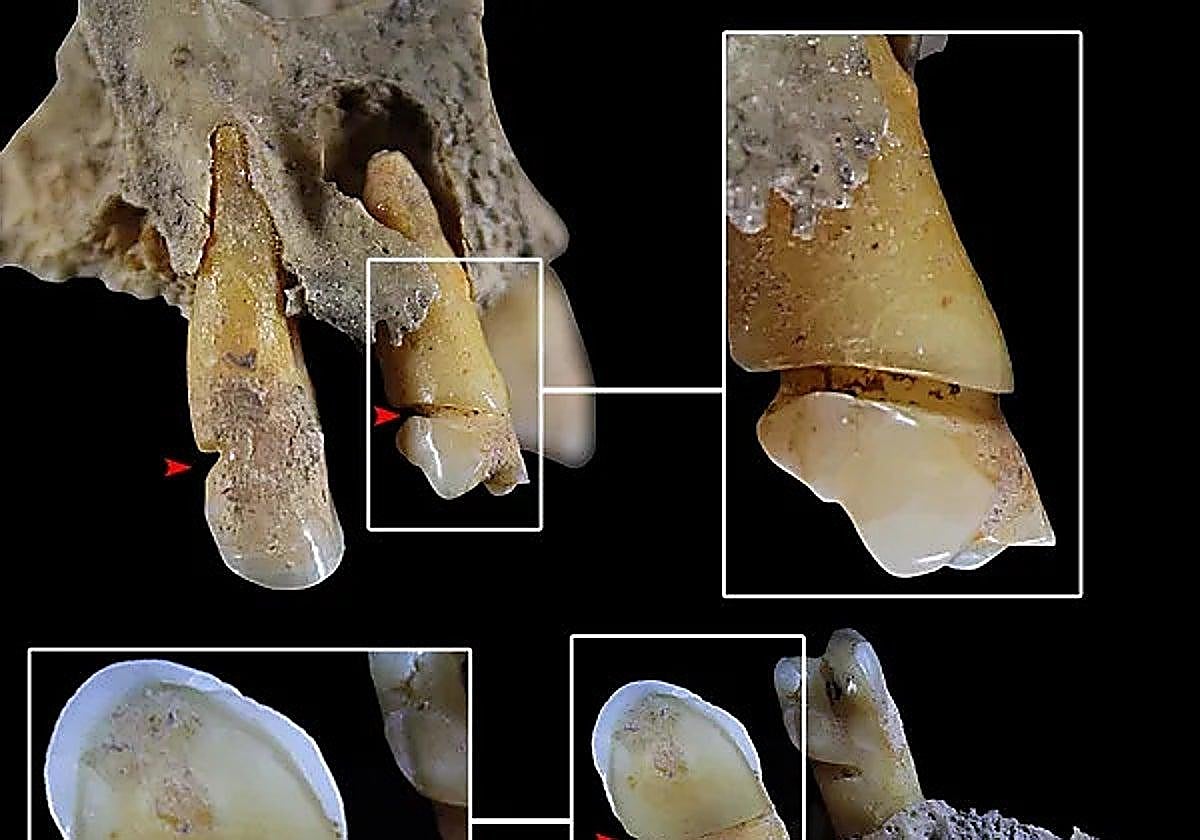
The study focused on the exhaustive examination of the dental wear of 106 individuals buried at sites in Darr, in the province of Granada, and Abla, in the province of Almería. The researchers, led by Marina Lozano and Ángel Rubio Salvador, have used different types of microscopy to identify notches, lascings in the enamel and deep grooves in the anterior dentition that do not correspond to the chewing of food.
The findings, led by the Catalan Institute of human paleoecology and social evolution (IPHES), in close collaboration with the Anthropology Laboratory of the University of Granada, have been published in the prestigious journal of Archaeological Science.
They report that these marks are the direct result of prolonged technical activity: the use of the teeth as a "third hand" to manipulate, hold or process plant and animal fibres. The evidence is conclusive in showing that this wear pattern only appears on female remains, which establishes a direct and exclusive relationship between women and textile manufacture in this Bronze Age society.
According to Ideal , this Argaric culture was characterised by a complex society, with clear social differentiation based on both age and gender. Although the existence of a rich material production in ceramics, metallurgy and lithics was known, until now it had not been possible to identify with such precision the craftsmen behind the remains of fibres and fabrics found at the sites.
The dental study allows us to conclude that there was a double specialisation: on the one hand, only a small group of the population was dedicated to these high-precision manual tasks and, on the other hand, this occupation was forbidden or not practised by men. This discovery breaks simplistic views of the past and gives women a leading and specialised role in the Argaric economy.
Another of the most revealing aspects of the research is the precociousness with which this technical formation began. When analysing individuals of different age groups, the scientists observed that the notches and occlusal grooves were already present in adolescents, with the severity of the wear increasing as the individual grew older.
This allows us to infer that professional specialisation began in the early stages of life and remained a constant activity throughout a woman's existence. The production of threads was not, therefore, an occasional task, but a lifelong occupation that required an apprenticeship from youth and left an indelible mark on the physiognomy of the workers.
![[]](http://static.vocstatic.com/voc26/latest/assets/images/favicon/surinenglish/apple-touch-icon-57x57.png)