
The Euro Zone
Changing fortunes
A World Cup victory won't transform an economy, but Spain's macroeconomics are already in winning shape compared to 2010 says columnist Mark Nayler
Mark Nayler
I was in The Hague on July 11, 2010, when Spain beat the Netherlands to win their first World Cup - also with a single goal in extra time.
I’m not particularly interested in football, so instead of watching the final (broadcast that year from Johannesburg), I was drinking with my then-girlfriend on a terrace on the main square. In any case, we didn’t need to be in front of a TV to know what was going on: the noise from the surrounding bars told us everything.
Or rather, the lack of noise. The tense silence of extra time was not broken by shouts and screams of elated relief - unlike in every village, town and city throughout Spain last Sunday night. The quietness spoke eloquently of defeat.
For the rest of that day, the atmosphere in that charming Dutch city was depressed and subdued.
The same could have been said of the Spanish economy. Two years before La Roja’s first World Cup triumph, the country was plunged into recession by a global financial crisis, exacerbated in Spain’s case by a burst housing bubble.
In 2009, Spanish GDP contracted by 3.8 per cent and in 2010 posted growth of just 0.1 per cent. Proper expansion didn’t start again until 2015.
Unemployment hit 20 per cent during the World Cup year and soared to 26 per cent in 2013. Winning the biggest football tournament on earth changed none of that.
Sixteen years and four World Cups on, Spain’s economy is much more reflective of its triumphant football team.
Its GDP growth rates since the pandemic have been amongst the highest in Europe. In 2024, its economy was named the best in the world by The Economist magazine.
Unemployment, though always a problem (especially amongst youth), has fallen to 10 per cent. Spain beats its own tourism records every year and in 2025 welcomed 97 million foreign visitors.
All of which is just as well, because according to the (limited) research, winning a World Cup does very little for the victorious country’s economy.
It essentially acts as an advertising campaign, massively boosting brand awareness. Exports surge briefly - and that’s basically it.
Madrid’s tax coffers will also receive a few million euros from the 50 million dollars (47.3 million euros) FIFA pays to the champion federation, via squad members resident in Spain; but that will hardly be enough to impact the country’s already-stellar macroeconomics.
Still, there is a beautiful irony here, one that even Donald Trump might appreciate. It looks as if Spanish exports will benefit, if only briefly, from La Roja winning a World Cup in the US., whose president recently threatened to cut all trade ties with Madrid.
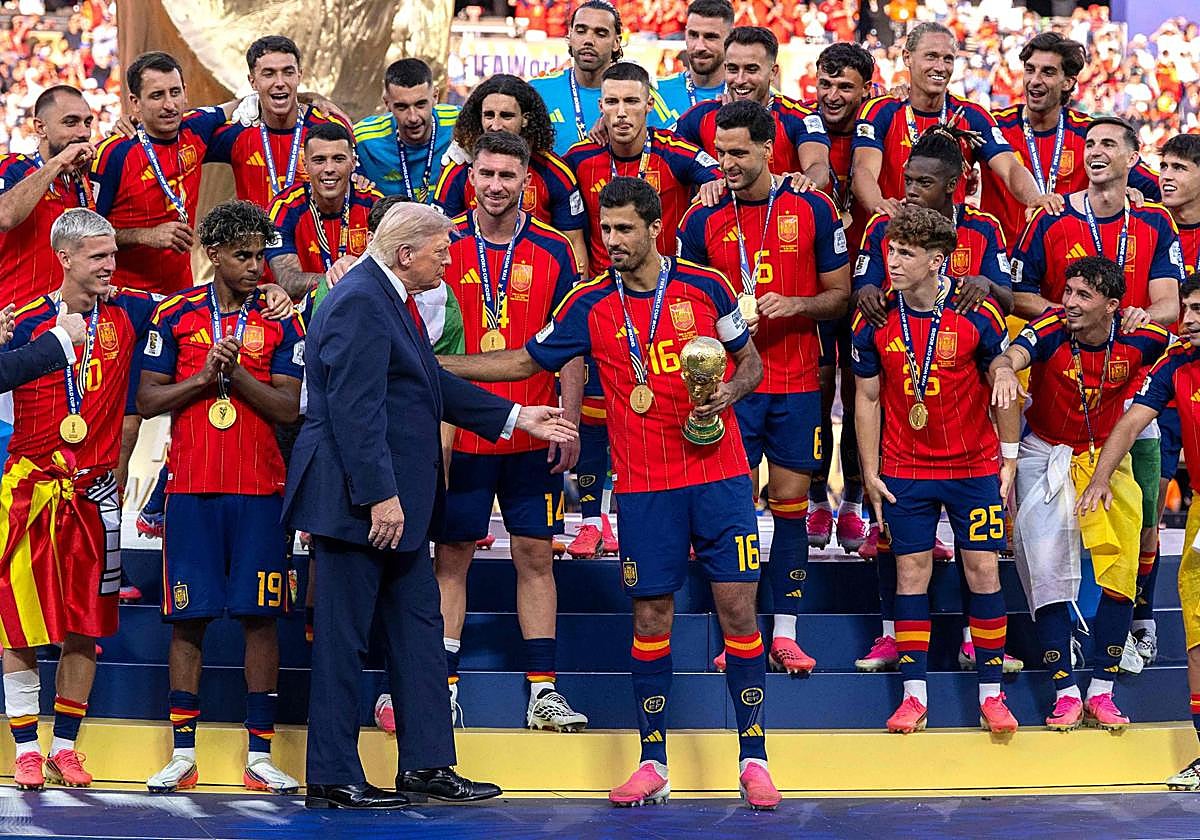
Perhaps that’s why Trump looked so uneasy - and so deeply unwelcome - as he lingered on the winners’ platform in New York last Sunday.
![[]](http://static.vocstatic.com/voc26/latest/assets/images/favicon/surinenglish/apple-touch-icon-57x57.png)