
Coastline technology
Worried about jellyfish? There is an app for that
Oceanaria has been developed by Malaga University researchers and selected as an example of a public service applied to the coastline
Ignacio Lillo
A new app, available on the Google Play Store and Apple App Store, uses artificial intelligence to predict jellyfish, algae and sea foam up to five days in advance.
Developed by the University of Malaga, with funding from the Junta, through the Next Generation funds, the Oceanaria app helps tourists find the best swimming spots.
The tool uses artificial intelligence for multiple purposes, both for recreational use of the coastline and to support local councils and the coasts authority in its management. Such has been its success that it has been selected as an example of public service at national level.
The app offers information on the entire Andalusian coastline, "from the first beach in Huelva to the last one in Almeria", explains the director of the Chair of Coastal Sciences, Francisco Franco.
The tool has been designed with a dual purpose: to help the management of coastal municipalities, and to serve as a reference for tourists and sportsmen and women.
It makes it possible to specify, for example, the area where clean-up workers should be assigned to remove invasive algae. "Depending on the currents, we have studied the mechanisms that bring them in and we know the probability for each of the beaches in Andalucía," said Franco.
"In Malaga, for example, we know that in westerly conditions, the area from La Malagueta to El Palo receives a large amount of algae."
When these conditions occur, the app reports the probability of the arrival of jellyfish and the manager can decide where to send the operational services.
When these conditions occur, the app reports the probability of arrival and the manager can decide where to send the operational services. "With this, we are reducing our carbon footprint: staff go straight to the problem area and energy expenditure, gas emissions and working time are optimised."
It also allows councils to optimise cleaning and safety using satellite data and precise mathematical modelling.
Jellyfish: AI predicts their arrival
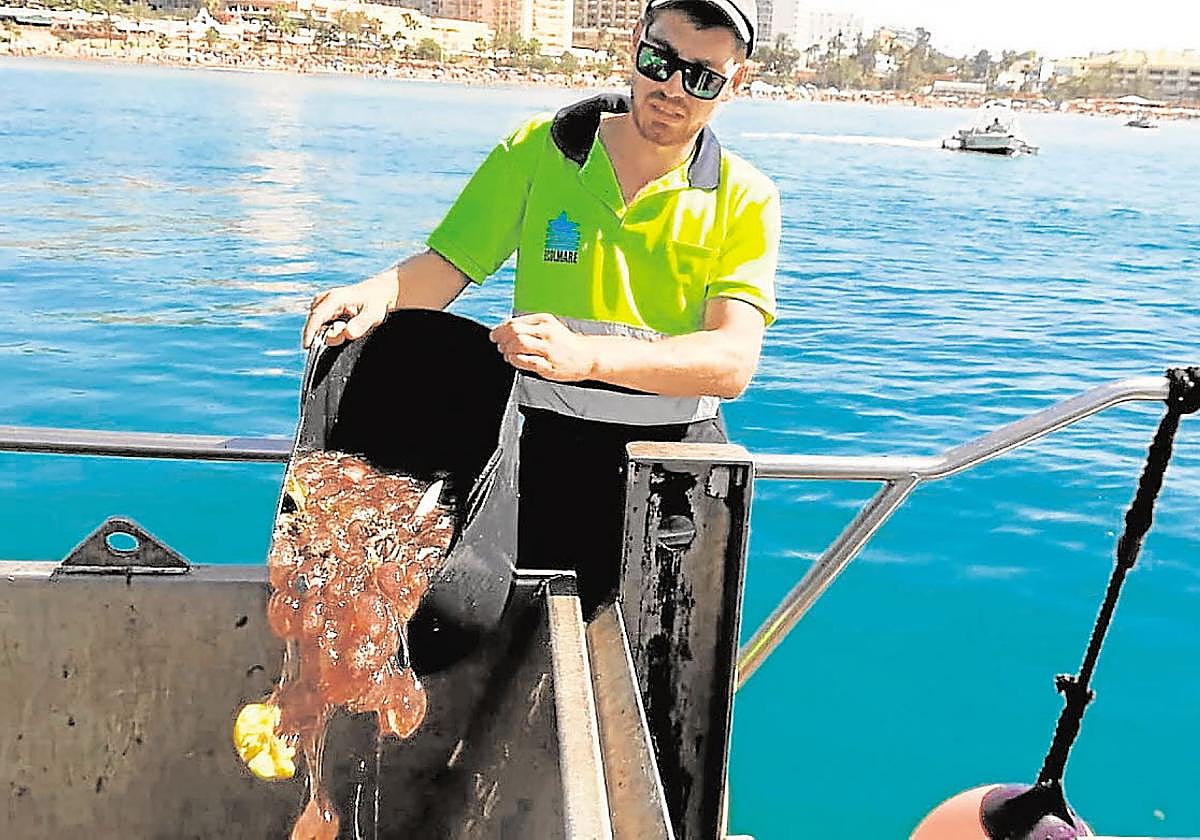
Both in the field of management and public information, one of the most outstanding sections is the one referring to the presence of jellyfish, both to warn bathers and to choose the beach that is free of them.
"Artificial intelligence uses knowledge of the currents, because jellyfish, contrary to what people think, do not appear when the water is warmer, but rather they allow themselves to be dragged along. So, their arrival depends on the currents."
The department uses mathematical modelling that continuously makes predictions of where the swarms are heading, in addition to real-time observation.
"This is very valuable information for lifeguards, who know five days in advance if they are going to have to reinforce their work on certain beaches. This has a direct application in terms of prevention and safety."
Dirty seawater
Another very useful option, due to its impact on bathers, is the one that refers to the appearance of scum or froth on the surface of the water. "Depending on the waves, winds and tides over the next few days, we can predict when and on which beaches it will appear. This also allows the catamaran boats to get closer to certain beaches and thus to fine-tune their effectiveness."
In addition, those who practise water sports, such as windsurfing and kitesurfing, can see the most suitable enclaves along the Andalusian coastline for each sport.
"You can find out the best beach where to practice all water sports, all over Andalucía."
The application also offers links to hotels and restaurants, as well as tourist information for each municipality.
Surfing and sailing
This is done using satellite information on wind, waves, air and water temperature, tides, ultraviolet index and rainfall, among others.
"The water sports table shows what can be done on each beach at each time of day, for example, the best time of day to go sailing." In these cases, the system gives a score, from 0 to 10, depending on how easy it is to do the sport.
For all these functionalities, the Oceanaria project has been selected as a national 'success story' in the application of marine science for coastal communities. This and four other selected cases will form part of a guidebook.
"We should be proud of national science, and in this case of the science done in Malaga, as it is at the forefront in the use of artificial intelligence to improve the quality of the natural environment of the coast, to make cleaning and maintenance processes more effective and to have safer beaches," reflects Francisco Franco. "This is an example of how information can make life easier for citizens and decision-makers in our coastal municipalities.
Together with the Chair of Coastal Sciences, the Oceanaria project involves the powerful research group of Differential Equations, Numerical Analysis and Applications (EDANYA) of the University of Malaga. This is the same team of scientists, experts in applied mathematics, which advises the institutions on the modelling and prediction of possible tsunamis.
![[]](http://static.vocstatic.com/voc26/latest/assets/images/favicon/surinenglish/apple-touch-icon-57x57.png)