
Technology
A ‘tree’ powered by artificial intelligence takes root in Benarrabá to combat the heat
Since January, the company Biotonomy has been trialling its ‘Tree Hub’ project in the municipality – a mobile solution that combines nature and technology to cool down squares lacking vegetation
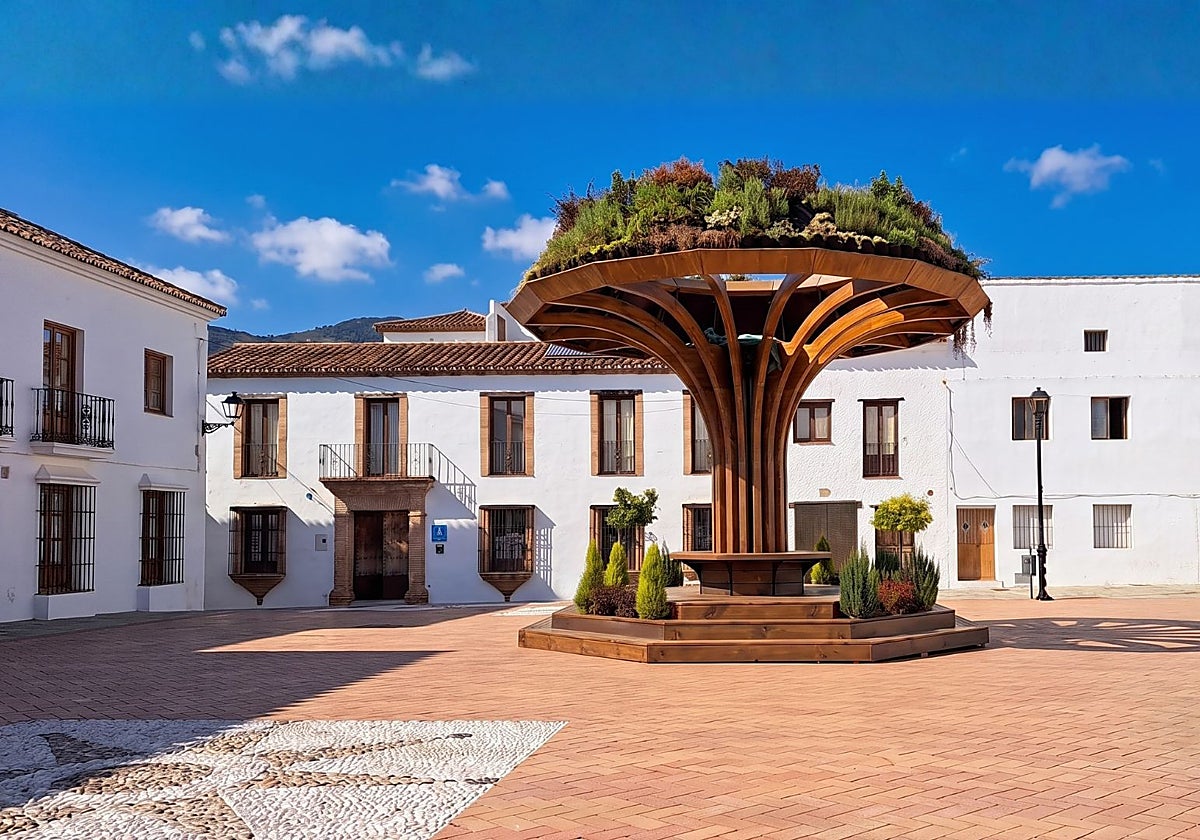

In the town of Benarrabá, in the province of Malaga, there has been a tree since January that did not grow from a seed. It ... has its own structure and foliage, provides shade, has Wi-Fi connectivity and even features a screen. Nor does it sink its roots into the ground and when the time comes, it can be moved. It is the first prototype of the ‘Tree Hub’, a project by the Malaga-based company Biotonomy aimed at bringing green infrastructure precisely to those corners of towns and cities where planting a conventional tree is impossible.
The idea came about after repeatedly coming up against this problem. Biotonomy usually works with vertical gardens and green roofs to introduce vegetation into urban environments, but there were some places where this proved difficult: listed building façades, completely paved squares, or spaces where there was simply no soil available.
“We began to envisage a structure that could provide greenery and shade without needing either a façade or soil for planting,” explains Juan Ignacio Marín, the company’s Director of Business Development. The result eventually took the form of a tree. And then came the technology, Wi-Fi and other features.
‘We began to envisage a structure that could provide greenery and shade without needing either a façade or soil for planting’
The first ended up putting down roots – albeit mobile ones – in Benarrabá. The choice of this small town in the Genal Valley was no accident. Marín highlights the mayor’s commitment to innovation and his willingness to turn the town into a testing ground for an initiative still in its early stages. “We’re confident it will be rolled out worldwide, but the first one will always be in Benarrabá,” he says.
The Tree Hub was initially installed in Plaza Veracruz, although the Town Council and local residents have decided to find it a new location. The reason has little to do with technology: a large number of the town’s events and the local fair are held there. The move will free up that space and bring the structure closer to an area also linked to Benarrabá’s commitment to attracting digital nomads.
Piece of furniture
Beyond its eye-catching appearance, Biotonomy aims for the invention to function as a piece of street furniture capable of bringing green infrastructure into mass production. Rather than a pergola or a design tailored specifically to each square, the company proposes manufacturing modular units that can be replicated and adapted.
The aim of its developers is that one day an architect might decide to place several Tree Hubs in a square or along a promenade in the same way that benches, street lamps or litter bins are currently arranged. They argue that this approach would enable faster action to be taken in spaces where a tree would take years to reach a sufficient size.
In Benarrabá, however, the most basic function has also been the one best understood: shade. The square where the prototype was installed had virtually none, and Marín says it is the elderly who have appreciated it the most. Young people were initially more interested in the screen and the connectivity. “When they were told it was the first of its kind in the world – a smart tree with Wi-Fi – people were absolutely blown away,” he recalls of the excitement sparked by its installation in a village of around 500 inhabitants.
And the mountain winter has also served as a unique test of endurance. The first unit was built from wood and arrived in Benarrabá in January, just in time to face spells of rain and wind over the following months. Marín admits there were ‘several sleepless nights’ spent worrying whether the prototype would hold up, but the structure remains intact. Subsequent versions will use more durable materials and will be designed to withstand the conditions typical of any public space for decades to come.
Price is now another challenge. The initial units cost around 120,000 euros to install, plus a monthly maintenance fee of around 500 euros, which includes the platform. The aim is to gradually reduce manufacturing costs until they fall below 40,000 euros. Biotonomy’s initial target is to install between ten and fifteen units over the next two years before seeking support from a major manufacturer to enable production on a larger scale.
![[]](http://static.vocstatic.com/voc26/latest/assets/images/favicon/surinenglish/apple-touch-icon-57x57.png)