
Sun&Tech Málaga by Alhambra Venture
EU aims to boost tech sector with more investment and less bureaucracy
MEP Diego Solier presented the Cloud and AI Development Act at Sun&Tech Málaga by Alhambra Venture: a piece of legislation through which Europe aims to attract investment, boost data centres and reduce regulatory barriers to technological development
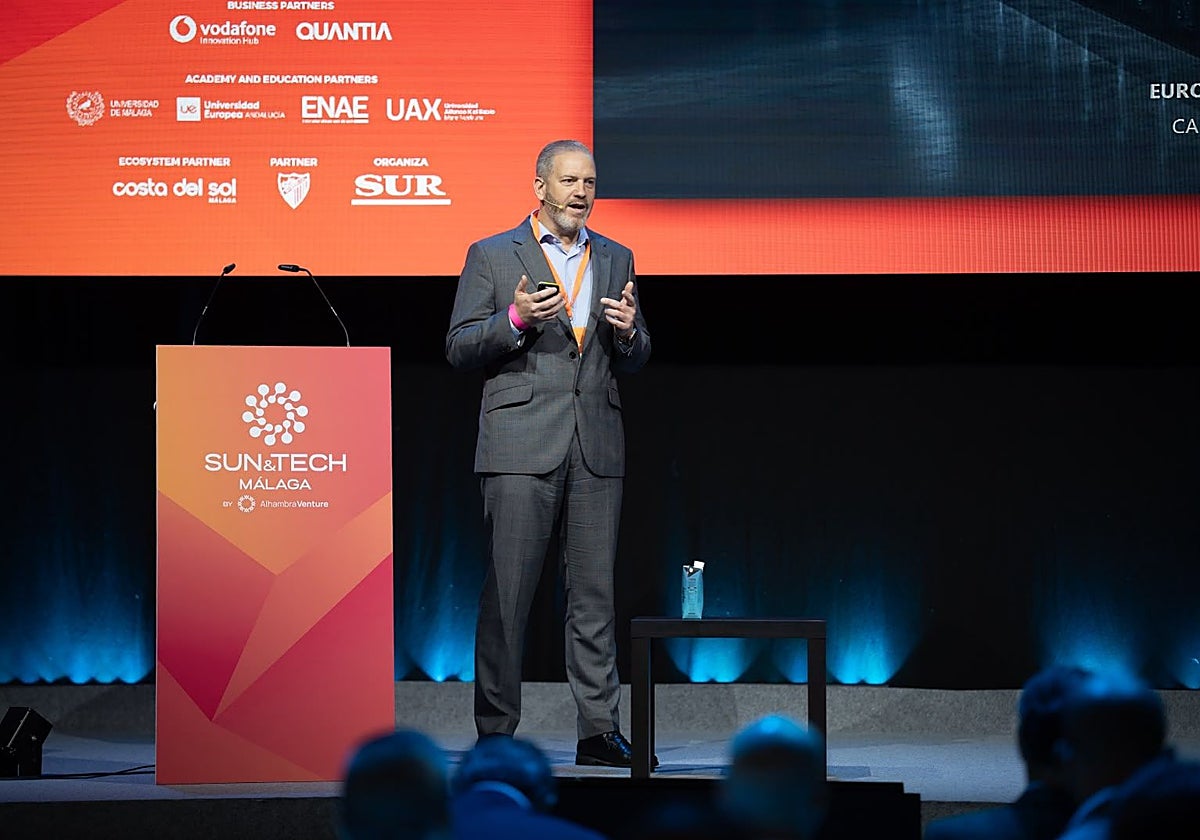

"I was fortunate enough to be appointed as the lead rapporteur for what I believe is one of the pieces of legislation that will ... have the greatest impact on the future of technology in Europe," MEP Diego Soler said at the start of his talk at the Sun&Tech Málaga by Alhambra Venture event on Thursday.
The focus of his speech was the Cloud and AI Development Act (Cada). The regulations aim to boost the data centres, infrastructure, computing capacity and cloud services that Europe needs to develop its technology sector securely. "We all want to lead the way in AI, we all want cloud services. But where is that AI going to run?" Solier asked, pointing out that the cloud requires physical infrastructure to support its growth.
One of Cada's objectives is to increase Europe's computing capacity in light of the expected growth in the adoption of AI. Solier stressed the need to attract private investment, as public funding will not be sufficient to develop all the necessary infrastructure. Furthermore, he linked technological innovation to business competitiveness and Europe's ability to tackle its debt.
Energy is another fundamental pillars. Solier pointed out that one of Europe's main problems is not only energy generation, but also connecting projects to the electricity grid. He called for investment to enable the available capacity to be utilised and to meet the needs of data centres. "Without energy sovereignty, we will never achieve technological sovereignty," he stated.
The four challenges the regulations pose
The Cada presents four major challenges: funding, regulatory flexibility, European sovereignty and demand generation. The first involves attracting private capital to develop computing infrastructure. To achieve this, Solier considers it essential to offer legal certainty, predictability and more streamlined procedures that encourage investors to back Europe.
The third pillar aims to reduce dependence on the current major providers of cloud and AI services. The fourth pillar involves boosting demand for European technology, starting with public procurement, to encourage a greater proportion of workloads to be processed within the continent.
To facilitate investment, the regulations provide for so-called "acceleration zones", which member states must designate. These zones will streamline the process for obtaining building permits and access to the electricity grid, as well as facilitating legal advice and the management of environmental requirements.
The proposal also includes European preference mechanisms to favour operators on the continent who wish to invest in this infrastructure. "What we cannot have, as has happened in the past, are airports without aeroplanes. We do not want data centres without power," Solier said.
The MEP also called for a review of the granting of permits, so that projects are prioritised according to their contribution to the country and the region, rather than solely on the basis of the order in which applications are received. As Solier explained, there are projects that have come to a standstill due to a lack of permits to connect to the electricity grid, a problem affecting various European countries.
Amendments and technological sovereignty
The legislation is currently undergoing amendments, following the presentation of the draft to the European Parliament. The aim is to incorporate improvements that will provide certainty for technology companies and investors.
One of the main points of debate centres on sovereignty. The Commission's proposal sets out four levels, ranging from the basic level to the highest level of security, aimed particularly at areas such as defence and national security services. Its requirements could also concern private companies in sectors deemed critical.
For Solier, sovereignty does not mean isolation from the global market or replacing all existing technology with exclusively European solutions. "For us, sovereignty means the ability to decide when it really matters what you do with your data and your services," he explained.
The MEP advocates measures such as having backup systems, contractual safeguards and infrastructure alternatives that enable organisations to retain control over data and critical services. In the face of direct blockades by suppliers, he advocates analysing the risks on a case-by-case basis and exploring measures to mitigate them before imposing restrictions that could harm businesses.
Simplify and listen
Towards the end of his speech, Solier highlighted over-regulation as one of the problems hindering European competitiveness. "We are experts at creating regulations, at having one set of regulations overlap with another and, in a way, leaving businesses in the dark, unsure of what they are actually required to comply with," he warned.
Through Cada, the MEP advocates simplifying procedures and preventing the accumulation of obligations from hampering the agility of Europe's technology sector. Solier presented a two-way communication platform designed to bring the legislative process closer to businesses. Solier encouraged companies and investors attending Sun&Tech Málaga by Alhambra Venture to put forward their concerns and proposals in order to identify potential impacts of the legislation and suggest improvements during the amendment phase.
The initiative is open to a wide range of sectors, from finance and energy to defence and European industry as a whole. As a means of contact, the MEP displayed a QR code on the final slide of his presentation, with the aim of facilitating direct participation by the private sector.
His closing message was a call to collaborate on drafting the legislation: to listen to businesses, draw on their experience and build a regulatory framework that fosters investment and innovation without creating unnecessary barriers to European technological development.
