
Culture
The ultimate in concerts: the T-shirt that makes people who can't hear the music feel the music
Marenostrum Fuengirola incorporates into its events waistcoats that send electrical pulses to different areas of the torso and arms to the rhythm of the sound
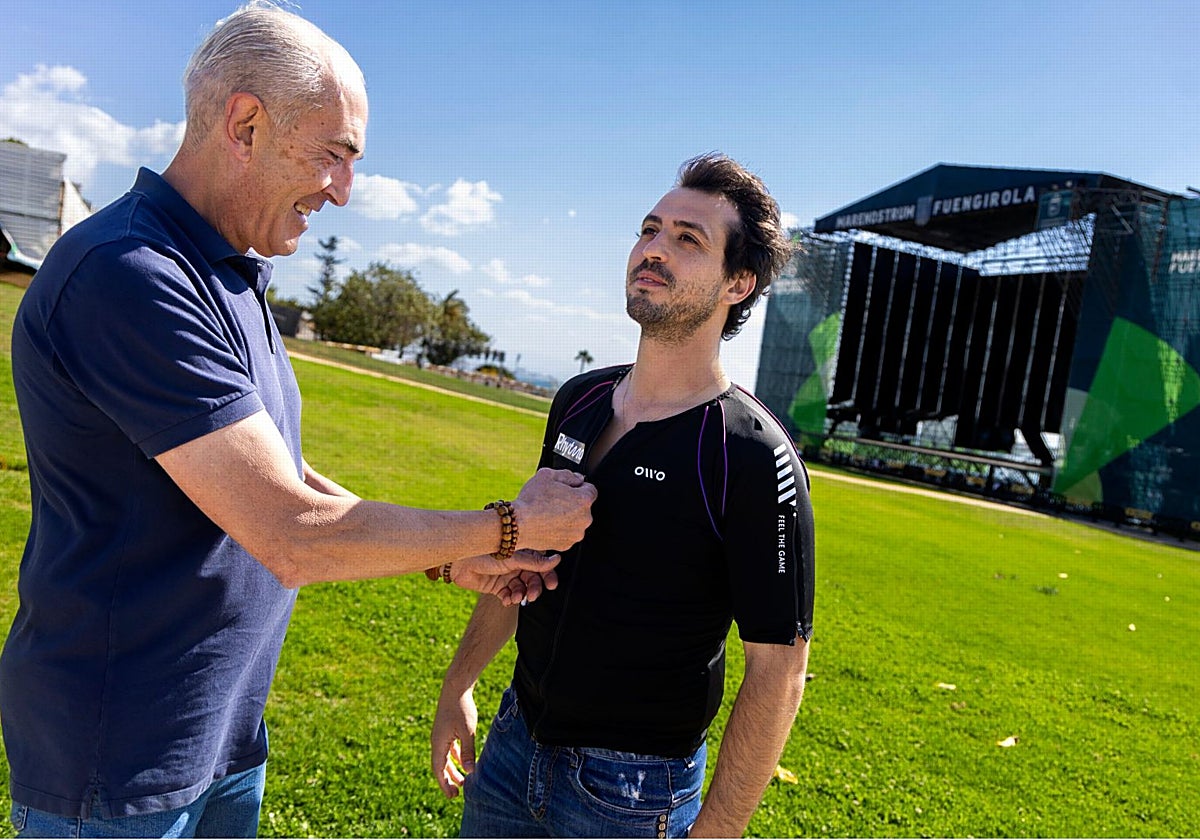

At first glance it looks like any other jersey, black and tight, but it is not. Inside it hides a dozen points that send electrical ... pulses to the body to the rhythm of the music through the torso and arms.
Eleven milliseconds after a sound is produced, the waistcoat reacts and the person who can not hear the song instead feels it instantly. The Malaga-based company Rhytmo is developing software for groups with physical barriers - hearing or visual - to improve their experience at concerts by incorporating the sense of touch.
The system is incorporated into the haptic T-shirts designed by Malaga firm OWO and which will now be implemented free of charge at Marenostrum Fuengirola concerts. Pablo Alborán's concert, on 6 June, will be the first one where it will be available.
A team of eleven experts have worked for two years on the development of this technology, which represents a significant leap forward compared to what already exists.
The vibrating backpacks, which bands such as Coldplay provide for hearing impaired fans at their shows and which have also been tested at Marenostrum, weigh three kilos, while these T-shirts weigh no more than 400 grams.
Most of the known systems have an appreciable delay for the wearer of around 50 milliseconds, but in this case this been reduced to 11 milliseconds.
"You hear any chord on stage and you are already feeling it on your skin," explains Josema Ezquerra, CEO of Rhytmo. Moreover, it not only transmits a reverberation: "We have created an artificial intelligence that makes sense of the style of the music, the rhythm that is playing, the artist and the musical genre".
So a ballad will only gently activate certain zones, but a reggaeton or a dj session will vibrate the whole waistcoat.
Pablo Alborán's performance will be the first to feature the device, along with a sign language interpreter
This is an "immersive experience" suitable for anyone, but priority will be given to deaf and deafblind people. Those interested should request the service by emailing accesibilidad@marenostrumfuengirola.es, and will be informed of availability and the protocol to be followed.
Next to the main entrance, a tent will be set up as a changing room where registered persons can put on the garment, which must be in direct contact with the skin. There, they will be calibrated in a personalised way, according to the level at which they begin to feel and how much they want to feel.
Afterwards, they will follow the concert from a space set up by Fuengirola Town Hall on the Marenostrum hill next to a technical table that sends the electro-stimulation signals to the waistcoat via Wi-Fi.
For Rodrigo Romero, Councillor for Culture of the municipality, "it is the responsibility of the venues to have a suitable environment so that everyone can enjoy the concert".
Marenostrum Fuengirola has had an Accessibility Plan since 2019 that aims to break down the barriers that make it difficult for people with disabilities to participate in the event. During the presentation, Romero recalled a Morat concert which was attended by a large group of deaf people with sign language interpreters.
"They all danced and enjoyed themselves. It should always be like this at all concerts, nobody should be left out of an experience that is also the collective experience par excellence", he pointed out.
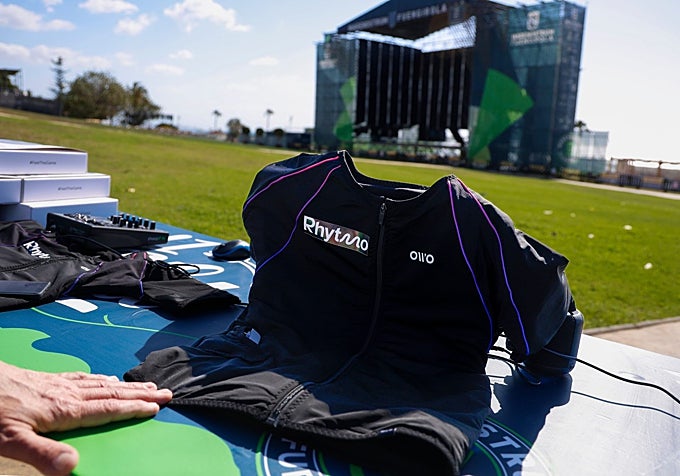
For the time being, there will be 20 T-shirts available for the concerts taking place on the Marenostrum hill (not in the castle).
Pablo Alborán's concert, in less than a month, will be the first to put them to the test, in an event that will also be accessible for many other reasons. With the collaboration of the Music For All Foundation, there will be a Spanish sign language (LSE) interpreter, Chus Beltrán, who will sign live throughout the show, making it easier for the hearing impaired to follow in real time.
In addition to this measure, there will be reserved parking for people with reduced mobility, an exclusive access lane, a raised platform, adapted toilets, an accessible bar, anti-noise helmets and earplugs, the admission of guide dogs and complete signage using Navilens codes with audio-description of the space.
It is an evolution of the T-shirts that have been used for years in the world of video games - patented by OWO - to amplify the experience of the game through sensations. In fact, the Fuengirola-based company Rhytmo comes from this sector.
"Many people were already working on video games with haptic sensations. And when we thought about what other model to investigate, we thought of one with a social impact", says Josema Ezquerra. In the last few months, people with blindness, deafness and reduced mobility have tested these T-shirts. "It has been a success because everyone, literally everyone, has flipped out. It's something they've never experienced before", he concludes proudly.
![[]](http://static.vocstatic.com/voc26/latest/assets/images/favicon/surinenglish/apple-touch-icon-57x57.png)