
Urban landscape
Golden Mile centrepiece: here's the lowdown on Marbella's new obelisk
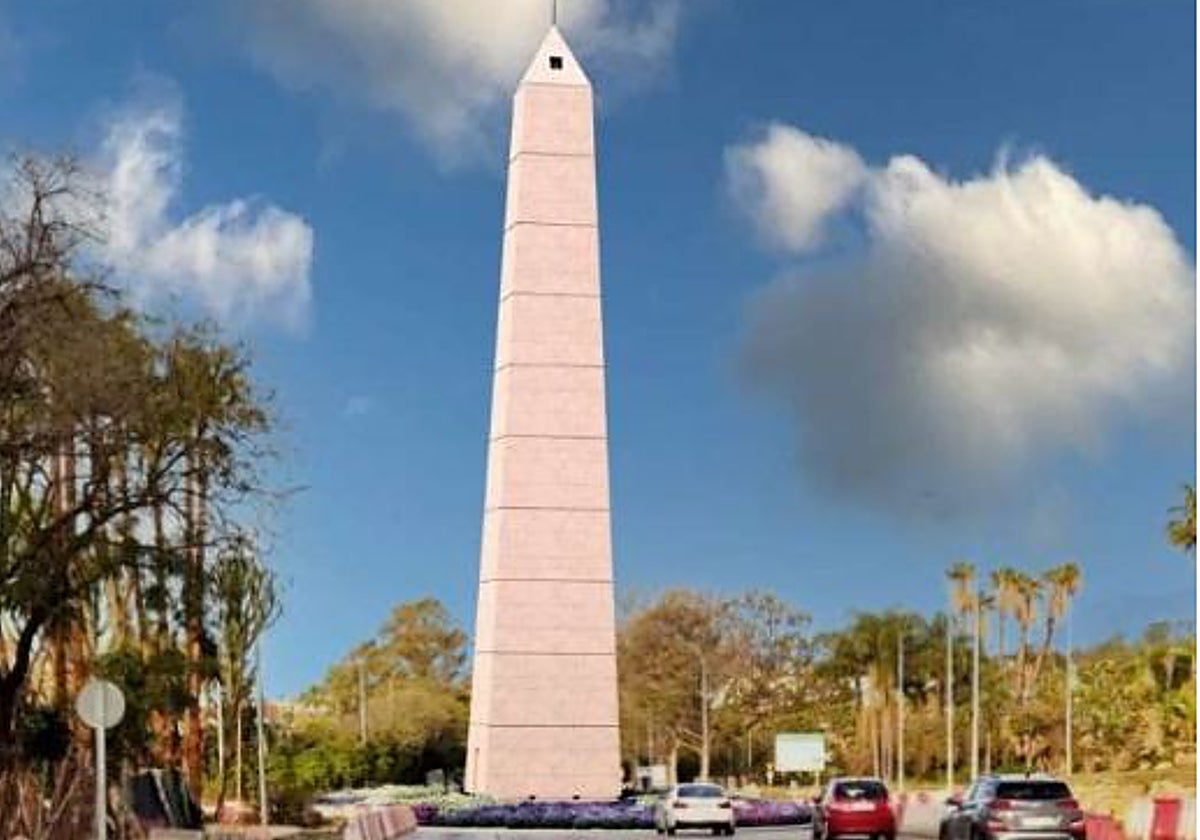
The structure, made of reinforced concrete and clad in white marble, will feature a lightning rod, reaching a total height of 43 metres, all part of the revamp of one of this Costa del Sol town's main thoroughfares

Marbella
"It is an architectural structure with great symbolism that has been used throughout history by various civilisations. Its form and presence transmit profound values ... and meanings, making it ideal as a commemorative or monumental element."
With these words, Amparo Corral, architect and director-general for public works in Marbella town hall, described the significance of having an obelisk at the heart of the project drawn up to install "a unique element" in the heart of Marbella's Golden Mile.
A structure that "represents the transcendence of time" due to its "verticality, solidity and durability". The monument will reach a height of 40 metres, 43 including the three-metre lightning rod that will crown thestructure. It will be built of reinforced concrete, clad in white Athena marble, a natural stone used outdoors for its resistance to water and humidity, and will feature an internal, spiral staircase and an area at the top for maintenance work.
The obelisk, conceived as "a unique piece that pays homage to Marbella town, not only as an internationally renowned tourist destination, but also as a place with a rich historical and cultural heritage", will be erected on a roundabout built at the junction of the N-340 and the Istán road (A-7176).
This roundabout was constructed as part of the comprehensive remodelling of the urban section of the Istán road, a project undertaken by the local council and regional government, completed just over four months ago. The roundabout will be adapted to accommodate the obelisk, which forms part of "a comprehensive strategy to transform the N-340 as it passes through Marbella, aimed at improving both mobility and the urban landscape of one of the municipality's main thoroughfares".
The obelisk will be illuminated with LED projectors, also featuring an internal, spiral staircase and luminous signage
This is part of Marbella's 'boulevard' project, already completed on the section between Marbella and Puente Romano, which will now proceed in both directions: eastward, with the section between the Manuel Haro roundabout and the Marbella Arch, and westward, between Puente Romano and the Swedish Forestry Centre.
The town hall has officially put both sections out to tender. Together, they total 2,513 metres in length and the latter includes the construction of this distinctive monument. The tender budget is nearly 3.86 million euros, of which 785,369.23 euros correspond to the obelisk. Completion time for all the work is ten months.
Natural cross ventilation
The location of the obelisk has taken into account the prevailing wind conditions and it was decided to position the structure on the southwest-northeast axis, following the route of the N-340 dual carriageway. The placement also incorporates natural cross ventilation in the design to maximise airflow inside. The obelisk will have a hollow, truncated pyramid shape, with a 7x7-metre square base and a 3.5x3.5-metre top section.
It will be constructed in four sections, using custom-made metal formwork with longitudinal reinforcement and stirrups. Each section will be 7.28-metres high, plus a final section for access to the topmost area set aside for maintenance work. The reinforced concrete walls will have an average thickness of 30 to 40 centimetres. Inside, it will house a one-metre-wide metal spiral staircase that will provide access to the upper platform.
The obelisk will be built on a concrete foundation and will have a one-metre-wide perimeter strip paved with honed grey granite, surrounded by a 458-square-metre landscaped area. A three-metre-high lightning rod will top off the structure, equipped with a grounding system using grounding rods or a buried ring. Since the structure exceeds 40 metres in height, luminous beacons must be installed in accordance with Spain's aeronautical regulations.
This monument will also feature an exterior architectural lighting system with LED projectors embedded in the base and directed towards the structure, activated by an automatic lighting system with an astronomical clock or twilight sensor. All this will be finished off with an ornamental and road safety lighting system installed around the perimeter of the roundabout, (to be installed once the obelisk is in situ). Lastly, it will have an irrigation system (controlled remotely), stormwater drainage, a telecoms infrastructure and pre-wiring for a video surveillance system.
![[]](http://static.vocstatic.com/voc26/latest/assets/images/favicon/surinenglish/apple-touch-icon-57x57.png)