
Animal welfare
Marbella releases two loggerhead turtles found on the brink of death
The two animals were rescued from situations that “seriously threatened their survival” and have now been returned to their natural habitat following a lengthy rehabilitation process

Marbella
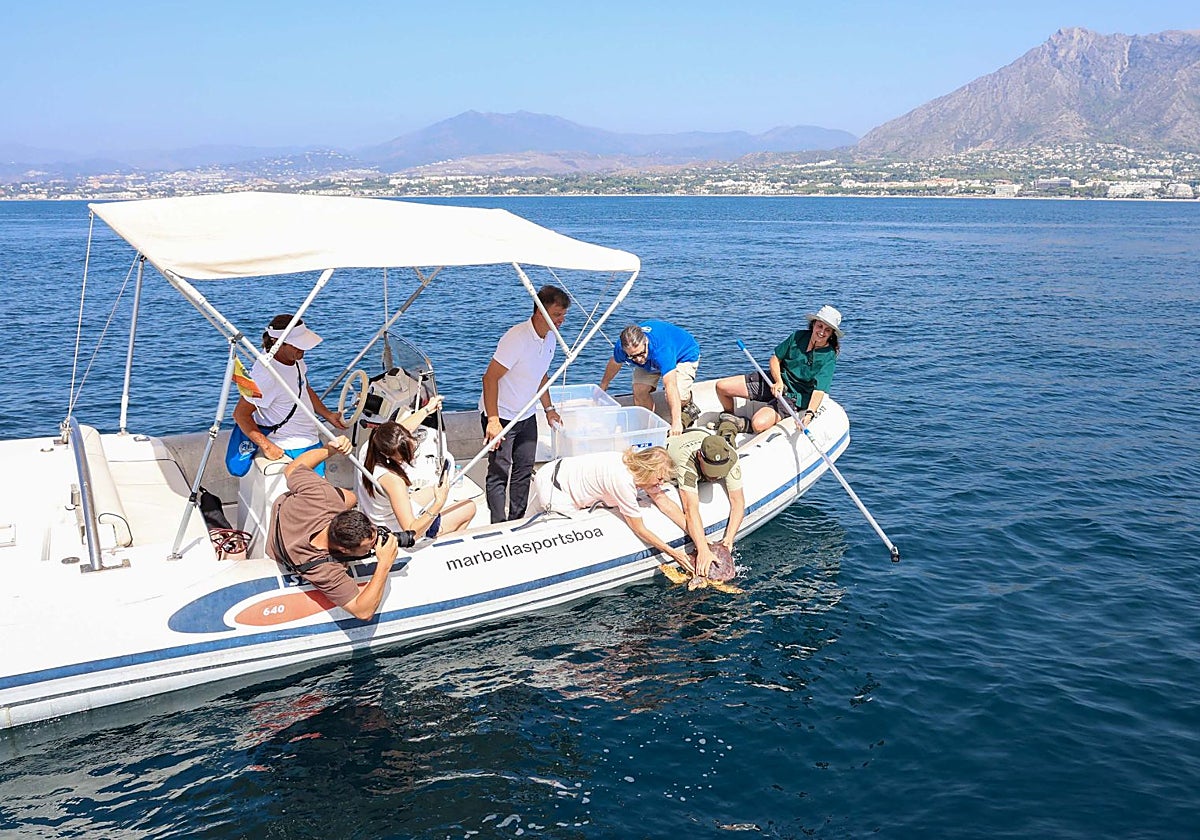
Two loggerhead sea turtles were released back into the sea off the coast of Marbella on Thursday after being rescued from situations that “seriously threatened ... their survival”. After undergoing veterinary care and a rehabilitation programme, Pepa and Hulia were transported on a boat that set sail from the Virgen del Carmen Marina out to sea to release them more than two miles from the coast.
Pepa was found on 4 March stranded on a beach in Rincón de la Victoria, suffering from severe dehydration, impaired buoyancy and lung damage: Hulia was found on 30 June on a beach near Retamar, in Almería, with a serious entanglement caused by raffia sacks and other marine debris affecting her neck and all four flippers, which had caused constriction injuries. Both are loggerhead sea turtles (Caretta caretta), a species listed in the Andalusian catalogue of threatened species (Decree 23/2012) with the conservation status ‘vulnerable’ (VU), although their global status, according to the criteria of the International Union for Conservation of Nature (IUCN), is ‘endangered’ (EN).
Pepa was found by officers from the Guardia Civil’s nature protection service (SEPRONA). While an adult loggerhead turtle can weigh up to 150 kilos, Pepa weighed just 4.3 kilos, and her recovery has required not only intensive veterinary treatment but also tube-feeding. The recovery process has taken place at one of the two Andalusian centres for sustainable marine environment management (Cegma) run by the Andalusian regional government. In Hulia’s case, upon admission she was also in poor physical condition and dehydrated, although her weight was significantly higher than that of her fellow turtle from Malaga (6.3 kilos); she received veterinary treatment, care and a rehabilitation programme.
Both turtles have now been released back into the sea following an assessment of their ability to cope effectively in their natural habitat.
The town's mayor, Ángeles Muñoz, said that she was pleased that Marbella was chosen to host this initiative. Muñoz praised the coordination between the regional ministry of the environment, organisations specialising in biodiversity, SEPRONA, the veterinary teams from the Andalusian marine environment management centre and the Seville Aquarium, among other professionals and organisations. In this regard, she said that the release represents “the result of a joint effort to return to the sea two animals that were found in circumstances where their lives were in grave danger”.
In recent years, Marbella has recorded instances of this species nesting on the beaches of Calahonda and Nueva Andalucía
The mayor, who was accompanied by the councillor for the environment, Diego López, and the director of the Marina, Carlos Romero, also highlighted Marbella’s commitment to the conservation of loggerhead turtles and the protection of the marine ecosystem. She explained that the municipality has recorded nesting by this species in recent years on the beaches of Calahonda and Nueva Andalucía. In this regard, she highlighted the role played by organisations such as ProDunas and the involvement of local residents and volunteers in monitoring and protecting the nests.
Citizen participation
Muñoz said that coastal conservation “also requires the public’s cooperation” and warned of the consequences that waste ending up in the sea can cause. “A plastic bag, a fishing net or any plastic item left lying around can end up in the water and pose a serious threat to marine species such as turtles,” she said, calling for prevention and individual responsibility.
In this regard, the mayor said that the council “remains committed to environmental protection and the conservation of the coastline”, as evidenced by the various awards it has received in recognition of the quality and sustainability of its beaches. She championed the importance of environmental education from an early age through activities and talks aimed at young children “so that they can learn about the municipality’s biodiversity and understand the need to preserve the environment”.
The loggerhead turtle (Caretta caretta) can live for 50 or 60 years and, over the course of its life, lay up to 60 nests on sandy beaches, each of which can contain up to 100 eggs, which it buries at a depth of around 40 or 50 centimetres. However, nesting is currently threatened by several human-induced factors, including the collection of eggs, accidental destruction during fishing activities and, more recently, the growing prevalence of recreational activities.
![[]](http://static.vocstatic.com/voc26/latest/assets/images/favicon/surinenglish/apple-touch-icon-57x57.png)