
Society
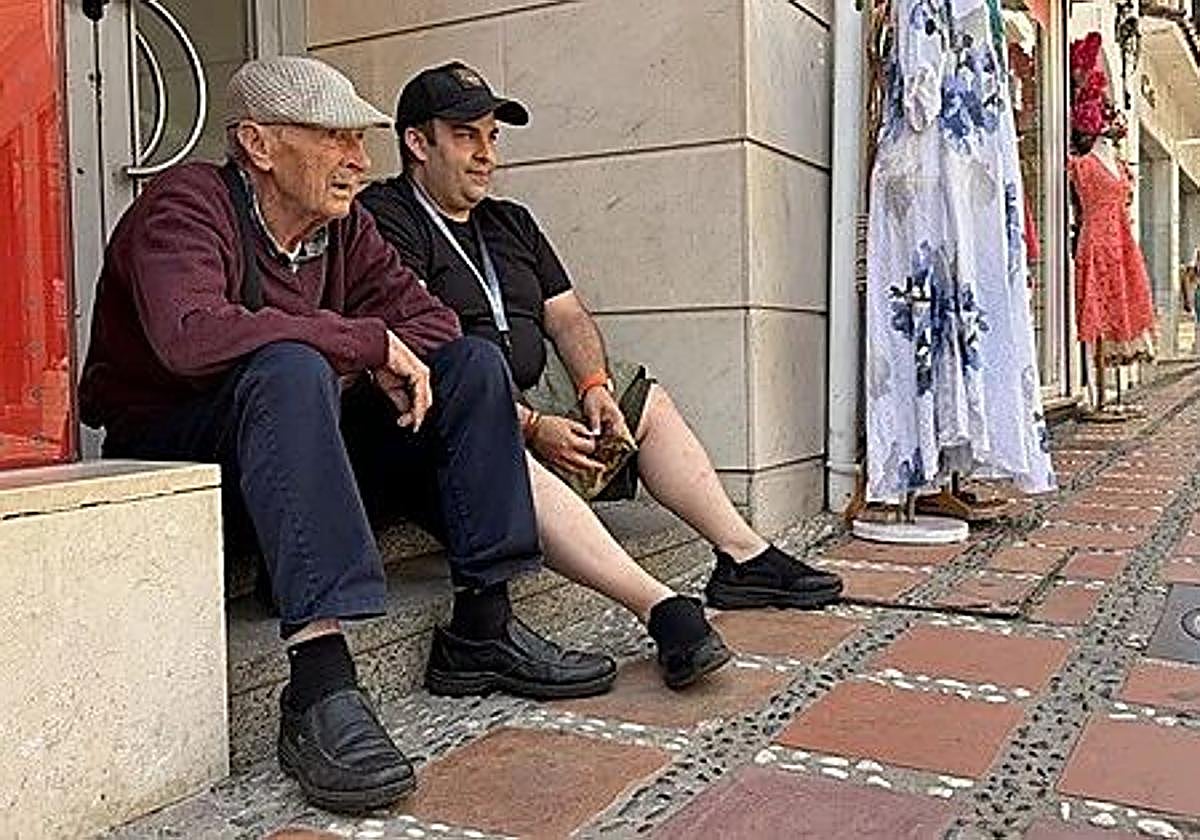
Marbella resident Arturo, 86, and his grandson who live on the town's streets: 'We just want to pay rent'
Since October 2025, the two men, one of them retired and the other with a job, have been alternating nights sleeping rough in the Old Town and in hostels when they can afford it
José Carlos García
Marbella
He walks at a fairly brisk pace, but has to stop every few minutes. He sits down, takes a breath and says: "I have a crushed vertebra, L1." Arturo Hurtado de Mendoza, 86, takes SUR to the doorstep of a bank in Marbella's Old Town on which he has slept on more than one occasion.
His grandson Juan José Urda accompanies us. It's the beginning of the month, so Arturo has just received his pension and Juan José, who works in the kitchen of a private hospital, has just received his salary. These days they can afford to sleep on a hostel mattress, but it won't be long before they have to go on the street again.
They have been alternating nights sleeping rough in the Old Town and in hostels since October last year, the same month Arturo turned 86. "They charge more than 100 euros for a day, so it's impossible to pay for a whole month," he says, referring to the hostel.
Arturo's L1 vertebra keeps bothering him. He stops again and continues explaining: "They told me I need surgery, but how can I have surgery at 86 years old?" he asks rhetorically. It's the second pause on a journey that Google Maps places at 270 metres, which is the distance between the churro shop where he had a coffee and the bank branch.
"A lot of people know me, so someone came by and said: 'Here, take 10 euros and have a coffee,'" he says. A bank branch like the one where he now occasionally sleeps was the last job he had before moving to Marbella. He went to work in Puerto Banús in 1974, where he held various jobs over 25 years, including "14 or 15" at the Casino. "I earned 275,000 pesetas in '88," he says.
Arturo was also once a municipal employee, the job he retired from. Before that, he ran a copy shop that wiped out all his savings when it collapsed with the crisis and the bursting of the housing bubble. He was also once an agent for a well-known insurance agency.
How hasn't that been enough to buy a house? "Yes, but I sold it to pay for my wife's surgery in a private hospital. The public healthcare system couldn't cover it. She didn't even need rehabilitation, because she died of a hospital-acquired infection. They told me to file a complaint, but I didn't. I had her cremated," he says.
Arturo arrives without resting again at the wide step of the bank branch. He sits down and takes off his jacket. The rest of his clothes and personal belongings are divided between the hostel, a friend's house and a storage unit. Did he ever imagine he'd end up sleeping on the street? "My father used to say that life can turn upside down in an instant and that's what happened to me."
These days, he feels fortunate that his hostel room has a kitchen, which guarantees him a hot meal. When he doesn't have the money, whether in a hostel or on the streets, his menu becomes "sliced bread with cold cuts or chorizo".
Dignity
Since a Marbella social media account featured their story, Arturo and Juan José have received help from "people who have paid for one or more nights at the hostel". "I'm truly grateful, but I don't want to live on charity," he says.
What they really want is dignity. "We want to pay rent, because with my pension and my grandson's salary we have 2,400 euros and we can do it," he says.
"Post it, post it, that's what I'm asking," he tells SUR, asking for their story to be shared. In reality, their problem isn't being able to afford rent, even in these times of skyrocketing prices, but rather the condition. "They ask for a three-month deposit, I understand that, but we can't pay that," he says. "Either ten months' deposit or a salary of more than 1,700 euros," Juan José adds.
They found a place to live in Malaga: 450 euros, including food and expenses, staying with a family, but they had to leave last June. Ironically, when that happened, Arturo returned to what is still his home: a subsidised housing unit that he says he got with one of his daughters, Juan José's mother. He says he is still allowed to stay there, although the last time they charged him rent, but his grandson is not welcome and he refuses to leave him behind. Furthermore, he says it's impossible for him to continue living there "because of a very bad relationship" with his daughter's partner.
Arturo prefers to stay as he is while he waits to find a place. For now, he says, they've "paid for the hostel until Saturday".
![[]](http://static.vocstatic.com/voc26/latest/assets/images/favicon/surinenglish/apple-touch-icon-57x57.png)