
Wildfire
The fire in Benahavís has been 'stabilised' and all residents can return to their homes
The situation has been downgraded to a pre-emergency status and the operation is continuing, working to control a fire that has spread across 378 hectares
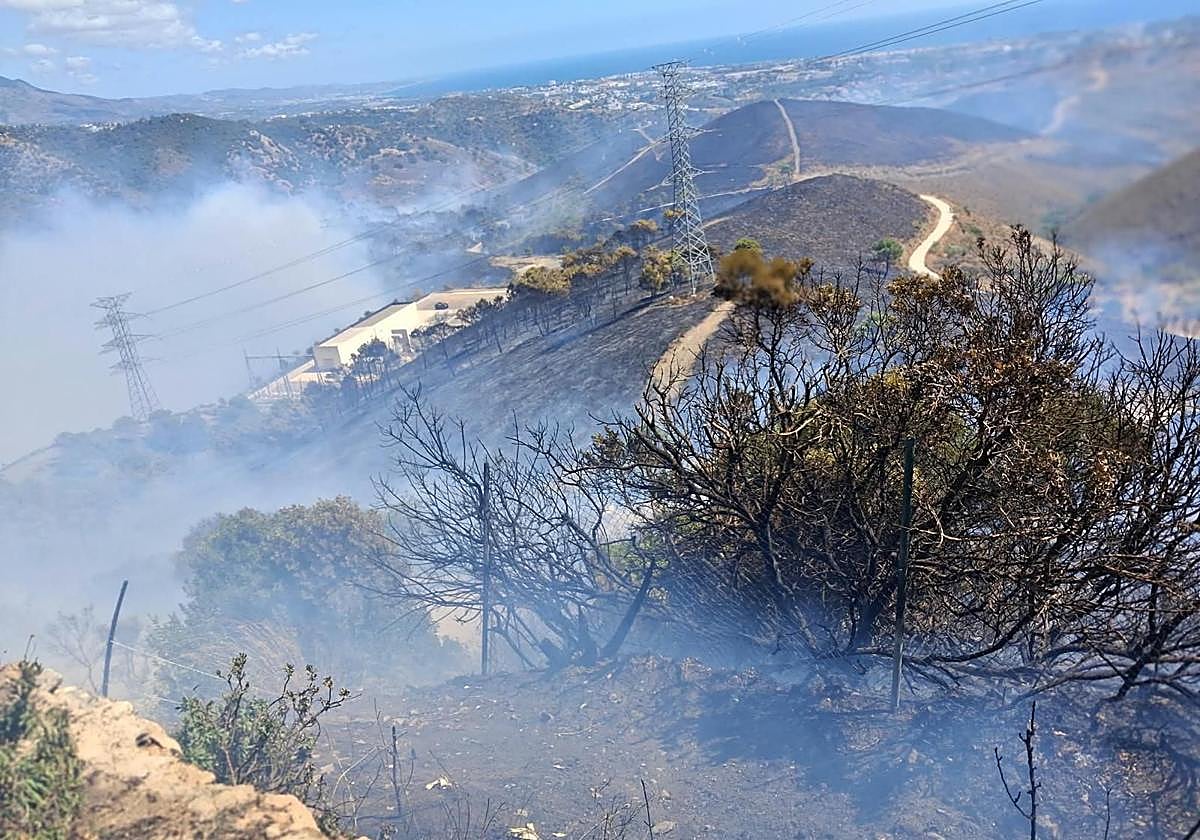

Benahavís
The regional government of Andalucía has declared the fire that broke out at 12.37pm last Sunday near the Rosario chapel in Benahavís to be ' ... stabilised', and the situation has been downgraded to operational level 0 - in other words, the pre-emergency phase.
This means that the forward command post has been decommissioned, although the operation is not yet over; the team must first bring the fire under control and then extinguish it. According to estimates by the Infoca Plan, the fire has spread across (but not burned) 378 hectares.
This new situation has made it possible to lift the ‘precautionary evacuation’ order imposed on residents of the three residential estates who were still unable to return to their homes: Montemayor, La Coja and Benahavís Hills.
The fire came very close to some of these homes. “Normality is now being fully restored,” summarised regional minister Antonio Sanz from the command post set up at the base of the Andalusian Emergency Group (GREA) in Benahavís, as he announced the new phase, which was formally activated at 7.30pm.
On Monday morning, the Andalusian regional government had lifted the lockdown for the rest of the town, which has a population of 9,500. The measure had been in force since it was announced by the regional government in a message sent at 2.34 pm on Sunday via the ES-Alert system. However, for residents of those three housing estates, the restrictions remained in place until the lockdown was scaled back to the pre-emergency level.
The lifting of the lockdown was made possible by the fact that an area stretching from Montemayor Castle to the Benahavís road (A-7175) was "secured on both flanks", which also allowed this road to be reopened on Sunday night, as explained by the regional government’s head of emergency services.
Residents of three housing estates were unable to return to their homes until 7.30 pm on Monday, when the alert level was downgraded to ‘pre-emergency’
From early on Monday morning, the only area where the fire remained ‘active’ was at the head of the blaze, in the north-west – a point situated to the north of the Montemayor housing estate and close to the area affected by the major fire in Pujerra in June 2022.
This was precisely the objective that the emergency management team had set themselves for Sunday night: that if the fire had to advance, it would do so towards an area that had already been burnt, and which therefore had a lower forest density.
“It was an intense night, as we had anticipated, but it has yielded good results,” Sanz summarised that morning. The head of emergency services admitted that if the fire had advanced towards the Ronda road, it would have spread due to the greater amount of vegetation present there.
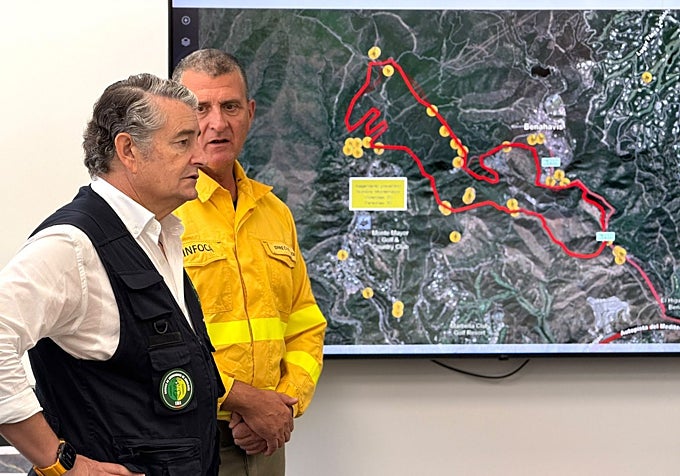
By Sunday night, they had managed to "halt the spread of the fire", and efforts throughout Monday focused on "consolidating" the perimeter and "diverting" the fire towards the northern part of Montemayor. From early on Monday morning, a "favourable" development had already been anticipated thanks to a reduction in wind strength.
‘Real danger’
The councillor acknowledged that the fire had been "very dangerous" and "extremely complex" due to its proximity to homes in the housing estates and the speed at which it was spreading on Sunday, fuelled by winds of 30 kilometres per hour, with gusts of 50, and the steep terrain of the area.
Sanz described the initial moments as “truly dangerous” and “extremely tense” because the first calls to 112 were from people who could not locate their relatives. The fire burnt through the cabling connected to a telephone exchange, leaving many residents cut off from communication, and it was not until midday on Monday that "a large part" of communications was restored, though not all of them. The lockdown was not only announced via the ES-Alert message, but the Local Police, the Guardia Civil and Civil Protection also ensured that the information reached every home and housing estate using public address systems.
Sanz admits that there were some ‘very tense’ moments on Sunday due to calls to 112 from people who were unable to contact their relatives
Sanz also welcomed the fact that no homes were affected by the fire, although minor damage was reported to outdoor areas such as terraces, entrances, gates and fences. There were no injuries reported on Monday, in contrast to the three cases recorded on Sunday.
The most serious case involved a 78-year-old man who suffered burns while trying to put out the fire; he was taken to Malaga Regional University Hospital and subsequently transferred to the Burns Unit at Virgen del Rocío University Hospital in Seville, where he remains in a stable condition. The other two people injured were an Infoca worker, who suffered a fractured wrist after a fall, and a local resident who suffered smoke inhalation.
Up to 22 aircraft
From Sunday evening, more than 200 firefighters had been working to extinguish the blaze, and this number remained the same into the morning, when seven aerial resources were deployed. Subsequently, the number of aerial resources involved in fighting the fire was increased to 22, comprising 12 helicopters (three heavy, six medium, two light and one command helicopter) and ten aeroplanes (six ground-based cargo aircraft, two light amphibious aircraft, one seaplane and one coordination aircraft). The number of personnel deployed reached 200 from the Infoca Plan during the day, joined by six fire crews from the Málaga Provincial Consortium and one from Marbella.
At around 7pm, half an hour before the fire was downgraded to a pre-emergency status, the resources deployed had been reduced to 153 personnel on the ground, with nine fire engines and two bulldozers, as well as a medical unit and a meteorology and communications unit, whilst in the air there remained one coordination aircraft and four helicopters (two light, one medium and one heavy).
![[]](http://static.vocstatic.com/voc26/latest/assets/images/favicon/surinenglish/apple-touch-icon-57x57.png)