
Climate change
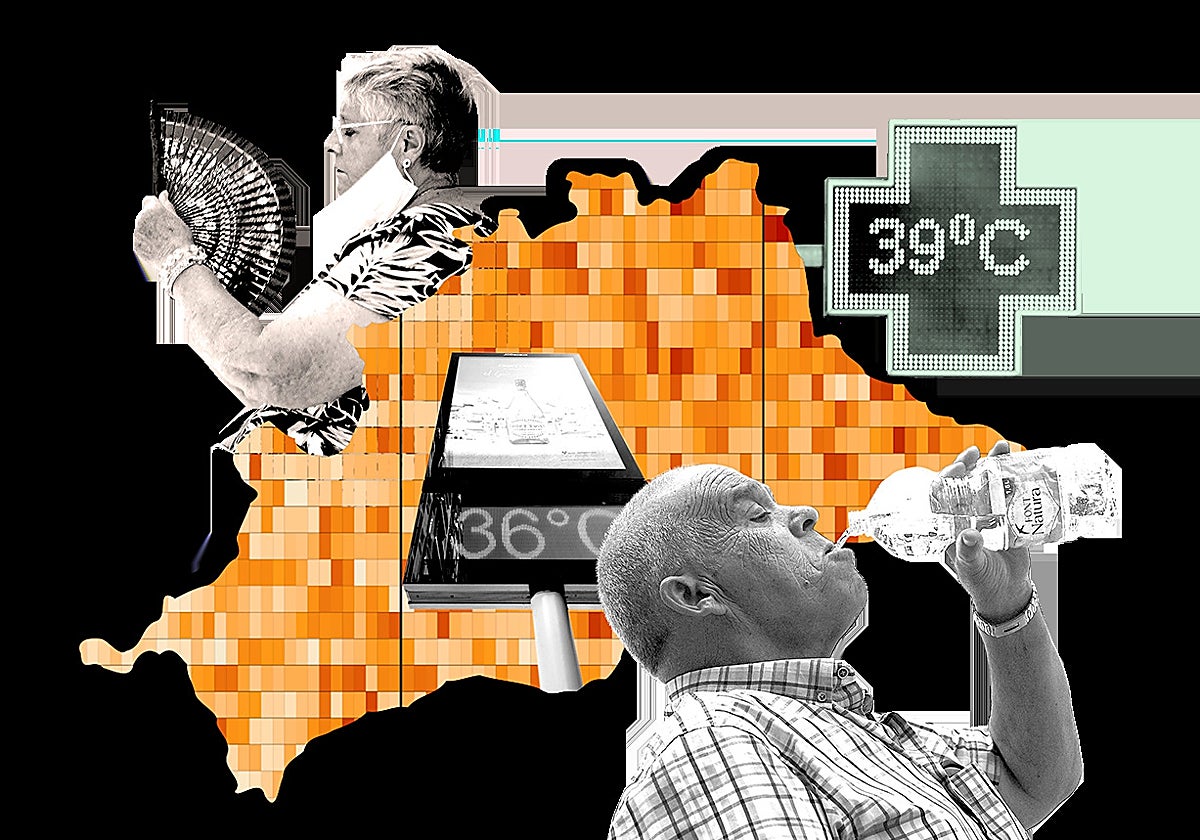
Malaga's maximum temperatures no longer drop below 30C in summer
The number of days with more than 30C has doubled compared to the start of the 21st century
Ignacio Lillo
The years of the late 20th and early 21st centuries, when summer temperatures were significantly milder in Malaga province than those so far this decade, are now a distant memory. In the summer of 2025, maximum temperatures reached 30C or higher on 77 out of the 92 days in June, July and August.
This means that it was very hot on almost 84 per cent of the days, according to data from the Aemet (state meteorological agency) thermometer at Malaga Airport.
To illustrate just how much harsher summers are now than before, Malaga weather expert José Luis Escudero cites the reference period Aemet is currently using for its climate studies: from 1991 to 2020. Over those almost 30 years, the average was 43 days with temperatures of 30C or higher. Therefore, the data from 2025 contains almost double the days.
Very few 'cool' days
In June, the number of days with high temperatures increased from seven to 19; in July, from 17 to 29; and in August, from 19 to 29. To make matters worse, during many of the periods that could be considered cooler, the maximum temperature almost always remained above 29C.
Related story
Sea water is also getting warmer, which is the key to understanding what's happening. This widespread heat isn't just caused by the warm 'terral' wind, as one might expect, but also by the easterly wind and high humidity (which used to help cool things down).
"Days with a terral wind reach 35C or more, but they aren't the most common. The rest are due to the easterly wind and subsidence, when hot air descends," Escudero warns.
The heat index is even worse: "33C with 70 per cent humidity gives a heat index of 38C, which is why we're sweating all day."
Tropical nights
Nighttime temperatures rarely drop below 20C. Tropical minimum temperatures are now practically the norm for all summer nights and torrid or equatorial minimum temperatures (25C) are becoming increasingly common.
In fact, last summer, according to Aemet data, there were 24 tropical nights in June; 29 tropical and one torrid in July; and 26 tropical and three torrid nights in August.
Enrique Salvo, director of the climate change chair at Malaga University, focuses on what is happening in the sea. "We don't realise what it means that the Mediterranean is warming 20 times faster than the average," he warns.
Among the direct repercussions are increasingly prolonged heat waves and a rise in sea level that is up to three times the average for the oceans, at six or seven millimetres annually compared to two to four millimetres for the rest of the world. "All of this presents a major challenge for the future."
Regarding the repercussions for people, Salvo is more concerned about nighttime minimum temperatures, "with high values and relative humidity, which leaves very low climatic comfort conditions". "As a result, people can't sleep and this causes aggression and general malaise," he says.
Aemet's director in Malaga, Jesús Riesco, says that the climate warning is everywhere: "in the temperature of the sea water, in the number of warm nights, in the fact that maximum temperatures of 30C and minimum temperatures of 20C are being recorded earlier on the coast, in the number of heat waves and their longer duration".
According to him, average temperatures are rising not only in Malaga province, but also in Andalucía and the whole of Spain.
"This sustained increase in average temperatures is the most important indicator," he says. In fact, the graph at the provincial level since 1961 shows that only from 2022 onwards has the average annual temperature exceeded 18C and even approached 18.5.
The meteorologist concludes: "In a climate that wasn't constantly changing, historical records for maximum and minimum temperatures would be broken more or less equally. But we see that this isn't the case. Historical minimums are not being broken as fast as many historical maximums."
Access environmental monitoring and nature news
![[]](http://static.vocstatic.com/voc26/latest/assets/images/favicon/surinenglish/apple-touch-icon-57x57.png)