
Malaga province is suffering from the worst drought since 2008 with no end in sight
Restrictions on irrigation in the Axarquía will extend to Malaga city and the Guadalhorce in March if there is a still a lack of rain
IGNACIO LILLO / FRANCISCO JIMÉNEZ
MALAGA.
The province of Malaga is getting drier and all eyes are glued on the sky for a glimpse of some sign of much-needed rain to ease a situation that is critical, especially for the area's crops.
Meanwhile, farmers and water basin managers count the days to the completion of the Junta de Andalucía's announced works that would transfer more cubic hectometres of fresh water into the mains pipeline.
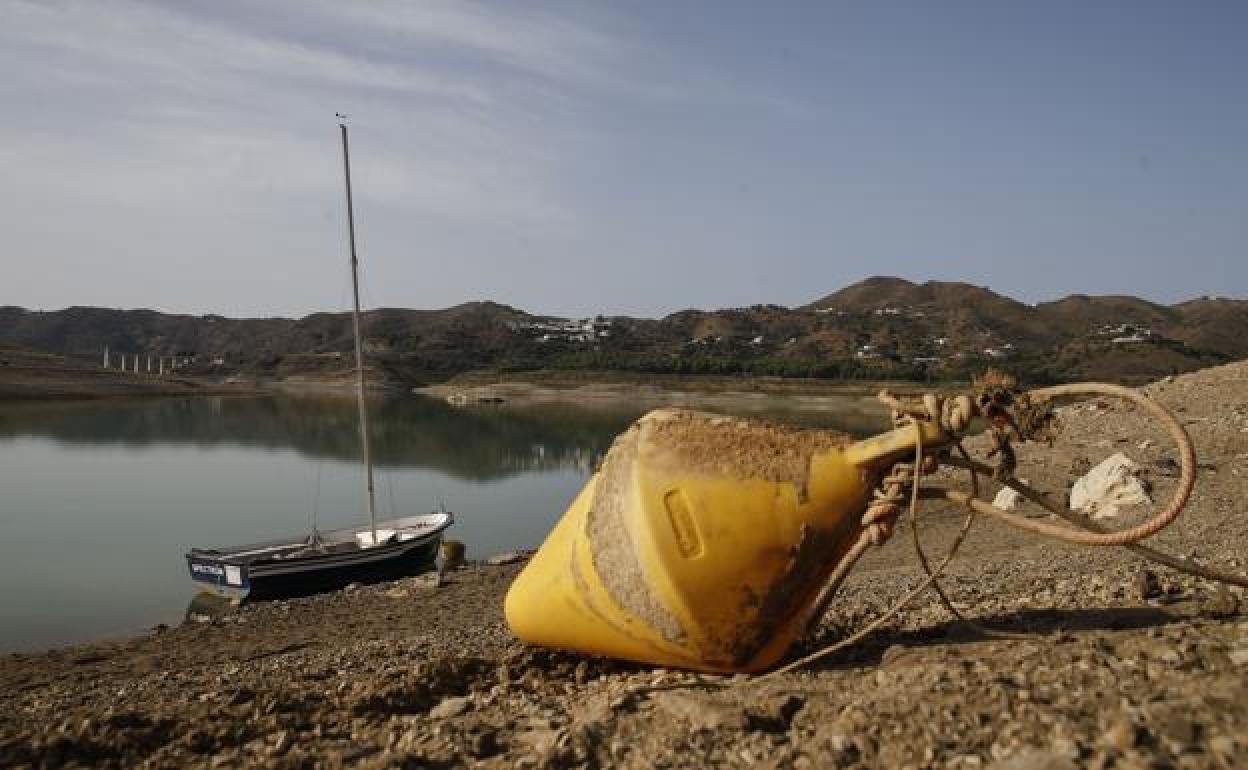
Now, in this final quarter of the year, Malaga province is suffering its worst drought since 2008, when La Viñuela reservoir in Axarquía was last at historic lows.
Malaga city and Guadalhorce valley will face restrictions on irrigation and sluicing from March if it doesn't rain enough to bolster reserves.
There is no short-term solution in sight, as there are no significant wet weather fronts forecast, and the majority of the works designed to solve the problem have not been completed.
The extent of the drought situation the region is currently experiencing has not been seen for 13 years. According to data from the regional government's Red Hidrosur information service, it was in December 2008 that the La Viñuela reached its lowest ever level. La Viñuela is the reservoir that is used as a gauge of the situation in the province as it is the biggest reservoir and the one that supplies the irrigation crops in the Axarquía district, which make up a large part of the demand.
Noticia Relacionada
Back then, the reservoir went down to 12% of its capacity, with just 20 cubic hectometres. Land use for subtropical crops, which require large quantities of water, has multiplied since then.
In July that year, the reservoir reached the same level it is at now, with 29.5 Hm3 (17.8%), and it is expected to fall further in the coming weeks. The Junta de Andalucía has already decreed the Viñuela-Axarquía system to be on alert for "exceptional drought" and "emergency for serious shortage".
Beyond 2008, we have to go back to 1995 to find a situation as dramatic as this one. If the clouds don't ease the problem first, the same situation could affect the entire metropolitan area of Malaga, the Guadalhorce Valley and the western Costa del Sol, where 80 per cent of the population lives and it is already assumed that the official drought declaration will come next March according to sources.
If these fears are confirmed, the first measure to adopt would be to reduce the quota of water assigned to irrigation farmers and, if that is not enough and the situation worsens, more serious measures could be adopted, including restrictions on urban use (watering gardens, hosing down streets, swimming pools, etc).
Threat to the Costa
This is an extreme that nobody wants to get to, firstly because domestic consumption has less room to go down without affecting the public, and secondly due to the possible impact on Costa del Sol tourism.
In the western Costa area, the first step to be taken to avoid rationing supply would be to have the Marbella desalination plant working at full capacity. Because golf courses and other large green areas are irrigated with recycled wastewater instead, the desalination plant could be sufficient.
Another frequent solution on that stretch of coast in such cases is the purchase of water from nearby Campo de Gibraltar, although reserves in that area around La Línea and Algeciras are already depleted.
The delegate in Malaga for the regional ministry of Agriculture, Livestock, Fishing and Sustainable Development, Fernando Fernández Tapia-Ruano, has so far ruled out widening restrictions to all the province next March.
He said, "That looks like its a long way off - 100mm of rain can fall here in a moment and that would change the scenario from one day to the next."
Reservoir situation
The 2020-2021 water year has been very dry. The La Viñuela reservoir serving the Axarquía has had just 4 Hm3, when the average is 88.
The situation in the rest of the province, although not so worrying, is not much better. La Concepción reservoir, which supplies the western Costa del Sol, is small and it fills and empties easily virtually every year. It even has to discharge water into the sea in rainy periods as it is too small - something that planned bypass pipes to increase connectivity with Malaga city and the Axarquía are meant to avoid. La Concepción is currently 44.4% full.
Guadalhorce valley
The reservoir with the most water and which guarantees a supply for the city of Malaga area and the Guadalhorce valley is Guadalteba lake. This is at 57.6% capacity and has 88.4 Hm3, whereas it had 106 the same time last year. On the other hand, the other main sources of water for Malaga city - the Guadalhorce and Conde de Guadalhorce, are very low, at 28.8% and 24.4%, respectively.
The worst of all is that there is no solution on the horizon. José María Sánchez-Laulhé, head of the Aemet official weather station in Malaga, explains that recent low pressure has done little but leave a few light showers and the forecast isn't for any significant rainfall in the short term.
To get through this difficult period, while everyone waits for it to rain, the Junta is carrying out a range of emergency works.
The Junta's local head for the Environment, Fernando Fernández Tapia-Ruano, explains that the feeder-tunnels into La Viñuela, which has eight feeder reservoirs to bring in rainwater, have been cleared after being blocked with obstructions "for years".
Work has also started on improved treatment at the Rincón and Vélez wastewater plants, as well as two in Torrox, so treated water from there can be used for irrigating the countryside.
In terms of the wells in the Chíllar river area, by Nerja, the plan is for there to be a supply for human consumption by March, as well as other works to improve pumping and treatment stations.
On top of this is the so-called "water motorway" to bring water from the La Concepción and the western Costa towards Malaga city and the Axarquía. This is expected to be ready by February.
![[]](http://static.vocstatic.com/voc26/latest/assets/images/favicon/surinenglish/apple-touch-icon-57x57.png)