
Culture
The romantic traveller: Russian composer Mikhail Glinka’s Andalusian journey brought to life with AI
The Russian Museum Collection follows in the footsteps of the father of Russian classical music in his fascination with Andalusian folklore

They had come to southern Spain in search of Arabs living amongst the ruins of Al-Andalus, but found none. Instead, these 19th-century aristocrats ... discovered ‘Romani people with a tireless and never-ending folk festival’.
The Russian composer Mikhail Glinka was one of them - perhaps one of the least well-known Romantic travellers - yet Andalucía left a profound mark on his life and work.
A collection from the Russian Museum reconstructs the Spanish landscape that so astonished these visitors through the story of the father of Russian classical music, with the help of artificial intelligence.
“In Andalucía, he discovered folklore and the wisdom of the Andalusian people,” says the exhibition’s curator, Pepe Zapata, an artist, photographer, collector and, like Glinka, a traveller.
In a Europe characterised by a degree of uniformity following the 19th-century Industrial Revolution, “Spain remained unspoilt and almost untamed”. He explains that the composer learnt Spanish before arriving in the country - an unusual feat at a time when French was the universal language.
Suffering from a broken heart, Glinka found a cure in the ‘Andalusian fiesta’. He experienced these celebrations in the streets and was captivated by the guitarist El Murciano, who taught him the rhythms of rondeñas, malagueñas, fandangos and jotas in Granada. Glinka later incorporated these elements into his work, laying the foundations for Russian nationalist music featuring castanets and clear Spanish guitar influences. “Nationalisms were born of impurity, just like flamenco,” adds Zapata.
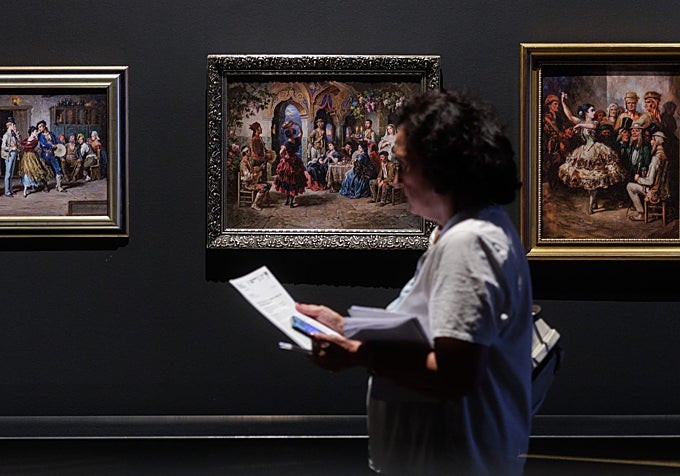
The exhibition, Mikhail Glinka: The Romantic Traveller, recreates the landscapes encountered by 19th-century travellers through engravings and genre paintings - many on loan from the Carmen Thyssen Museum in Malaga and the Antonio Castillo Collection - which depict a Spain of farmhouses, village festivals and bandits.
It begins with the Grand Tour: the journey undertaken by wealthy young elites after their studies to discover exotic cultures. Zapata distinguishes between those who travelled as tourists in carriages and those who rode donkeys to immerse themselves in local life.
In this first green-walled room, maps, travel books and souvenir engravings are displayed. These images are brought to life with colour and motion in a video powered by Artificial Intelligence - a great “ally for creation”, according to Zapata.
Using digital AI tools and mixed media, Zapata gives an almost photographic quality to the famous portrait of Miguel de Cervantes and Gustave Doré’s engraving of Don Quixote, “the main artistic attraction for 19th-century global travellers”. Antique trunks, a model ship from the period and an authentic bandit’s knife sit alongside Manuel Barrón y Carrillo’s painting of a carriage ambush (View of the Port of Miravete, the Old Road to Madrid), illustrating the hazards of the journey.
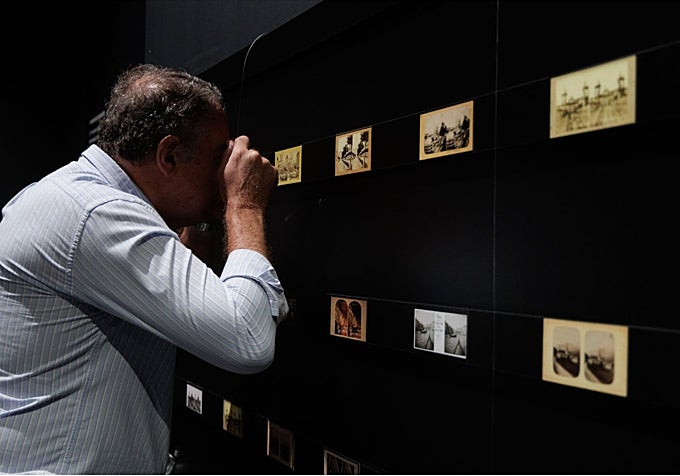
The second room, painted black, explores the advent of photography, which fundamentally altered how we view the world. It focuses on stereoscopy - one of the earliest forms of 3D imaging, developed in the 19th century.
Charles Wheatstone first achieved this using dual-perspective drawings and a mirror stereoscope. By the mid-19th century, photography and David Brewster’s new viewer turned the technique into a mass craze. Visitors can view these scenes just as people did two centuries ago - searching for the exact point where a flat image gains depth - using 3D photographs, tabletop stereoscopes and stereoscopic cards from the Fernández Rivero Collection.
Photography also transformed printmaking. Research by photographic historian Juan Antonio Fernández Rivero reveals that illustrator Gustave Doré and his team used at least 40 photographs for their Spanish travel illustrations in Le Tour du Monde magazine and the book L’Espagne.
These drawings decisively shaped the Romantic vision of Spain held by 19th-century artists. The exhibition displays Doré’s artwork alongside the original photographs, going a step further using 21st-century digital techniques to transform the engravings into textured, colourful works reminiscent of 19th-century costumbrista paintings.
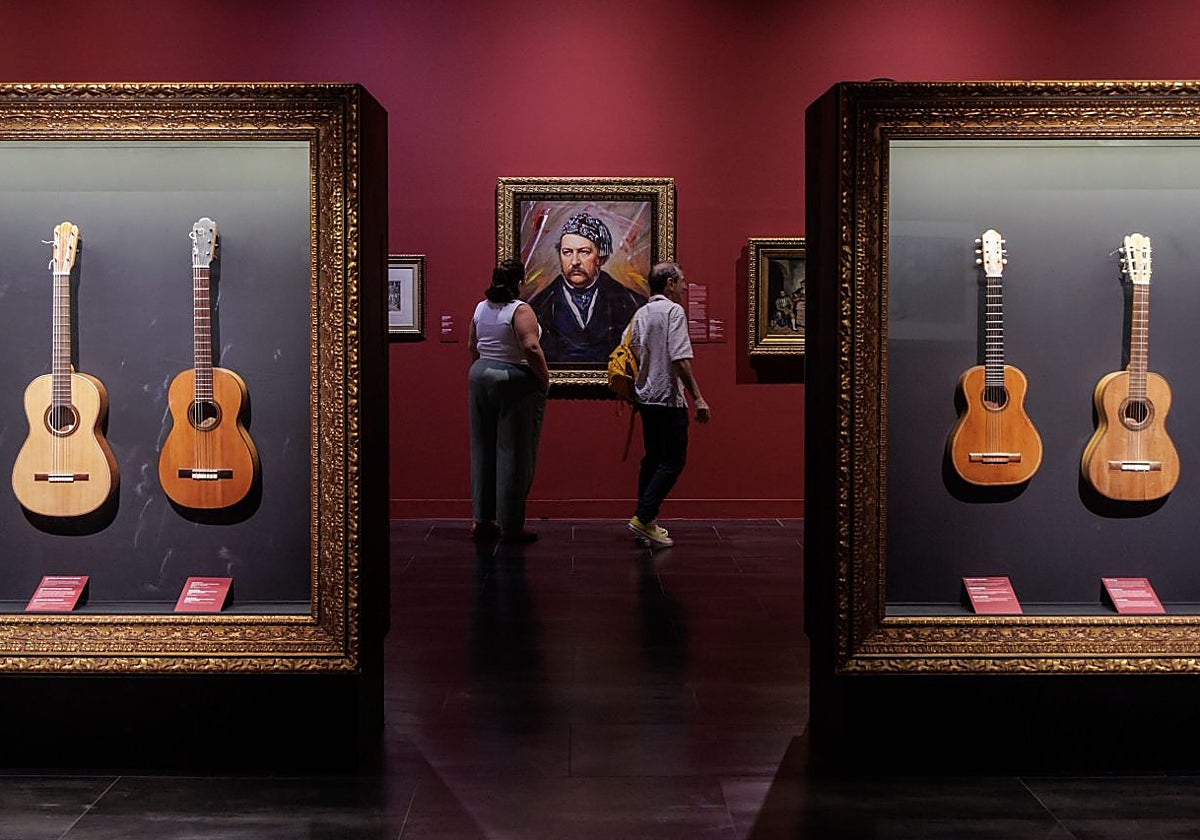
The final red-walled room is dedicated to the music that inspired Glinka upon his return to Russia. It was in Spain that he discovered tambourines, guitars, bandurrias and castanets. On display are items from the Barcelona Music Museum, including historic guitars by luthiers such as Antonio de Torres Jurado, Francisco Sanguino and Jean Nicolas Lambert.
These are joined by an 19th-century piano from Malaga (from the Miguel Ángel Piédrola Collection) and a mechanical device with a metal disc playing Glinka’s music.
Paintings such as José Denis Belgrano’s Después de la corrida and Manuel Cabral Bejarano’s Jaleando a la puerta del cortijo capture moments of song, music and dance in 19th-century Andalucía. Beside them, restored iconic photographs bring key figures to life, including Ramón Montoya - the guitarist who transformed the malagueña - and Juan Breva, the singer from Vélez who accompanied himself on the six-string guitar.
Mikhail Glinka: The Romantic Traveller, open until late October, breathes new life into the depleted Russian Museum without relying on Russian loans - which were withdrawn following the invasion of Ukraine. The richness of Russian art and culture maintains a foothold in the Tabacalera building, where most of the space has been occupied for under a year by the MEET brand (Málaga Espacio Expositivo Tabacalera) to host temporary exhibitions.
![[]](http://static.vocstatic.com/voc26/latest/assets/images/favicon/surinenglish/apple-touch-icon-57x57.png)