
Malaga Ibis hotel fire
Why did the fire in the Ibis hotel and Le Grand Café in Malaga reignite so many times?
An expert helps SUR analyse the techniques and structural keys of extinguishing an extremely complex fire
Chus Heredia
Malaga
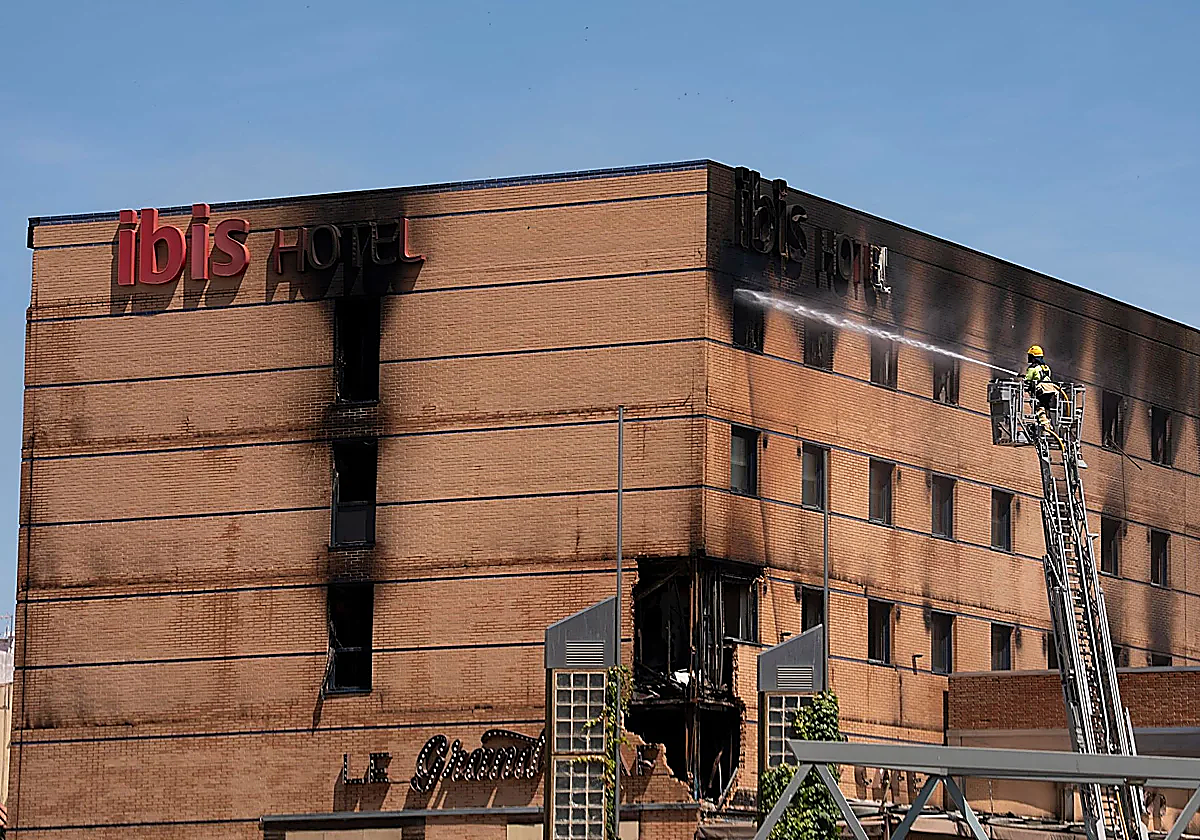
Malaga's firefighters were unable to tackle from inside the massive fire that started in Le Grand Café and spread to the Ibis hotel on Monday because of the wooden beams and false ceilings.
Many are wondering why the fire reignited several times since 25 May. A key factor is the structural instability following the collapse of the building's compartmentalisation, which has forced firefighters to work almost exclusively from the outside, making it impossible to systematically use thermal imaging cameras and demolition hooks to extinguish smouldering hotspots.
SUR spoke with Pedro Pacheco from the Andalusian firefighters' unit, who explained the technical complexity involved in fires like the one in Malaga. He declined to comment on the building's future, but it's clear the damage seems almost impossible to repair.
At the moment, the authorities have fenced off the entire perimeter to prevent further incidents.
Heat transfer
The root of the problem lies in the initial heat transfer and the building's construction characteristics, which combine highly combustible materials with confined, difficult-to-access spaces.
"The fire in the restaurant was brutal. The heat load it transmitted to the rest of the hotel was devastating. This immediately caused the building's containment measures to fail. Once the fire compartments were breached, the fire spread rapidly. All the heat and hot gases were transferred to the entire surface," Pacheco said.
Heat accumulation in false ceilings
The main reason the fire keeps reigniting is the presence of smouldering hotspots in the suspended ceilings in the hotel.
Under normal conditions, firefighters conduct a visual and tactical inspection with specialised technology. "We have this tool, the thermal camera, which very clearly marks the hot spots by changing colour tones," Pacheco said.
Upon detecting these transfer points, firefighters proceed to mechanically open the ceiling. "We break through the suspended ceiling and we finish cooling or extinguishing the fire in that area."
The particular case
The building's vulnerability has complicated the application of this safety protocol in this particular incident. "We haven't been able to remove all the false ceilings or conduct a thermal imaging inspection on every floor," Pacheco explained.
"Since we can't scan or break through the ceilings from the inside, the trapped heat remains and may build up, potentially reigniting at some point," he said.
The risk of collapse
The impossibility of proceeding through the interior of the building is due to potential floor collapse. The building has a combustible internal structure of wooden floors.
The dangerous nature of the terrain became clear during the initial firefighting efforts on the upper floor, where a firefighter sustained injuries when the floor gave way beneath his feet. This incident led to a radical change in strategy: attacking from the outside.
Differences between wood and metal
Unlike metal structures, which undergo rapid deformation and transmit stresses that cause a chain reaction of collapse at anchor points and welds, wood exhibits a different physical behaviour.
"Wood begins to burn and gradually loses cross-section. There comes a point when the section can no longer withstand the stress and breaks, but it doesn't undergo that deformation," Pacheco explained.
Although this may keep the building seemingly standing for a little longer, the risk of sudden floor collapse makes it impossible for people to walk on it.
Selective demolition of the facade
With an internal operation ruled out, the firefighters relied on peripheral water spraying and selective removal of loose facade elements. However, this also presents severe technical and safety limitations for personnel.
Pacheco highlighted the risks of using the available machinery under these conditions. "The aerial ladder is like a catapult. Any slight movement could send our colleagues flying," he said.
Furthermore, the behaviour of the exterior walls when struck is unpredictable, so this requires extreme caution to prevent debris from hitting emergency vehicles or the workers.
![[]](http://static.vocstatic.com/voc26/latest/assets/images/favicon/surinenglish/apple-touch-icon-57x57.png)