
Public health
Malaga city centre residents express concerns about drugs on the streets
The Local Police have received two reports concerning Calle Pozos Dulces in recent weeks, which has led to the identification of five people
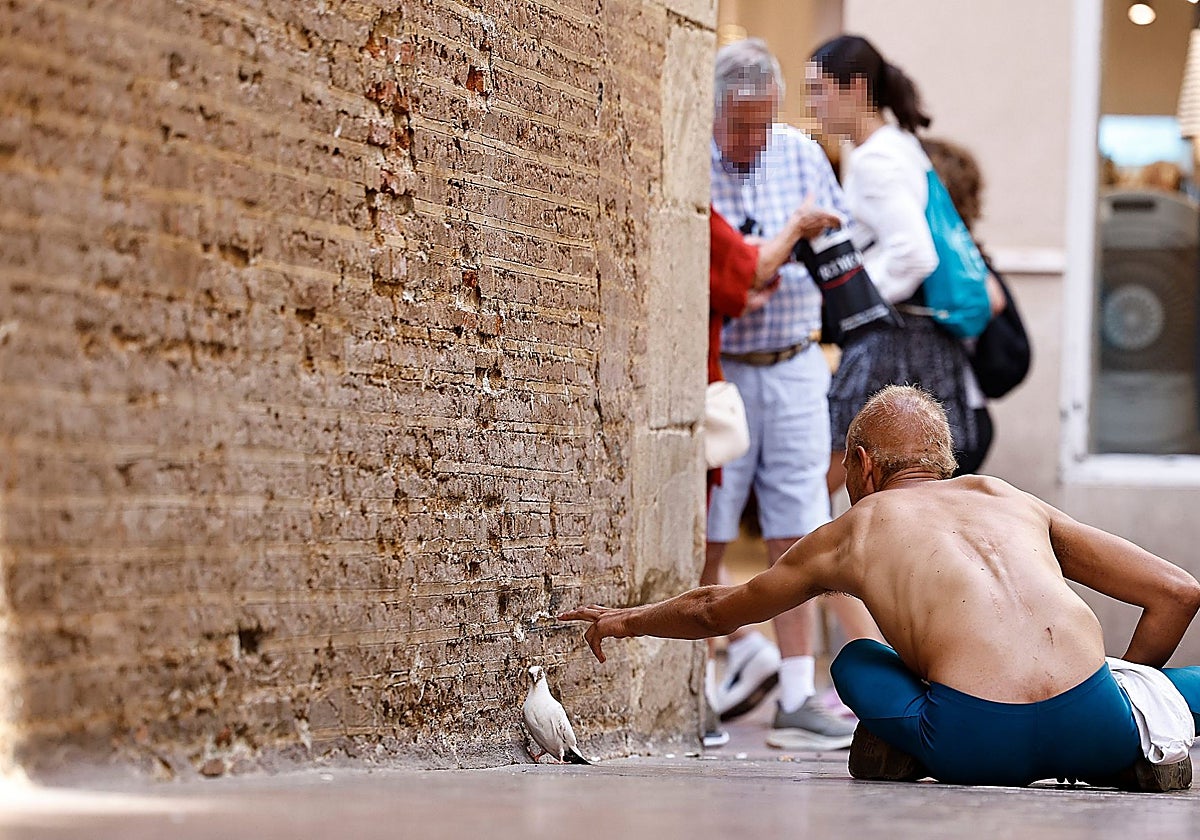

A very thin young man is sitting on the ground on Calle Francisco de Rioja in Malaga city, his extremely long legs and arms stretched ... out. A pigeon seems to be keeping him company. Arcadius, from Poland, stares intently at the bird. People are looking at him too, but they walk straight past.
"Do you need any help?" the SUR journalist asks. "I need some money. Look, my trousers are torn. And I've got a cut on my foot," he replies.
During the conversation, he confesses that he has addiction problems. Suddenly, he returns to his reverie. The white dove, as if it were Picasso's very own, does not leave him alone, nor do Arcadius's eyes stray from it.
The deterioration in the man's condition due to his life on the streets and drug use is plain to see. The residents of the city centre are also voicing their concern about the social problem that is crushing some people like a steamroller.
A resident of Calle Pozos Dulces explains that, in the area around his home, at any time of day, even in broad daylight, they can see people using drugs. He suspects that the groups, sometimes of up to eight people, are smoking heroin.
At 11am, SUR sees three people sleeping on the ground, sheltered in the shade in Plaza del Pericón. A little further on, another young man is resting on a low bench.
According to the local resident SUR speaks with, the drug users in the area are not violent people. He occasionally goes to his window to ask them to move because smoke is drifting into his home. They agree.
"They don't do anything, but they don't bring anything good either," he says. He's worried that his young daughter might see this scene, so when he takes her out, he does his best to take a detour to prevent her from witnessing the squalor of drug use.
A worker in the area says that he has noticed drug users relieve themselves in the street. Many of them are homeless. This entails nuisance and unsanitary conditions for the neighbourhood.
Another worker in the area, Nacho, from Valencia, says that he moved to Malaga in 2000. At the time, he was alarmed by the drug activity in the city and he now feels that something similar is happening again.
Nacho states that he has seen a couple of people taking drugs at midday on several occasions near La Casa Invisible. The area reveals drug activity leftovers: white paper wrappers, crumpled tins and signs that something has been burnt there.
One of the responsibilities of the Local Police is to monitor drug use in public spaces. In recent days, they have received two calls from the Pozos Dulces area: one on 7 September reporting three individuals using drugs, although no one was present when the patrol arrived, and another on 12 September, when they identified five people and arrested one of them for a previous offence.
Carlos Carreras, from the historic centre residents' association, says that drug use on the streets "is more common than it seems". His organisation receives many complaints.
"Residents see it from their own windows and balconies," Carreras says, adding that most of the complaints come from people living on the ground floor.
He also says that key boxes, typical of tourist flats, sometimes appear outside uninhabitable buildings. Given the state of the buildings, it is obvious that their intended use is for the sale of drugs.
Carreras has also noticed another hotspot for drug use: the nightlife venues around Calle Pito and Calle Aventurero.
![[]](http://static.vocstatic.com/voc26/latest/assets/images/favicon/surinenglish/apple-touch-icon-57x57.png)