
Legal
Spanish rail operator Renfe to pay almost 21,000 euros to passenger injured due to escalator failure at Fuengirola station
Malaga provincial court finds Renfe failed to prove that it had taken adequate safety measures and did not challenge the passenger's account of the accident
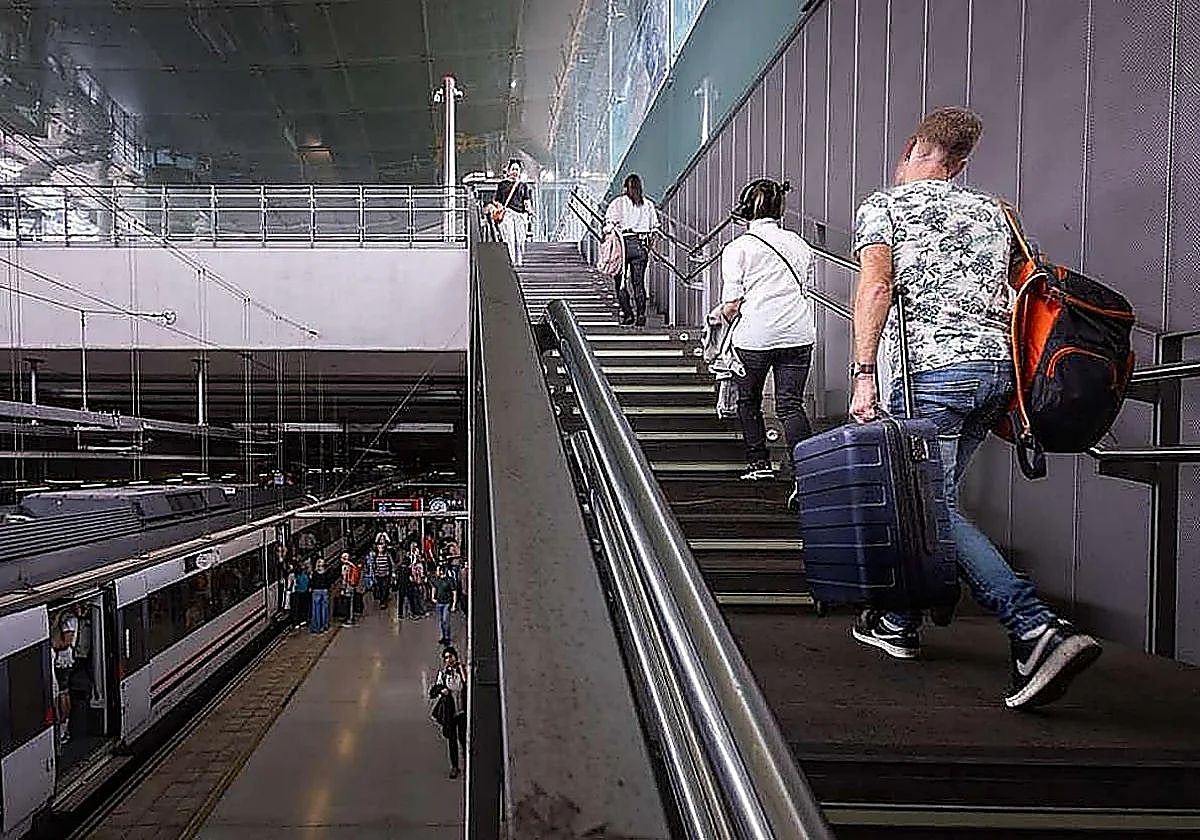

A passenger injured when an escalator suddenly stopped at Fuengirola railway station must receive almost 21,000 euros in compensation from Spain's railway operator ... Renfe, after the Malaga provincial court found that the rail operator had failed to prove it had taken the necessary safety measures.
The court has upheld an earlier ruling in the passenger's favour, bringing a legal battle over the accident to a close almost a decade after it happened.
The accident occurred when the woman and her husband arrived at Fuengirola station on a Cercanías train from Malaga. As they made their way towards the exit, the escalator suddenly stopped, sending luggage carried by other passengers rolling down the steps. One of the bags struck the woman, injuring her arms and legs and forcing her to seek medical treatment.
The court has ordered Renfe to pay her 20,713.83 euros after rejecting the operator's appeal and upholding in full a ruling from Malaga's court of first instance, which had ruled in the passenger's favour.
Throughout the proceedings, Renfe argued that the woman had failed to prove that she had been a passenger because she had not produced her train ticket.
The provincial court rejected that argument, noting that she could quite reasonably have lost the ticket in the aftermath of the accident. Given the seriousness of her injuries and the fact that she had to go to hospital, the court said losing the ticket was "plausible and even logical".
The panel of judges also pointed out that the ticket was not the only way to prove that she had travelled on the train.
The woman was on the station platform, an area that only passengers with tickets can enter. The court noted that Renfe's own security system prevents people without tickets from entering the platforms. The company therefore could not later deny something that its own staff had already established.
The judges concluded that she must have been in the restricted area because Renfe staff had checked that she was a passenger and had a valid ticket. Renfe therefore "cannot contradict its own actions and now deny what it previously accepted".
Reconstruction of the accident
The court also rejected Renfe's account of how the accident happened. To establish what had taken place, the judges considered both the injured woman's husband's testimony and an incident report drawn up by the station's security guard on the day of the accident. The report gave an account consistent with the woman's version of events.
Against that evidence, the court noted that Renfe had provided nothing capable of disproving the account, even though the burden of doing so fell on the company. The judges therefore rejected this part of the appeal as well.
Renfe's responsibility
One of the most significant aspects of the ruling concerns the company's responsibility as a transport provider. The judges noted that, alongside the liability, consumer protection legislation also applies. That legislation places a particular duty of care on companies that provide transport services.
The court rejected the argument that the escalator's sudden stop amounted to an ordinary risk of everyday life.
The ruling states that service providers are responsible for damage caused to consumers unless they can prove that they complied with the relevant legal requirements and took all the care and precautions that the nature of the service demands.
Under this principle, the court said the injured passenger did not have to prove exactly what negligence Renfe had committed. Instead, the company had to show that it had taken all reasonable precautions and that the equipment met the necessary safety standards.
In this case, the court found that Renfe had failed to provide such evidence. The judges said the escalator could only have stopped abruptly because it was malfunctioning, because its monitoring and control systems had failed, or because the installation did not meet the required safety standards.
The judges also rejected the idea that a sudden escalator failure could count as an ordinary risk of everyday life. In their view, the malfunction itself created the dangerous situation that ultimately caused the passenger's injuries.
Renfe also challenged the amount of compensation, arguing that the court had placed too high a value on the passenger's injuries and lasting effects. The provincial court rejected that argument too, backing the assessment made by the court of first instance, which had set the compensation at an amount it considered proportionate to the proven injuries.
![[]](http://static.vocstatic.com/voc26/latest/assets/images/favicon/surinenglish/apple-touch-icon-57x57.png)