
112 incident
Malaga Airport passenger starts punching employee after being told boarding has closed
The provincial court has upheld the fine of 400 euros and the compensation of 543 euros, but refused to increase the compensation awarded to the worker, who said she had to take sick leave due to anxiety
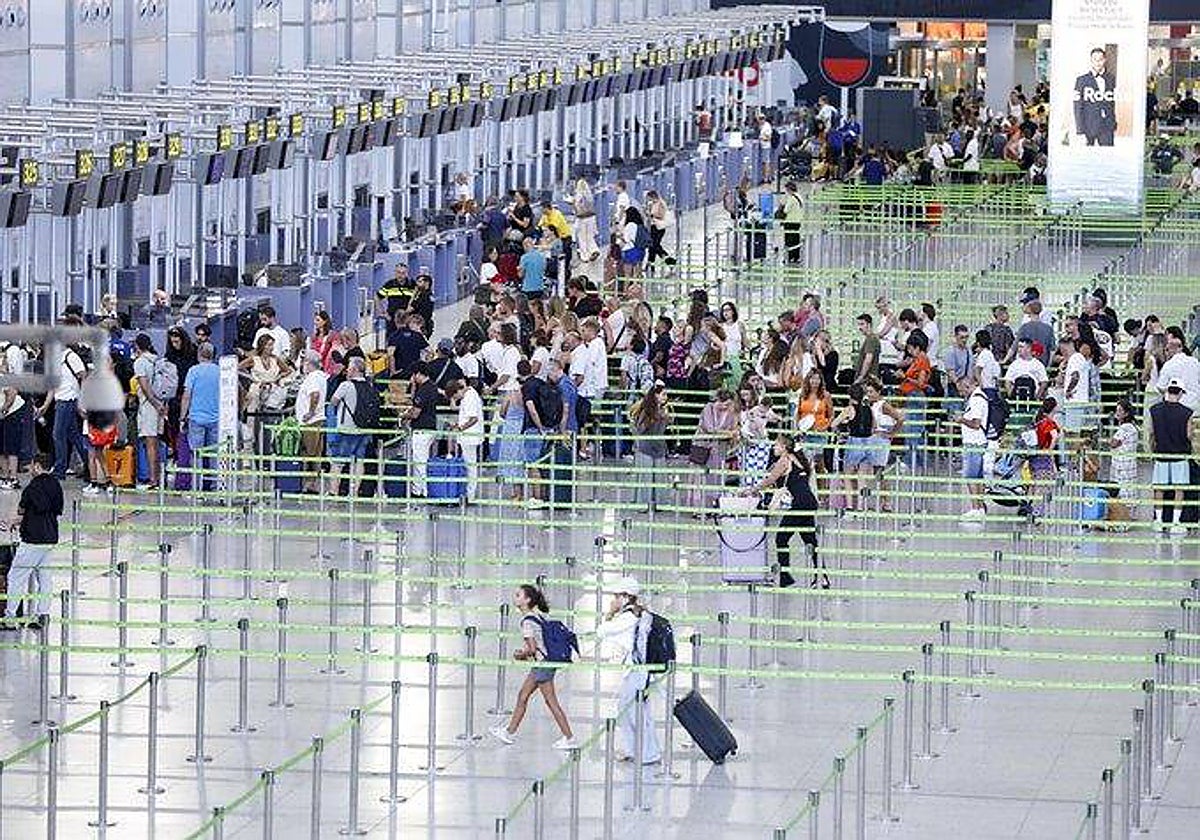

The provincial court of Malaga has convicted a woman of a minor offence of causing bodily harm after she assaulted an airport worker who had ... told her the gate to her flight to Ibiza had closed. The court has ordered the defendant to pay a fine of 400 euros and a compensation of 543.66 euros.
The incident happened in the afternoon, when the defendant arrived late at the boarding gate at Malaga Airport with her family. They were therefore not allowed to board the plane, which upset the woman.
She began to act aggressively and, at one point, lunged at the member of staff who was responsible for boarding passengers for that flight. According to the facts established by the court, "she grabbed her by the hair, threw her to the ground and punched her several times". The employee suffered several bruises and neck pain.
The two women appealed against the initial ruling. The defendant contested the evidence and asked for her state of mind at the time of the incident to be taken into account, while the worker sought compensation for the consequences which the assault had on her health and work.
Conflicting accounts
The passenger's defence team said that, given the conflicting accounts of the two women, the judge could not regard the presumption of innocence as having been rebutted. The judge hearing the appeal pointed out that it was the trial judge who had heard the statements of the parties involved and the witnesses during the trial and that it was his responsibility, on appeal, to review whether the assessment of those statements complied with the "rules of logic".
Having examined the arguments, he concluded that there were sufficient grounds to give credence to the complainant.
Two witnesses who saw the incident corroborated the employee's account. Both worked at the airport, but according to the court, this was not sufficient to call their impartiality into question. The judge pointed out that there was also no evidence of a friendship between them that would cast doubt on their accounts.
The case also included the medical report on the treatment the victim had received "moments after the events had taken place". The forensic report found that the injuries were consistent with the woman's description of the assault.
The passenger also requested that the court take into account the mitigating circumstance of "obstinacy". The court said that, in the case of a minor offence, the judge may set the sentence within the statutory minimum and maximum limits without having to adhere to the general rules on the application of mitigating and aggravating circumstances.
The judge acknowledged that being left behind may have frustrated the passenger and that she may have taken out her frustration on the member of staff, "who was in no way at fault". What he ruled out is that the frustration reached such a level that it impaired her faculties to the extent of justifying a reduction in the sentence.
Non-pecuniary damage
The worker appealed only against the compensation award. The 543.66 euros correspond to the seven days it took her to recover from her physical injuries: two days for minor injury and five days for moderate injury.
Her appeal sought to add a fine for non-pecuniary damage and another for loss of earnings, that is, for the income she failed to receive. She stated that, as a result of the blows, she suffered from an anxiety disorder which forced her to take sick leave.
The court acknowledged that it could be inferred from the medical documentation provided that the claimant suffered from anxiety and depression and was unable to work for a period of time. However, the court did not include these circumstances in the established facts and the judge said that, on appeal, he could not increase the compensation on the basis of facts that were not established in that account.
The ruling adds that the forensic doctor also did not confirm the alleged condition when they examined the claimant, despite the fact that the examination took place after the period of sick leave. For that very reason, it does not award compensation for non-pecuniary damage.
