
Travel
Malaga Airport delays 2.1 million passengers, but only 50,000 will receive compensation
The Airhelp platform puts the on-time performance rate for the Costa del Sol Airport at 63%, placing it 17th out of 28 in the ranking

Málaga
Summer is a very busy time for Malaga Airport, which has just hit a half-year record of 13.2 million passengers, following a 6. ... 7% increase.
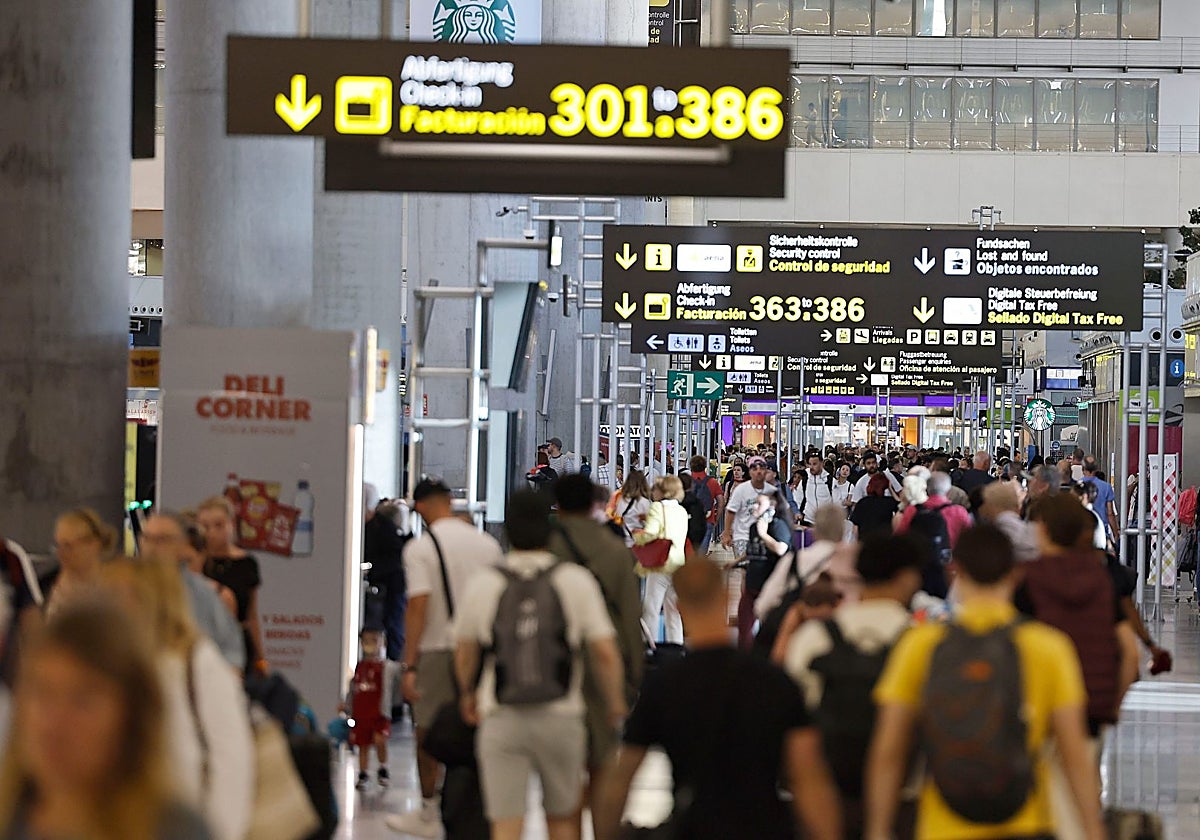
The constant glances at the information screens show that everybody shares the same fear: flight delays or cancellations.
Of the nearly six million passengers who departed from the airport between January and June, aboard 43,000 flights, 2.1 million had to endure delays.
Related story
Only 50,000 of them, however, will be entitled to compensation, as their flights arrived three hours or more late, were cancelled or the passengers missed their connecting flight due to a previous disruption.
This data comes from a report by Airhelp, a travel technology company specialising in managing flight disruptions. The report on punctuality concerns all Spanish airports with a minimum traffic volume of 200 flights per month, that is, 28 airports.
Malaga Airport ranks 17th, with a punctuality rate of 63%, making it the fourth busiest airport in the Aena network, surpassed only by Madrid, Barcelona and Palma de Mallorca. This places the Costa del Sol Airport in line with the national average.
The study, which reveals a significant decline in on-time flights compared with 2025, notes that, in the first half of this year, more than 67 million passengers travelled from airports across Spain. Of these, more than 24 million endured delays or cancellations, representing a significant increase compared with the 13.9 million during the same period last year.
Airhelp highlights that "the figures reflect a deterioration in air operations in Spain", attributing this to the fact that, while between January and June last year 79.1% of flights took off on time, in 2026 the on-time performance rate fell to 63.3%. This means that more than one in three flights experienced some kind of disruption.
Airhelp also points out that this increase in disruptions has not led to a higher number of passengers entitled to financial compensation. In the first half of 2026, 525,000 passengers met the criteria set out in European regulations to claim compensation, compared with 559,000 a year earlier.
Among the airports in the report, Granada Airport was the most punctual during the first half of 2026. Of the nearly 2,000 flights, 74.4% took off on time. Melilla Airport follows, also with a punctuality rate of 74.4%, and Almeria Airport comes next, with 72.3%.
At the other end of the scale are Fuerteventura, Santiago de Compostela and Ceuta, which recorded the worst punctuality rates for the period, at 50%, 48.9% and 43%, respectively.
Aena's two major airports, Madrid and Barcelona, maintained punctuality rates of 64.7 % and 63.9%, respectively.
Airhelp also highlights that Bilbao Airport, recognised as the best in Spain and third in Europe in the AirHelp Score 2026, ended the half-year term with 69.3% of its flights operating on schedule.
An analysis by airline shows that Ryanair is the company with the highest number of passengers in Spain. This is also the case in Malaga. Nationwide, more than 16.8 million passengers flew with this airline from Spanish airports during the period in question.
Next come Vueling, with almost 10.5 million passengers, and Iberia, with 9.7 million.
When it comes to punctuality, however, the rankings change. Vueling achieved the best result among the three main airlines between January and June 2026, with 70.5% of flights on time, followed by Iberia, with 65.1%, and Ryanair, with 63%.
![[]](http://static.vocstatic.com/voc26/latest/assets/images/favicon/surinenglish/apple-touch-icon-57x57.png)