
Economy
Malaga's 2025 Holy Week generated more than 320 million euros, almost 20% less than in 2023
The chair of religious brotherhood studies attributes the decline to the drop in visitors after the initial post-pandemic tourist boom
José Antonio Sau
The total economic impact of Holy Week in Malaga in 2025 amounted to 320.52 million euros, according to a study director of the chair of religious brotherhood studies Benjamín del Alcázar presented on Monday.
The chair's most recent report dates to 2023, when the economic impact was almost 394 million euros, which means that "there has been a decline of almost 19.8% compared to 2023".
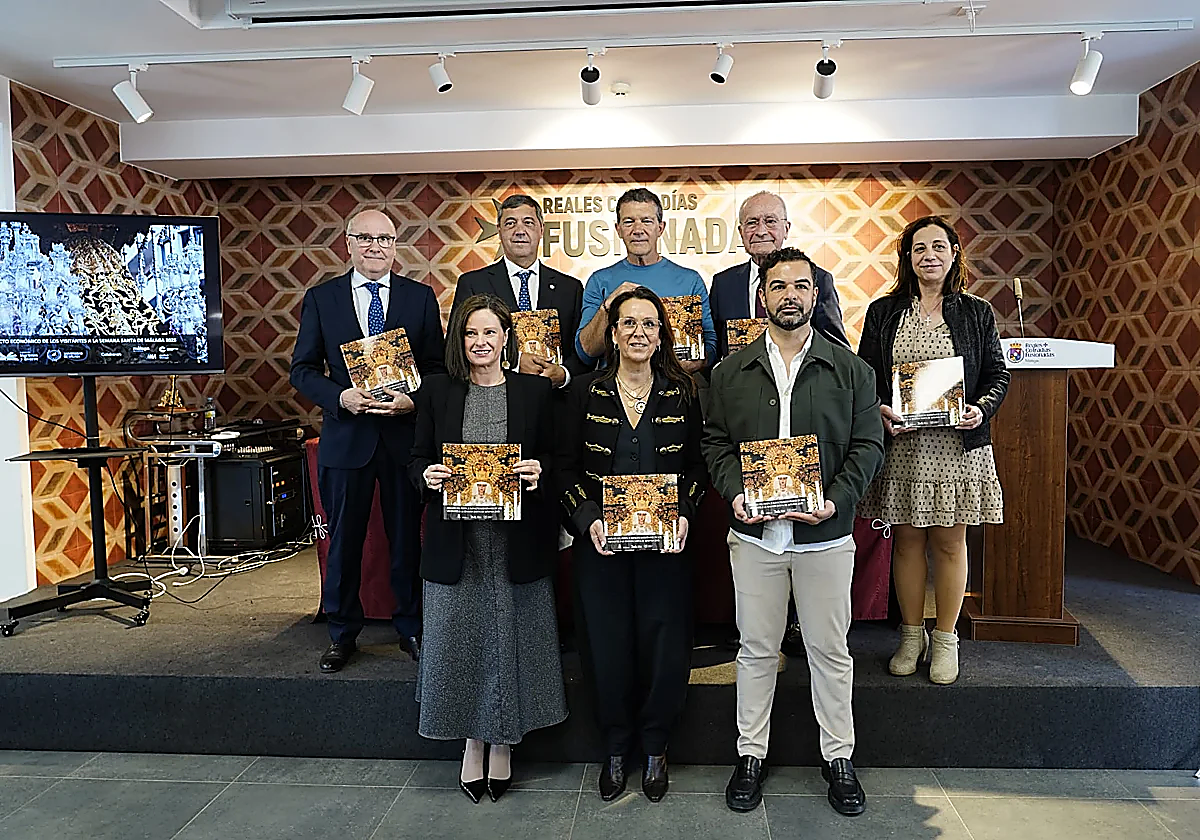
The figures relate exclusively to the impact generated in the city during the seven days of Holy Week. Mayor of Malaga Francisco de la Torre, UMA rector Teodomiro López and actor Antonio Banderas attended the presentation.
Calculations
The report highlights that the average expenditure per visit to Holy Week by residents is 53.08 euros, compared with 372.50 euros among non-resident visitors. The local public mostly spends on eating out, transport to the city centre and shopping. Outside visitors spend on accommodation, eating and shopping.
All of this highlights the capacity of Holy Week to generate income for the city through the "urban and tourist experience". The direct economic impact in 2025 amounted to 204.57 million euros, to which the report adds the direct and induced impact on the entire Andalusian productive fabric to reach 320.52 million.
When incorporating the direct and induced effects on the entire Andalusian productive fabric, the impact rises to €320.52 million.
According to Del Alcázar, the decline last year can be attributed to the stabilisation stage following the post-pandemic, "driven mainly by the drop in non-resident visitors". In other words, "2023 was a particularly significant year", after "two years without processions and two years of the pandemic". "Holy Week played a leading role in that significant boom," Del Alcázar said.
Last year's poor weather forecasts further contributed to many visitors' decision not to travel in the end. Del Alcázar reminded the presentation attendees of the rain that ruined Holy Tuesday last year.
In any case, 320 million euros, Del Alcázar said, "is a very significant figure, bearing in mind that we are talking about just seven days of Holy Week".
Furthermore, there were 2.6 million visits in 2025, 22.9% more than in 2023: of these, 91.9% were residents and the rest were non-residents. In terms of procession spectators, the report estimates an attendance of 513,675 people, of whom 81.2% were residents and 18.8% visitors. This difference between visits and spectators reflects the notable increase in the frequency of attendance by the local population, which raised the average number of days spent watching the processions.
The event is deeply rooted in the local community: seven out of ten Malaga residents attended the processions, eight out of ten say they have attended Holy Week celebrations on more than ten occasions and the average number of days attended stands at 5.7, "which confirms the importance of the local community as the social backbone of the event and a key economic driver".
Among non-resident visitors, 61.8% come from the domestic market, whilst the main international markets include Italy, the UK and Portugal. Of all tourists, 35.6% travelled specifically to see Holy Week and 44.4% were in the city on a holiday, which gave them the opportunity to also see the processions. Furthermore, 93.5% of non-residents are tourists staying overnight in the city, with an average stay of 5.4 days.
The average age of procession spectators is 38 and there is a growing female presence, as women account for 60.7% of spectators and 56.3% of visitors. In the tourist segment, almost half of those attending were visiting Malaga's Holy Week for the first time.
Residents give Holy Week a score of 8.4 out of ten and visitors an 8.3. Among the most highly rated aspects are safety, the range of bars and restaurants and the event's information and signage. Areas for improvement include accessibility and, in the case of residents, the official procession route. Visitors and residents associate Holy Week with tradition, passion and religious devotion.
Job creation
Del Alcázar highlighted that last year's Holy Week created 2,975 jobs and stated that it would be necessary to factor in the economic impact generated by the brotherhoods themselves, given their year-round activities.
Another 2025 study estimated the direct, indirect and induced impact at 39.7 million euros. It would also be necessary to quantify the impact generated by "third-party companies that see a potential market of great interest for the development of specific products and services" related to Holy Week.
Antonio Banderas, president of the Lágrimas y Favores foundation, said that they have been operating for 16 years with the aim of promoting "a Holy Week of solidarity". The actor said that in London he had met many young people who were able to pursue postgraduate studies in the US and Canada thanks to the foundation's scholarships.
Banderas said that they collaborate with Cudeca and Corinto. According to him, the chair of religious brotherhood studies is "an extraordinary tool for understanding ourselves, Holy Week in Malaga and the impact it has on many very different levels".
Francisco de la Torre said that Malaga has managed to overcome seasonality, with Holy Week undoubtedly having "a greater impact, as it brings higher occupancy rates and offers visitors an opportunity to get to know the city".
Award-winning work
The event also presented award-winning research works, such as Juan Carlos Galiano Díaz's thesis on processions in Andalucía between 1856 and 1919. The jury praised the work's rigorous analysis of the origins and consolidation of the Andalusian processional march.
Marta Bleda Soler also received an award for her thesis on sacred art and its link to visual culture and contemporary mass media.
Carlos Hidalgo Fernández became runner-up with his analysis of hymnal heritage in Malaga.
![[]](http://static.vocstatic.com/voc26/latest/assets/images/favicon/surinenglish/apple-touch-icon-57x57.png)