
Innovation
Malaga University to house Europe's most powerful quantum computer and employ over 100 engineers
The computer will have 431 qubits instead of the 317 initially announced, allowing it to handle more complex operations
Nuria Triguero
A few days ago, engineers from the Chinese company Origin Quantum visited the University of Malaga's (UMA) supercomputing centre to prepare for the installation of what will be the first quantum computer in southern Europe.
Their visit has updated the information available until this moment. The machine's power will be greater than initially planned, as it will have 431 qubits instead of 317.
"It will be the most advanced quantum computer in Europe," president of Quantum Labs, which signed the agreement with the UMA, Javier Romero, said.
Related story
This expansion means it will be able to handle "more and more complex operations in less time".
Romero said that the most powerful quantum computer in Europe at the moment is IBM's in Germany, which operates at around 300 qubits. "The new computer configuration we're going to install in Malaga exceeds this capacity by almost 50 per cent," he stated.
The gap with similar supercomputers in Spain is also significant: the quantum computer in Barcelona has 20 qubits, while the one in San Sebastián, developed by IBM, operates with 156.
Quantum computers harness the properties of quantum physics to perform highly complex calculations with unprecedented efficiency, promising a tremendous leap forward for research in fields such as biotechnology and the development of new materials.
This disruptive technology has become a new focus of competition among major powers, particularly between China and the US. For Europe, having computers and engineers capable of tackling the quantum challenge is a matter of technological sovereignty.
More than 100 engineers
The increased power of the machine in Malaga will not result in higher costs, but it will increase the complexity of the calculations and the volume of simultaneous work that it will be capable of handling.
"The greater capacity will allow us to launch up to 15 projects in parallel. Since each of these developments will require a team of between eight and ten engineers, we will need to hire a minimum of 100 workers to cover all the operations," Javier Romero said.
Quantum Labs is responsible for hiring these experts, who will work at the facilities of the UMA supercomputing centre in collaboration with research groups in computer science, chemistry, medicine, finance, 'big data' and microelectronics.
The quantum computer will be the backbone of a collaborative ecosystem with companies, startups and university researchers. "Third parties will be able to use the machine if they want to rent quantum computing time, with our software suite and all the data and servers located in Malaga. Furthermore, we will develop our own models. In the first year, we plan to launch 15 use cases and will begin with four that we have agreed upon with the digital agency of Andalucía," Romero said.
Multidisciplinary teams will form based on four different profiles: quantum programmers (engineers specialised in development and programming within the quantum environment), data specialists, microelectronics experts and specialists in the application subjects of each project, such as geologists, geneticists or graduates in finance and economics.
Quantum Labs is a joint venture between investment fund China Link ESGT (created by Romero in Hong Kong in 2007) and Origin Quantum, a spin-off of the China Academy of Sciences, which, incidentally, Prime Minister Sánchez visited ten days ago, with Javier Romero also present.
"Quantum Origin has the capability to design and manufacture its own quantum chips. It also produces the machines that manufacture the quantum chips. It manufactures the cryogenic cooling system, which is sold to well-known American technology companies. In short, it is capable of producing all the components of a quantum computer and operating it at both the hardware and software levels," Romero stated.
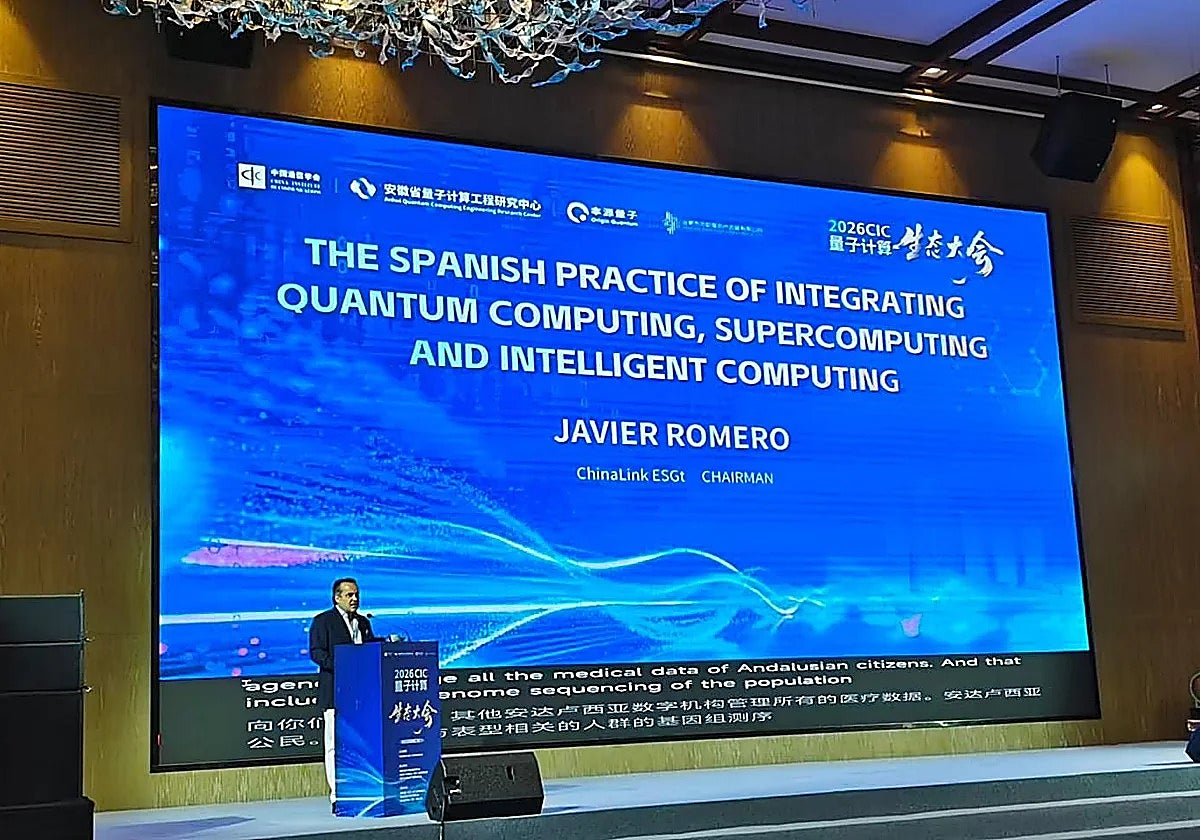
The burgeoning quantum ecosystem in Malaga is already beginning to gain international recognition. On 13 June, Javier Romero and Javier López (deputy rector for technological innovation at the UMA) spoke at the China national computing conference about the university's research projects in this field and about the initiative with Quantum Labs to place Malaga in the select group of cities that have a computer of this kind.
Read dedicated local reporting for Malaga city
![[]](http://static.vocstatic.com/voc26/latest/assets/images/favicon/surinenglish/apple-touch-icon-57x57.png)