
Society
Malaga former rough sleeper transforms trauma into motivation to help others
Alejandro Doña García wants to take a proposal to Malaga city council and urge the authorities to improve care for homeless people with mental illness
Cristina Vallejo
"I spent more than a year and a half homeless, during Covid-19. With mental health problems. With traumas that overwhelmed me. There were days when I lay crying on the ground, unable to get up, not knowing how to get out of it."
That is how the speech that Alejandro Doña García has prepared for the municipal meeting on 28 May begins. He wants to address the mayor and councillors directly.
He is exploring all options: persuading a political group to submit a motion based on his demands, finding support from a humanitarian organisation willing to accompany him to city hall that day, or, if all else fails, turning up alone in the hope that politicians will at least hear him. He carries with him a carefully prepared folder containing his proposal and supporting documents.
Alejandro Doña García is 32. The cause driving him is the plight of homeless people with severe mental illness, "the lowest of the low", as he puts it. "If being homeless is already rock bottom, imagine adding severe mental illness to it," he tells SUR.
He explains that these are often people who frighten others because they walk half-dressed through the streets or shout loudly in public. "They are not aware of their illness and you cannot simply reason with them or take them to a centre. That is not the solution. The system has to adapt, because right now it's outdated," Alejandro says.
Alongside the speech, he has drafted a document outlining proposals to improve care for homeless people with severe mental disorders. In it, he identifies shortcomings in the current system: the difficulty vulnerable people face in accessing existing services, the lack of intensive street outreach, the shortage of places in supported housing programmes and the high dropout rates and rejection of reintegration schemes.
He also proposes measures including stronger street intervention teams with mental health specialists, the creation of outreach teams focused on building trust with the most reluctant rough sleepers, more supported housing for people with severe mental illness, long-term intensive support, better coordination between municipal social services and the public mental health system and adapting care models to the realities of homelessness by reducing bureaucratic barriers.
In the speech he has prepared for the city hall, he sums it all up: "I'm asking for three very specific things: more specialised and long-term mental health outreach on the streets, more supported housing, because nobody recovers on the street, and real coordination between social and health services."
"When someone cannot follow the rules, it is often not a lack of willingness. It is illness and a fair city does not leave behind those who cannot keep up," he says.
Alejandro stresses the importance of housing and of the 'housing first' model: a social intervention policy that prioritises providing homeless people with safe accommodation immediately and without conditions.
"People do not recover from alcohol addiction or mental illness while living on the street. Recovery has to happen in a home, with professional support and follow-up. Shelters are not the answer either: they are overcrowded and there is still drug dealing and fighting inside them. It is not the right environment," Alejandro says.
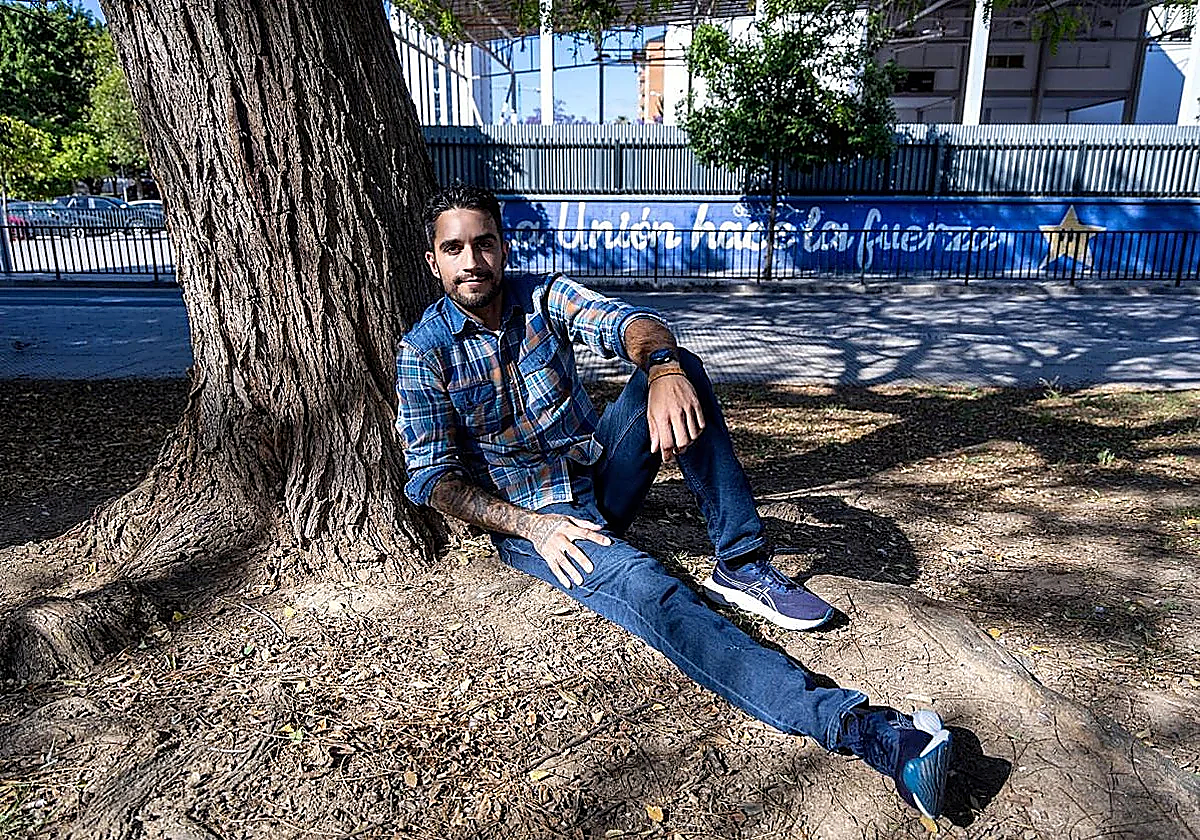
He speaks from personal experience. He meets SUR in Juan Pablo II park, next to the Hans Christian Andersen school, where he used to go to think, meditate and draw inspiration while homeless from the slogan on the school wall: 'Unity is strength'.
"This proposal comes from everything I experienced on the streets, because I spent almost two years homeless. It comes from everything I saw and suffered myself, from all those times I ended up collapsed on the ground crying. I want to turn all of that into something good, something with purpose, something that helps others," he says.
Alejandro ended up homeless after travelling to Germany for work. When he returned to Spain, he discovered that unpaid traffic fines had wiped out his savings. He first stayed at Casa de la Buena Vida, in the La Palmilla district, for a month and a half before being expelled. He then found himself living on the streets in March 2020, just as the pandemic began.
He admits that the trauma of homelessness revived the feelings of abandonment rooted in a difficult childhood. "That old wound reopened. In fact, it still does sometimes when I socialise and all my insecurities come back. But now I understand what it is. I understand what's happening to me," Alejandro states.
Above all, though, he says he is proud to have transformed his pain and bad experiences into something positive: a vocation to help others. Even while homeless himself, he says he often acted as a kind of guide, directing other rough sleepers towards available support services.
At the same time, he does not hide the fact that living on the streets strips people of their dignity. "You feel trapped in a hole and it is very difficult to get out," he says. To cope, he relied on self-deception. "During those almost two years I lived inside my own world. I created this fantasy that this was going to be my life, this half-hippie, half-bohemian, half-homeless existence. I had to believe that story in order to survive and ignore the reality that I was lying abandoned on the streets."
He slept at El Corte Inglés, ate at soup kitchens and occasionally saw his father, who would give him some money. Everything changed when the ASAEC association for companionship and welfare support approached him and offered help, which he accepted. The organisation paid for him to stay in a hostel in El Palo.
Soon afterwards, he found another job in Germany and left again. In recent years, he has travelled back and forth between Germany and Spain, but now with what he describes as a "normal" life, no longer homeless.
During his latest time in Germany, he worked for Amazon before returning to Malaga with savings and a determination to rebuild his life: complete his secondary education, sit university entrance exams for over-25s and study to become a social worker.
"My life experiences made me realise I have this empathy and closeness with vulnerable people," he says.
Today, he works weekends at a beach bar, trains in athletics and continues volunteering with organisations including ASAEC and Fundación Harena. "Getting off the streets should not depend on luck. It should depend on a system that genuinely works," Alejandro states.
He describe his dreams as a mission. He understands how difficult it is for someone with severe mental illness or someone driven into depression after losing work and then losing their home to comply with rules and schedules.
"You cannot keep appointments. You cannot adapt to a system that demands stability when you are completely broken. That is why there are still people living on the streets today. Not because there are no resources, but because those resources are not designed for the people who need them most," he says.
That is the warning Alejandro Doña plans to bring to Malaga city council in two weeks.
![[]](http://static.vocstatic.com/voc26/latest/assets/images/favicon/surinenglish/apple-touch-icon-57x57.png)