
Infrastructure
Malaga launches subsoil work to halt cracking of Sagrario church
The diocese has begun work to stabilise the church's foundations so that it can reopen after being closed for six years due to cracks

Málaga
The day that the Sagrario church in Malaga reopens its doors is drawing nearer, six years after it closed due to a large crack splitting ... it in two.
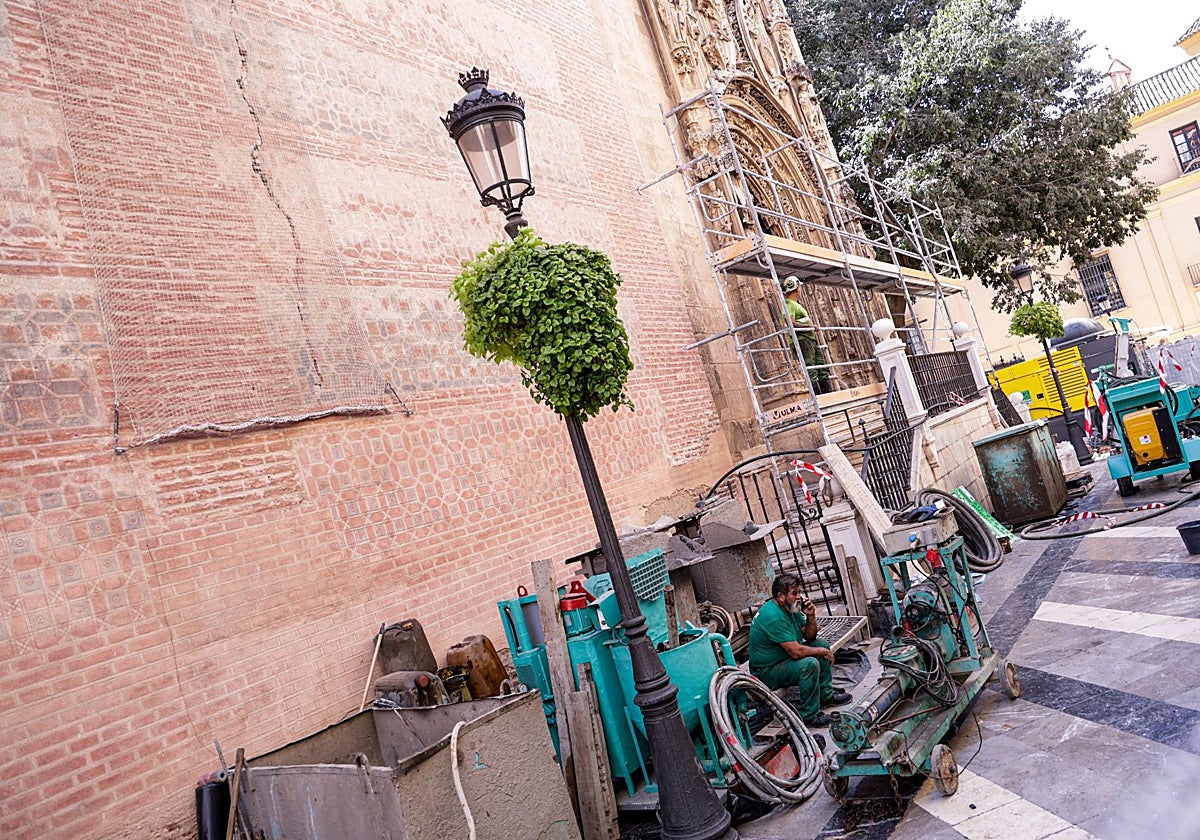
What caused the crack was the difference in the consistency of the subsoil. Work to stabilise the subsoil and halt the process began this week, with the authorisation of the regional government.
The work involves controlled injections of material at a depth of more than eight metres, below the level of the archaeological remains excavated in recent years. The aim is to give greater stability to the ground on which the church stands, halting its deterioration, particularly visible on the north facade.
Related story
-
Infrastructure
Jesús Hinojosa
This past spring, the regional government approved the plan "as it allows the ground to be treated from just one side of the foundation".
Furthermore, the regional ministry of culture said that "the method involving reinforced injections appears to be the most viable solution in terms of the extent of disruption and the execution of the works".
There is no need for further excavations beyond the ones the regional government requested in order to assess what lies beneath the church. The objective of that assessment was to ensure that the work would not damage important archaeological remains.
The labourers and machinery involved in carrying out these ground-reinforcement works are already occupying part of Calle Santa María. Scaffolding protects the Gothic entrance, which is due to undergo restoration.
Discussions between experts from the regional ministry of culture and the Bishopric have paved the way for a final solution after years of waiting.
The archaeological excavations of recent years revealed archaeological remains dating from the late Roman period, from which early Christian remains were uncovered: fragments of a ceramic oil lamp, decorated with a cross, and plates bearing the symbols of the lamb, the dove and the peacock, which could be dated to between the 4th and 6th centuries AD.
These artefacts were cleaned and catalogued so that they could be added to Museo de Málaga's collection.
In addition, the work uncovered walls and parts of the mosque that occupied the spot before the conquest by the Catholic Monarchs.
In 2021, the church of El Sagrario, built in the 18th century, was included on the red list of heritage the Hispania Nostra association has been compiling since 2007.
![[]](http://static.vocstatic.com/voc26/latest/assets/images/favicon/surinenglish/apple-touch-icon-57x57.png)