
Memoria SUR | Estampas de Málaga
Historic Malaga photography: Sabina Muchart and the Alhambra of cholesterol
Exploring the lost Neo-Mudejar architecture and vintage photography of Plaza de la Constitución
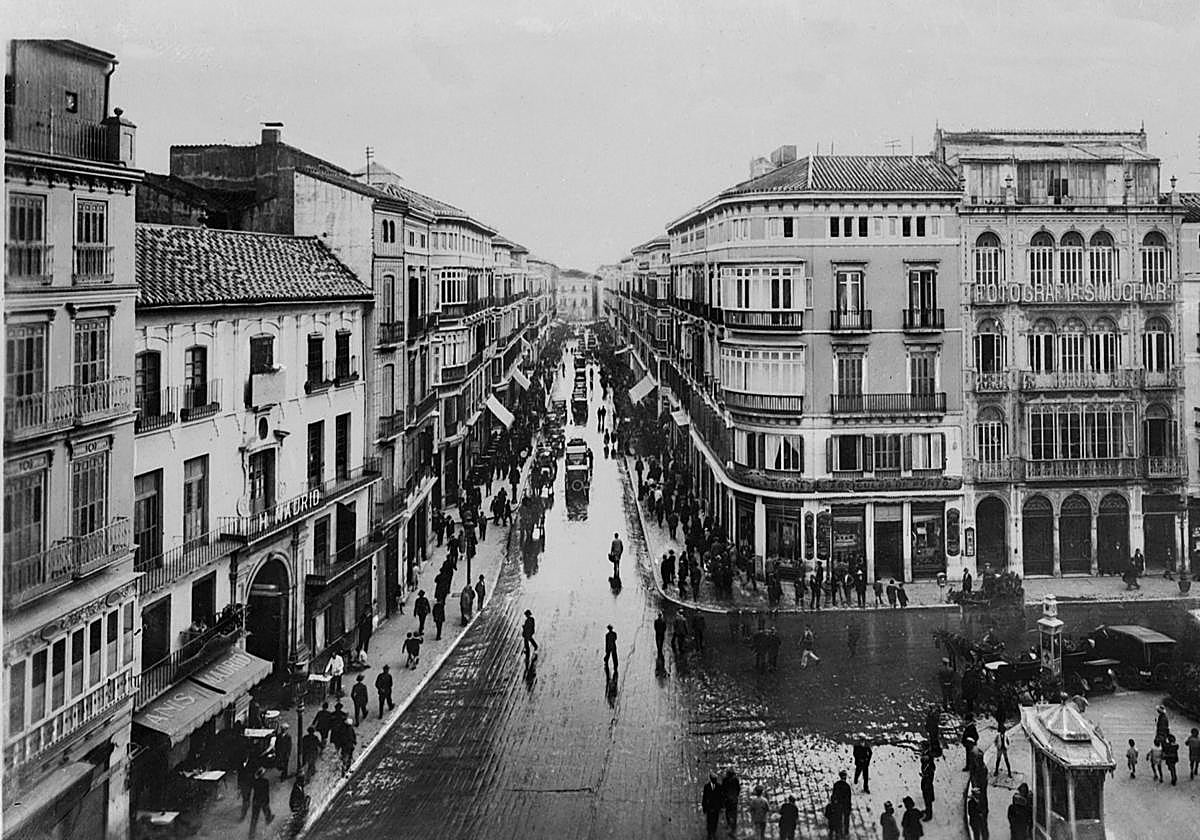

Three photos for a triangular vision of Malaga’s history. "Triangular" refers to the topographical operation used to map a location. In 'Scenes of Malaga: ... Southern Memory', historian Javier Ramírez follows this concept to place specific markers on a potential photographic - and almost sentimental - map of Malaga.
He does so using the three parameters of mechanical cameras: focus, depth of field, and time. The result: a personal lens that selects and interprets the layers drawn by time. Welcome to this visual history.
Late 1920s, 20th century Malaga
-
Calle Larios and the corner of Plaza de la Constitución
While absent from the Spanish Royal Academy dictionary, the term "Alhambrismo" has an extraordinary presence across various branches of art.
This Romantic gaze, focused on the Nasrid Alhambra, can be found in the works of English writers (Lord Byron), French (Chateaubriand, Victor Hugo), Americans (Washington Irving), or Spaniards (Martínez de la Rosa, Zorrilla), and in painters like David Roberts or Genaro Pérez Villamil.
In music, Alhambrismo hits a resonant note with composers such as Tárrega, Albéniz, Falla, or Debussy. In architecture, the style gained momentum in the final third of the 19th century.
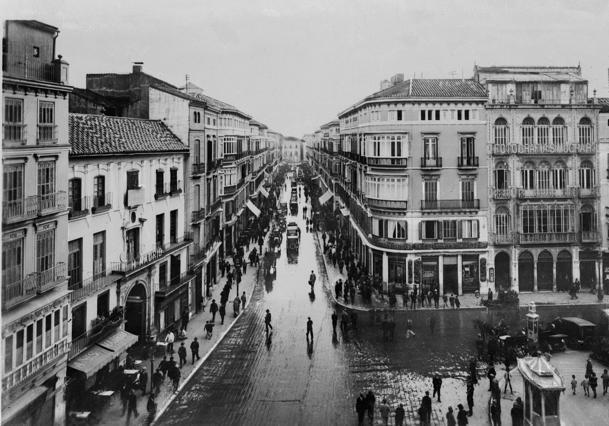
An old Roisin postcard, printed via phototype, shows - if not the first (1880s), then the most central - of the Neo-Mudejar buildings constructed in Malaga: the current number 2 of Constitution Square. For several decades, the top two floors housed the studio of Sabina Muchart, one of the great Spanish female photographers of the 19th century.
On the ground floor, E. Pérez-Bryan’s pharmacy sold a famous medicine based on cholesterol derivatives. The building was nicknamed based on its style and its therapeutic function: the "Alhambra of Cholesterol."
1940s, 20th century Malaga
-
Plaza de la Constitución
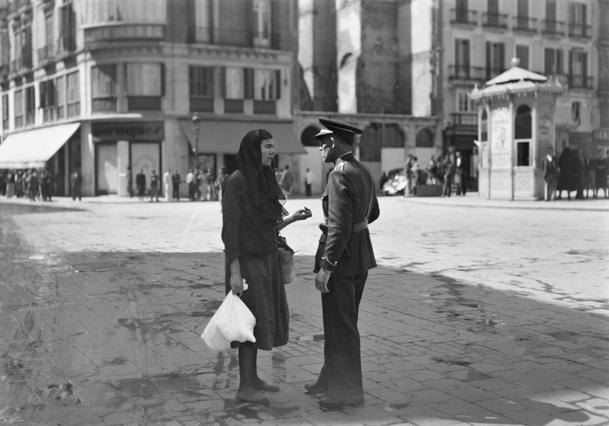
The merciless plague of fires that destroyed most buildings on Calle Larios during the early days of the Civil War also ruined the property that, following the illustrious archivist Francisco Bejarano, we remember as the Alhambra of Cholesterol.
The gap left by the absence of that singular house remained for several post-war years. Along with the pharmacy, the memory of S. Muchart Photography also vanished, to the point that the "S." was masculinised into "Sebastián." It wasn't until years later that research by Juan Antonio Fernández Rivero clarified it was Sabina, one of several women who ran photography studios in Malaga at the turn of the century.
The photograph discussed here belongs to a series in which the same guard talks with different people around the square. I deduce the photographer intended to document police checkpoints in the city centre - a reflection of the atmosphere of the time. However, the scene transcends the moment; we now read it as a symbol of an era. The portrait, no longer a premeditated pose, is captured in the street.
June, 1974, 20th century Malaga
-
Plaza de la Constitución
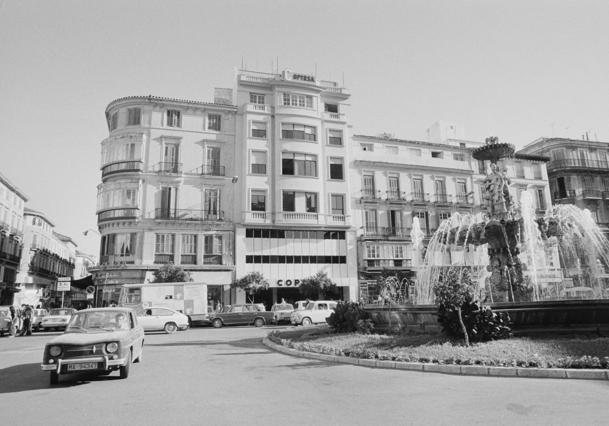
Since the early 1950s, the space connecting these three photographs has been occupied by a building that, in appearance, maintains a constant aesthetic today.
Changes in use over time have affected the facade and, above all, indicate the transformation occurring in the surrounding area and the city at large. Initially, in the attic - where we previously saw the glass frame of Sabina Muchart’s sunlit studio - stood the capital letters of Banco Popular.
The fifth floor originally featured arched windows and columns that echoed its 19th-century predecessor, maintaining harmony with the building opposite.The 1974 image shows the building now dominated by the Copyrsa brand, renovated with an "ultra-modern" window that would soon become dated.
It serves as a visual announcement of the property development boom (desarrollismo) that began to cover the city map without restraint.
![[]](http://static.vocstatic.com/voc26/latest/assets/images/favicon/surinenglish/apple-touch-icon-57x57.png)