
Weather
The terral wind pushes temperatures to nearly 41°C as the amber weather warning remains in force in Malaga on Tuesday
Coín has once again recorded the highest temperature in the province, at 40.8, with Estepona, Manilva and the airport not far behind


Málaga
"This terral wind, with 34°C in my area around Avenida Ortega y Gasset, and, above all, an outdoor humidity level of just 25 ... per cent, is exactly the kind of weather I love. If we had the same temperature but with an easterly levante wind and humidity at 69 per cent, the apparent temperature would be 40°C." This is how José Luis Escudero, the Malaga-based weather presenter, vividly describes the conditions experienced on Monday in the capital’s most central neighbourhoods. Just as Aemet had forecast, the warm westerly wind made itself felt, but it was particularly noticeable in the upper Guadalhorce valley and areas of the westernmost coast.
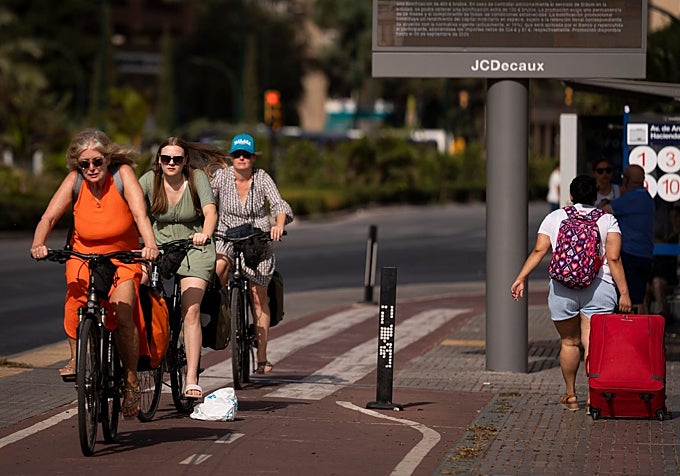
The state meteorological agency kept an orange-level warning (moderate risk to the population) in place, due to “land breezes that may bring maximum temperatures of 39 degrees, whilst in the lower reaches of the Guadalhorce river, temperatures may occasionally reach 41 degrees”. This warning covered the usual areas where the scorching westerly wind tends to make its presence felt, such as the aforementioned Guadalhorce valley (Coín, Álora, Pizarra, Cártama, etc.), as well as the city of Malaga, Estepona and Manilva.
In fact, it was Coín that recorded the day’s highest official temperature, at 40.8 degrees at 6pm. It was followed by Estepona (39.9), very close to the airport (39.6, which is the city’s reference point for statistical purposes) and Manilva (39.3). By contrast, as we have seen, conditions in the capital were more bearable, with "only" 36 in the city centre (the thermometer is located at the port).
Equatorial lows
The night-time minimum temperatures deserve special mention, as they have a significant impact on people’s health, in that they make it difficult to fall asleep without the aid of air-conditioning and fans (which can also lead to respiratory problems).
The temperature at the airport on Monday did not fall below 26.7 degrees (as recorded at 7am). This figure is considered to fall within the range of what are known as ‘torrid’ or ‘equatorial’ nights, which are those in which the temperature does not drop below 25 degrees.
The area closest to the coast will remain under an orange warning on Tuesday, when temperatures may once again reach 40 degrees at times, although this is most likely to occur in the Guadalhorce area. Once again, equatorial minimum temperatures of around 25 degrees are expected.
Looking ahead to Wednesday, the southern half of the province will remain under the influence of westerly winds, although these will gradually ease and the alert level will be downgraded from orange to yellow.
The east wind is back
We will therefore have to wait until Thursday 6 August, to see a change in wind direction. With the expected arrival of the levante, temperatures will drop by around eight degrees compared with the start of the week. Maximum temperatures in the city will be around 30, which is typical for this time of year, whilst minimum temperatures will drop to 21–22.
That said, with the arrival of the sea breeze, the air in coastal towns will once again become laden with humidity. Depending on other weather conditions, such as cloud cover or the presence of haze, this could lead to the dreaded stifling heat, which has already occurred on previous occasions in July.
It was, moreover, one of the hottest months on record according to Aemet’s historical data, though it did not set a new record. As José Luis Escudero pointed out, last month in Malaga city was the third-hottest July since records began at Málaga Airport, with an average temperature of 28.2 degrees. It was thus surpassed only by 2023, with an average of 29.4 degrees – which remains the hottest on record – and by 2015, with 28.3 degrees. As can be seen, the records have been set in three summers very close together.
Climate statistics also show that Malaga’s weather patterns differ from those of most of the Iberian Peninsula. Thestate agency has already announced that, provisionally, the month recorded an average temperature of 25.7 degrees across Spain, the same figure as in July 2022. As a result, both months are tied as the warmest in the entire historical record, which began in 1961.
![[]](http://static.vocstatic.com/voc26/latest/assets/images/favicon/surinenglish/apple-touch-icon-57x57.png)