
A family from Malaga escaped the war in Kyiv: 'We had to run if we were to get out'
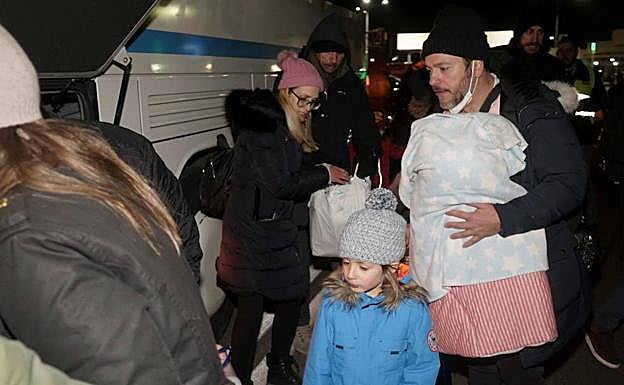
Antonio, Marina and their two children travelled across Ukraine for two days to reach Poland: "It was very difficult," they say
ALBERTO GÓMEZ
MALAGA.
In their first few days in Kyiv, children were playing in the street, people walked their dogs and drank coffee in bars. The supermarkets were open. Everything seemed "more or less normal". But that tense calm exploded in a matter of hours, the time it took the Russian troops to invade the Ukrainian capital, which took Antonio and Marina by surprise. They had arrived nearly three weeks earlier with their five-year-old son Juande, in case the surrogate birth of their baby Evelyn happened earlier than expected. They didn't think there would be any problems returning to Malaga, but the escalation of the conflict meant the air space was closed and Kyiv became a rat-trap. The day that Putin gave the order to lay seige to Ukraine, they had just left the clinic with the baby. They tried to process the paperwork to return urgently to Spain but all the flights had been cancelled. That is when their odyssey to escape the inferno began.
Antonio asked the Embassy for help on the Thursday: "They said they were in a meeting and would ring me back later that morning," he says, but nobody called so he went out to buy milk for the baby. It was then he discovered that all the pharmacies were closed, and realised that attack was imminent.
"There were enormous traffic jams. Everybody was trying to leave. It took me hours to find any baby milk," he says. By then, their families and friends in Malaga were starting to panic, worried that they would not be able to get out of Kyiv. His brother-in-law rang the Embassy. "They said they had tried to get hold of me but I hadn't answered. I imagine there was no cover while I was out searching for milk," he says. Soon afterwards they received a message from the diplomatic staff: "Pack a 10-kilo suitcase each and come to the Embassy straight away. We are leaving in a convoy," they said.
It didn't take long for the family to get organised. "We had to run, but the cases were already packed because we were ready to escape at any time. We left clothes and gifts in the hotel to reduce the weight," says Antonio.
The traffic which was clogging Kyiv was delaying every journey by hours, but they managed to get to the Embassy on time. Police officers from the Special Operations Group (GEO) were waiting there to accompany evacuees to the Polish border. When the Russian invasion began there were 320 Spanish citizens in Ukraine, according to the government. Many initially decided to stay because they had relatives there, but most changed their mind once the armed conflict began. Antonio, Marina and their two children joined the convoy which left for Warsaw that day, with another 50 Spanish people and the diplomatic staff who had been obliged to evacuate the Embassy.
Police escort
"They escorted us all the way," Antonio says, speaking to us by phone from Poland. It took more than two days to complete the 700-kilometre journey. "Sometimes we only travelled two kilometres in an hour, and they had to change the route several times. We got lost, found ourselves at a bridge which had been destroyed. Some of the civilians had to drive so the officials were able to sleep a bit. It was very difficult, very hard," he says. Luckily the GEO officers had biscuits, water and some food with them. "We can still hardly believe what we went through," says Antonio. "Just as we left, three sirens sounded and we heard an explosion. They told us afterwards that the Russians had bombarded a village we had passed through just two hours earlier," he says.
And how do you explain a war to a child? "We tried not to let him know. We said some things were breaking and we had to go so he wouldn't get scratched. He was very good, although he is nervous and didn't stop asking questions when we got here. When the car stopped for a break we ran little races so he could stretch his legs," Antonio says.
His sister, whose umbilical cord came off during the journey, was born in a country at war. "We travelled by day and night, along secondary roads full of potholes. The good thing is that the rattling sent her to sleep," he says.
They thought they were going to have to split up: "We left Kyiv without doing the paperwork. There was no time".
The Embassy suggested that until the administrative processes were completed, Antonio and baby Evelyn should stay in Lviv, a Ukrainian town on the Polish border, which was safer than the capital, while Marina and Juande carried on to Spain.
"In theory we couldn't cross the country, but through Rafael Pineda (chief of staff of the government's delegate in Andalucía, Pedro Fernández Peñalver), the Ministry ordered them to give us special safe conduct," he says.
Crossing the border astounded them. "You can't imagine the queues there are to get out of Ukraine. There are a lot of children, and it is terribly cold. Someone should help Poland to handle the checks at the border because they are very slow," he says. Once there, the police gave them a box with gauze, water, nappies and food. The chaos outside petrol stations and banks was behind them, but the fear hasn't left them.
"We hear a noise, like the wheels of a suitcase being pulled along, and we look at the sky in case it's a plane, thinking "Please don't let it bomb us," admits Antonio, to whom it seems inconceivable that one country is capable of invading another.
They have just spoken to the surrogate mother. "She's fine, at home in the east. She is very special to us. We hated having to leave the clothes behind that she had given us for the baby," he says.
Their plan is to fly to Madrid, where they can complete the paperwork for little Evelyn, and then return to Malaga where Antonio works as an engineer. They left their home in Teatinos ready to return as a family of four, but still can't believe that their nightmare is over.
"We still feel very tense. We're not used to the idea of being safe. I suppose we will feel better when we get home and everything is fine there," he says. Until then, though, they can't assimilate the fact that they have just escaped from a war.
![[]](http://static.vocstatic.com/voc26/latest/assets/images/favicon/surinenglish/apple-touch-icon-57x57.png)