
Environment
Estepona removes 950 tonnes of Asian algae from a single beach
The invasive species has also reached the coasts of Manilva, Casares and Marbella, the latter having removed more than 8,500 tonnes so far this year
José Carlos García
The invasive species Rugulopterix okamurae, better known as the Asian algae, has once again reached the westernmost coastline of Malaga province. Since last weekend, the exotic seaweed has reappeared on beaches in Manilva, Casares, Estepona and Marbella.
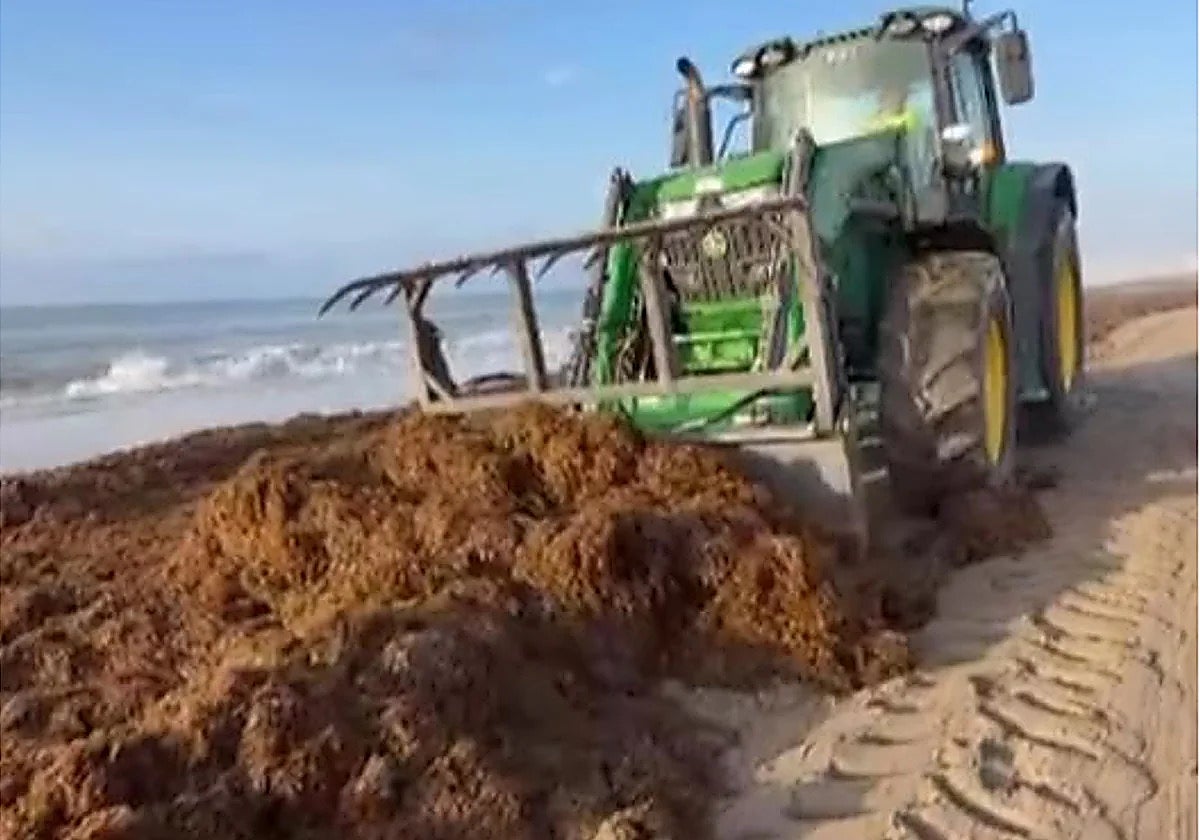
In Estepona alone, municipal services have removed 950 tonnes of algae since Saturday, according to official figures. Crews have collected all of it from La Rada beach, "where it just keeps coming in" because of the huge quantities accumulating close to the shoreline, town hall sources said.
The battle against the Asian algae continues to place a heavy burden on local authorities, which must commit significant resources to keep beaches clean. In Estepona, the town hall has deployed a special operation running daily from midday until midnight, involving up to 35 workers and 19 vehicles, including seven algae-removal machines, seven tractors, three water-tank trailers, a 4x4 lorry and a backhoe loader.
Related story
-
Environment
Ignacio Lillo
Given the situation and the "significant commitment of municipal staff and resources" required to tackle the problem, Estepona town hall has once again called on the central government to take action and coordinate a national response to the invasive species, with sufficient funding for its removal, management and prevention.
In Marbella, which has 27 kilometres of coastline and 24 beaches, crews work throughout the year to remove the invasive algae. So far in 2026, municipal services have cleared 8,559 tonnes. Between the start of June and the 12th of the month alone, they removed 1,456 tonnes, according to council figures.
In Casares, the town hall said it had endured "several intense days of work", while warning of the scale of the problem. "Despite the considerable effort made yesterday, the Casares coastline woke up covered in algae again this morning," the town hall said on Wednesday.
It has strengthened its clean-up operation by deploying more crews alongside backhoe loaders, trailers and specialist beach-cleaning machinery. Workers focused on Playa Ancha and Playa Chica on Tuesday and will continue on Wednesday from the far side of Torre de la Sal towards Piedra Paloma and the dog beach.
On bathing beaches, the huge build-up of algae creates public health concerns, unpleasant smells and leachate produced by fermentation and decomposition. It also damages the environment and the landscape, with knock-on effects for tourism and businesses that depend on it.
Force majeure and extreme necessity
The latest influx comes just six weeks after the Andalusian regional government formally declared the mass arrival of Rugulopterix okamurae on the region's coastline a case of force majeure and extreme necessity.
The decision, approved on 29 April, allows coastal municipalities to claim an exemption from Spain's state landfill tax, easing the financial burden of dealing with the exceptional environmental event.
Native to the Pacific Ocean, the species first appeared around the Strait of Gibraltar after authorities identified washed-up specimens on the coast of Ceuta in 2016. Since then, it has demonstrated an "extraordinary" ability to colonise new areas, spreading rapidly both eastwards and westwards on both sides of the Strait.
Estimates put its annual biomass in the area at around 100,000 tonnes of fresh weight. Winds then carry the algae to different coastal municipalities. According to the Andalusian government, the westernmost towns in Malaga province face "extraordinary pressure" because they must constantly remove the biomass, whose growth remains "relentless and uncontrolled". Its invasive behaviour produces "unprecedented and excessive" levels of biomass, far exceeding those of native species and other non-native organisms.
The uncontrolled spread of the algae, alongside scientific evidence showing that eradication and restoration of affected ecosystems is not feasible, at least in the medium term, led Spain to add the species to its catalogue of invasive species in 2020. The EU classified it as a species of concern two years later.
Access the broad Malaga and Costa del Sol news index
![[]](http://static.vocstatic.com/voc26/latest/assets/images/favicon/surinenglish/apple-touch-icon-57x57.png)