
Employment
Malaga province residents' work commute takes 40 minutes every day and costs 15% of their salary
A report by Comisiones Obreras sets out how much workers spend on travelling to the city from various outlying towns and calls for transport allowances to match reality
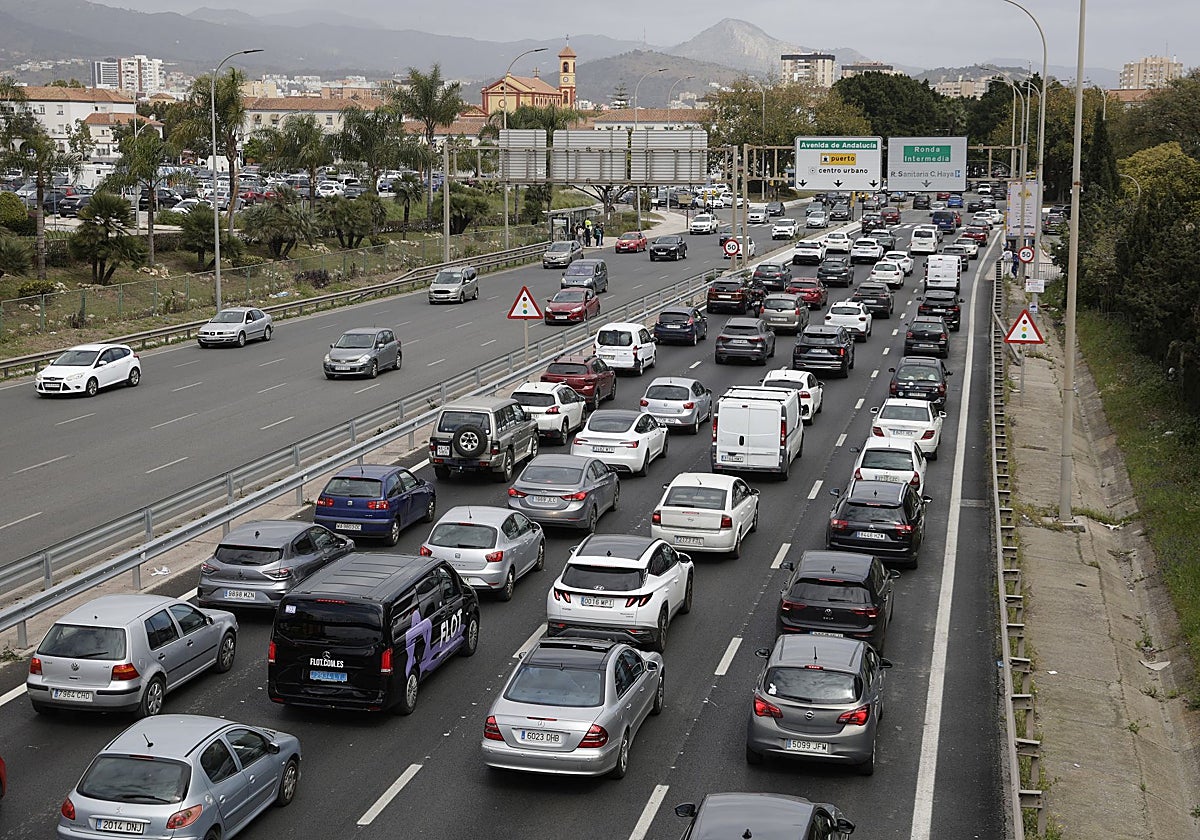

"When we talk about transport, we mustn't just talk about roads and traffic jams. We need to recognise that these journeys are part ... of working life: they involve shifts, work-life balance and financial considerations, a reality that working people face every single day of their lives," trade union Comisiones Obreras' Trinidad Salcedo said during a report presentation on Thursday.
Next to her, the union's general secretary, Fernando Cubillo, provided the figures: "Commuting takes time: it adds 15% to the working day. Malaga's wage-earning population not only works their eight hours a day, but also has to factor in commuting time, which averages around 40 minutes a day."
According to Cubillo, commuting costs workers an average of 15% of their salary. However, for 42.5% of Malaga's wage-earning population (more than 314,000 people) the salary barely reaches 620 euros a month, while a further 38% (280,000 people) earn 1,300 euros a month on average. "One really has to think twice about accepting a job in these circumstances," Cubillo said.
Related story
_20260618142049-Ry8RC0fuz7G6iwB5nheoNeO-366x256@Diario%20Sur.jpg)
Cubillo set out the costs, based on his calculations, of travelling from various towns on the outskirts of Malaga city or from other parts of the province where many people have had to move to due to the high cost of housing in the city.
For example, from Torremolinos, Alhaurín de la Torre, Benalmádena, Rincón de la Victoria or Cártama, transport costs amount to 200 euros a month. "When you earn 620 euros a month, we're talking about having to spend a third of your salary on transport," he said.
If you have to travel from Fuengirola, Pizarra or Mijas, transport costs amount to 350 euros a month. The figure rises to 450 euros for towns such as Coín, Álora or Vélez-Málaga, to 650 euros for Antequera, Marbella, Archidona, Nerja or Campillos and up to 1,000 euros for daily commutes from Estepona or Ronda.
-U66738714426ydh-680x476@Diario%20Sur.jpg)
Cubillo stated that the proportion of workers in the province that the high cost of transport affects is very high, as 82% of employment in the province is concentrated in the city and along the Costa del Sol.
"But these jobs have not gone exclusively to people living in Malaga and its surrounding municipalities," Cubillo said.
"If people have to move away because they cannot afford the rent, because they cannot live in towns under pressure from tourism and have to move to other towns, such as Coín or the Axarquía, that means spending 450 euros of their pay on travel costs just to get to Malaga," Cubillo stated.
The general secretary of Comisiones Obreras said that the trade union struggles to "get transport allowances" for workers, because, "in the vast majority of collective agreements, such transport allowances do not exist".
Furthermore, in the agreements that have them, the provisions are either very brief or the same amount for the entire workforce. "We are going to focus our efforts this year on ensuring the transport allowance is discussed," Cubillo said.
As well as time and money, commuting to work "takes its toll on occupational health".
Cubillo cited figures from the Andalusian regional government, which show that in the province of Malaga there have been 2,309 "commuting" accidents, 85% of which occurred in the city and in the municipalities of the Costa del Sol. These figures also show that one in four 'in itinere' workplace accidents in Andalucía occurs in the city of Malaga.
Cubillo also highlighted other consequences for workers' lives: he mentioned a waitress at a restaurant in Soho who commutes from Vélez-Málaga and pays 450 euros in travel costs, to which she must add the cost of parking, where she sometimes has to spend her break during her split shift.
Transport plans
Trinidad Salcedo pointed out that companies with more than 200 employees are required to draw up transport plans.
"Malaga has grown significantly, but transport and infrastructure have not kept pace," she said, adding some figures, such as the fact that the Tech Park reached 29,018 employees in 2025.
The A-357 road carries around 74,000 vehicles a day to Malaga and the commuter rail network exceeded 15.5 million passengers in 2025, nearly half of whom travelled on the C1 line from Malaga to Fuengirola, which remains a single-track line.
"That is why we place great emphasis on the need for transport plans, but not on a company-by-company basis. They must be drawn up for business hubs, such as the Tech Park as a whole, the airport area and El Viso-Guadalhorce," Salcedo said.
These plans are also based on surveys carried out among workers to find out where they live, the distances they travel, what their shifts are and whether they have a private vehicle.
"We need to think about measures that can be implemented straight away. We cannot tell people that they have to wait ten years for their commute to work to improve, because it will take years to build the major infrastructure projects that are needed in Malaga," Salcedo stated.
Among the structural solutions, the trade union proposes improving the Cercanías commuter rail service, making progress on the Costa del Sol rail corridor, carrying out a study on the Coín-Marbella line, completing works on the A-357, developing the western ring road and improving the major transport interchanges.
In the short term, Comisiones Obreras lists more buses and extended operating hours, express services, shuttle buses from the Cercanías and the metro, priority for bus lanes, company-organised public transport, car-sharing, co-ordinated timetables and working from home.
![[]](http://static.vocstatic.com/voc26/latest/assets/images/favicon/surinenglish/apple-touch-icon-57x57.png)