
History
Mystery of Nasrid key found in suitcase bought at Benalmádena flea market
Artefact was hidden alongside 19th-century Alhambra plans discovered seven years ago and went unnoticed in false lining until recent accident

It all began at the Benalmádena flea market, with a suitcase that José Antonio Fernández Molina bought seven years ago during one of his regular ... strolls around the market. Inside were original 19th-century documents of the Alhambra plans, yellowed by the passage of time, signed by the monument's archaeologist and restorer, Manuel Gómez-Moreno.
SUR published the discovery to great acclaim in 2019 and it seemed as though the story had ended there. But no. A chance fall of the suitcase while Fernández Molina was tidying his storage room revealed something else. "I heard a metallic clink," he says. In the false bottom of the lining, he found a Nasrid key.
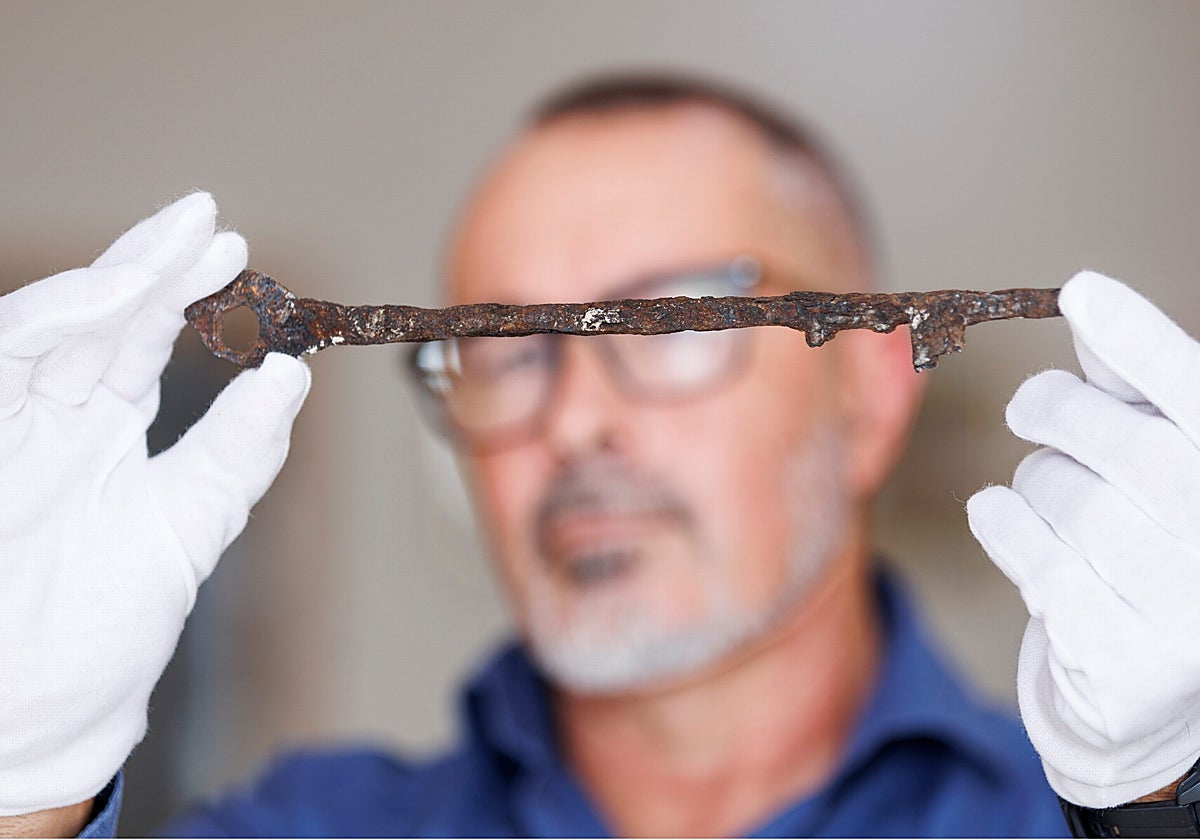
José Antonio Fernández Molina is a researcher and expert in unearthing treasures at flea markets that others discard. He puts on his gloves to show the piece. It is made of wrought iron, is square in shape and measures 27 centimetres. The material, shape and size are consistent with those produced during the Nasrid period.
The key originally had two prongs, but now only one remains and even that is only half intact. This is the main problem with iron: unlike bronze, it is "not very durable and it is prone to breakage and loss".
Fernández Molina has found only two other similar examples in Spain. One of them belongs to the Torre de la Vela in the Alhambra and dates from between the 14th and 15th centuries. In his comparative study, Fernández Molina has found many similarities with it: both have a circular, hollow head, a slender, elongated body and two thick teeth.
From this point on, it is all hypotheses. One of them points directly to the monument in Granada. For the time being, there is no certainty that this key once opened a lock at the Alhambra, but it is a possibility.
For Fernández Molina, it stands to reason that the man who was the fortress's great restorer would have kept that item alongside the plans he drew up of the complex. He was an archaeologist, a painter and chairman of the board of trustees. He had access to the entire site and it is to be expected that numerous objects from the time of the Nasrid kingdom would have come to light during the restoration work.
However, Fernández Molina cannot establish a direct link. To begin with, it is impossible that Manuel Gómez-Moreno could have placed the key there. The briefcase could not have belonged to him because Fernández Molina dates it to between the 1960s and 1970s and the archaeologist from Granada died in 1918.
After his death, his documents and the key passed into other hands. At some point, someone placed the papers in the briefcase and hid the key in its lining to protect it. It must have been someone very close to him, because Gómez-Moreno's obituary was found in the very same folder containing the plans.
According to what the flea market seller told him at the time, a man Fernández Molina never saw again, that lot of items had come from the clearance of a house in Granada. "We need to investigate further," the expert notes.
For the time being, Fernández Molina has sent an email to Patronato de la Alhambra to report the discovery and made himself available to their experts to investigate the key's origin and its possible connection to the monument. He had already done so in 2019 when he discovered the 1886 plans, although on that occasion no collaboration materialised. His aim is for it to be analysed in depth and "displayed where people can admire it".
This is not the first time the researcher has unearthed a piece of history at the flea market. Years ago, he bought an RAF pilot's helmet which contained documents belonging to British Second World War hero and pilot John Braham.
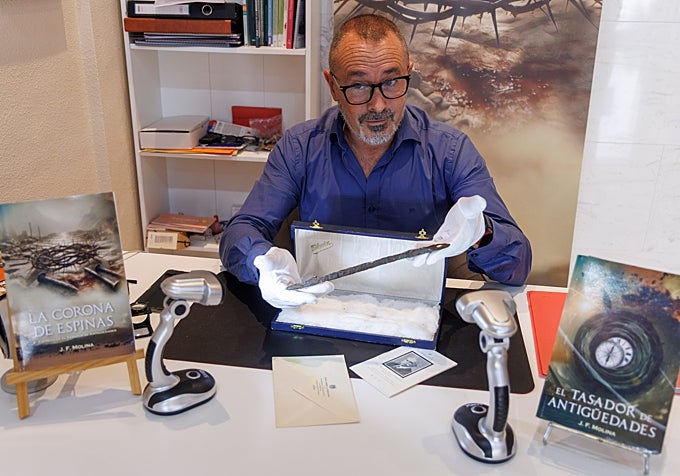
In 2021, he once again stumbled upon a forgotten gem: the memoirs of Walter Bohne, a Jewish man, a moving account of his experiences during the Second World War, complete with family photographs. Stories straight out of a novel that, three years ago, inspired him to make the leap into literature with El tasador de antigüedades: a work of fiction into which he poured his own experience, his historical interests and his technical expertise.
Fernández Molina is now back in bookshops with a second instalment featuring his protagonist John Fox, a charismatic, methodical and astute art investigator, in the book La corona de espinas, which he is presenting on 6 October at 6pm at Casa de la Cultura in Benalmádena.
Fernández Molina carefully puts the key away in a box after finishing the conversation. The item, which was on the verge of ending up in the bin, hidden away in that worn, moth-eaten suitcase that had been in his storage room for years, is now a treasure. It's all thanks to what some might consider a flaw. "I find it hard to throw things away," the researcher smiles.
![[]](http://static.vocstatic.com/voc26/latest/assets/images/favicon/surinenglish/apple-touch-icon-57x57.png)