
Cleaning of streams and drains to prepare them for the rains in Torremolinos
Clearing of undergrowth using heavy machinery and removal of debris to prevent watercourses and infrastructure from becoming blocked

Torremolinos
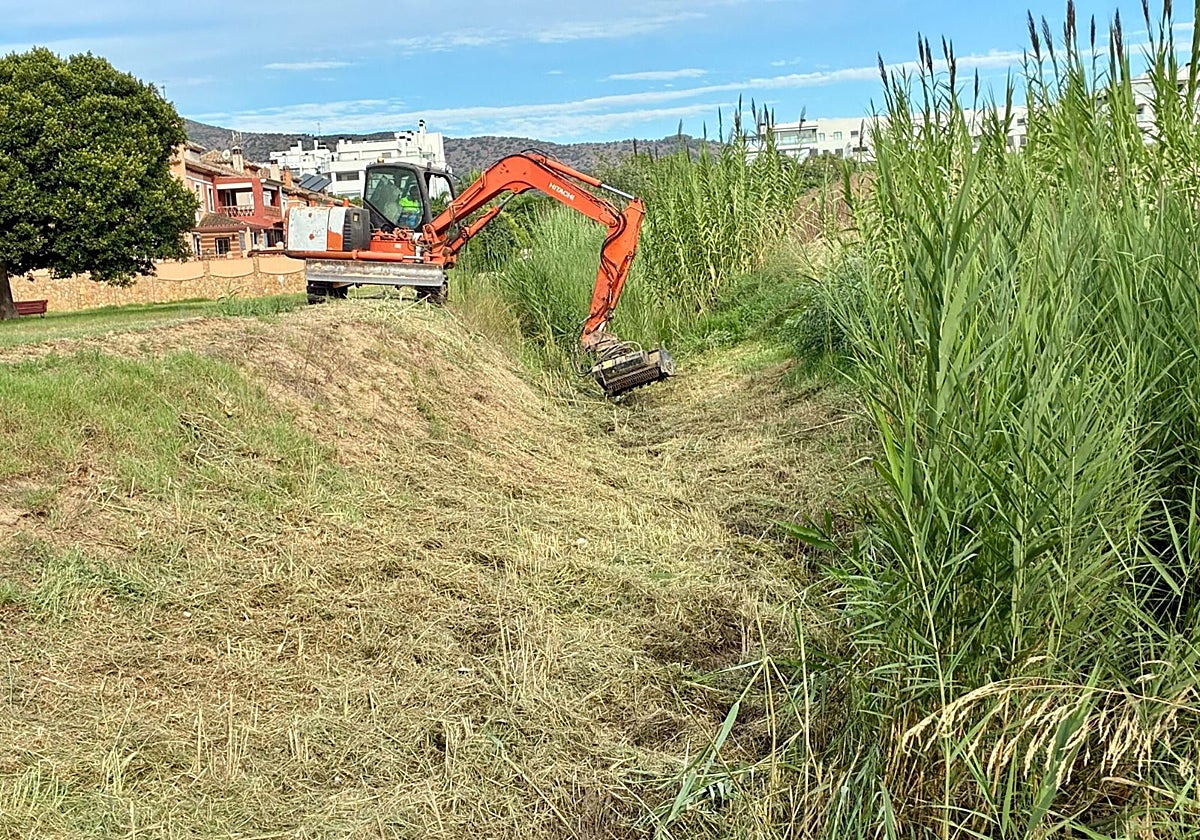
Torremolinos town hall, through the company Litosa, is carrying out a clean-up programme along the courses of local streams with the aim of clearing ... drainage channels and water outlets, thereby preventing flooding.
This work will be carried out on the Gazpacho, Saltillo, Cueva de la Higuera, Pan Triste and Pinillo streams until 2 November.
The work involves clearing and removing existing undergrowth to ensure that water can flow freely.
It has been necessary to hire an 8-tonne machine, which is tracked and fitted with a forestry mulcher on its arm, and is operated without a driver. In addition, the local authority’s own resources have been mobilised, including a tractor, lorries and a backhoe loader.
92
Metric tonnes
The company Aguas de Torremolinos has been working on the cleaning and maintenance of the sewerage network in the municipality and, so far this year, has carried out work on 808 drains and 18.59 kilometres of sewers, removing 92 tonnes of waste, of which around 40 per cent consisted of wet wipes.
Meanwhile, the company Aguas de Torremolinos has been working on the cleaning and maintenance of the sewerage network in the municipality and, so far this year, has carried out work on 808 drains and 18.59 kilometres of sewers, removing 92 tonnes of waste, of which around 40 per cent consisted of wet wipes.
These measures help to keep the infrastructure in good condition and prevent potential traffic jams and incidents, particularly during periods of rain.
Sanitation
In addition, the own hall highlights the addition of a new sanitation lorry, which improves the service. The vehicle has a capacity of 9,000 litres, compared with the previous one’s 7,000 litres, and is fitted with a pressurised water system capable of up to 250 bar and 212 litres per minute, enabling a faster and more effective response.
It is a quieter machine, which reduces disturbance to residents and provides safer working conditions for operators, thanks to the option of remote control.
According to the local government, these measures complement the preventative cleaning work scheduled throughout the year, with the aim of ensuring maximum water drainage capacity in the event of heavy rainfall.
Gully covers play a vital role in this process, as they are the urban infrastructure elements responsible for collecting rainwater and channelling it into the sewerage network. However, their drainage capacity can be reduced when debris carried by the rain accumulates in them.
Neighbours
Mayor of Torremolinos, Margarita del Cid and her counterpart from Benalmádena, Juan Antonio Lara, held, last April, a working meeting to address issues of common interest to their towns, whose boundaries have become blurred as a result of the population growth they have experienced, with a combined total of over 150,000 inhabitants.
One of the measures that emerged from the meeting was, in fact, to tackle the clearing of riverbeds in the neighbouring areas, by carrying out maintenance work on a rotational basis.
It is no coincidence that Torremolinos and Benalmádena are separated by the Saltillo stream. When this stream swells, combined with the sediment and vegetation it carries, it can cause problems both at its mouth on the beach and right along the seafront promenade, at a point where Puerto Marina, in Benalmádena and La Carihuela, in Torremolinos, meet, with a high concentration of businesses and a large number of local residents and visitors.
Inter-municipal cooperation also extends to matters such as the construction of the Autovía del Agua, a water infrastructure project co-financed by the Regional Government of Andalucía and Acosol.
![[]](http://static.vocstatic.com/voc26/latest/assets/images/favicon/surinenglish/apple-touch-icon-57x57.png)