
History
A mural that seeks 'neither resentment nor revenge; only memory' in the Axarquía
The work, which depicts La Desbandá - one of the darkest moments in Spain's Civil War, has been created by the students of Ben Al Jatib school in Rincón de la Victoria and one of the survivors played a leading role in the artwork

Rincón de la Victoria
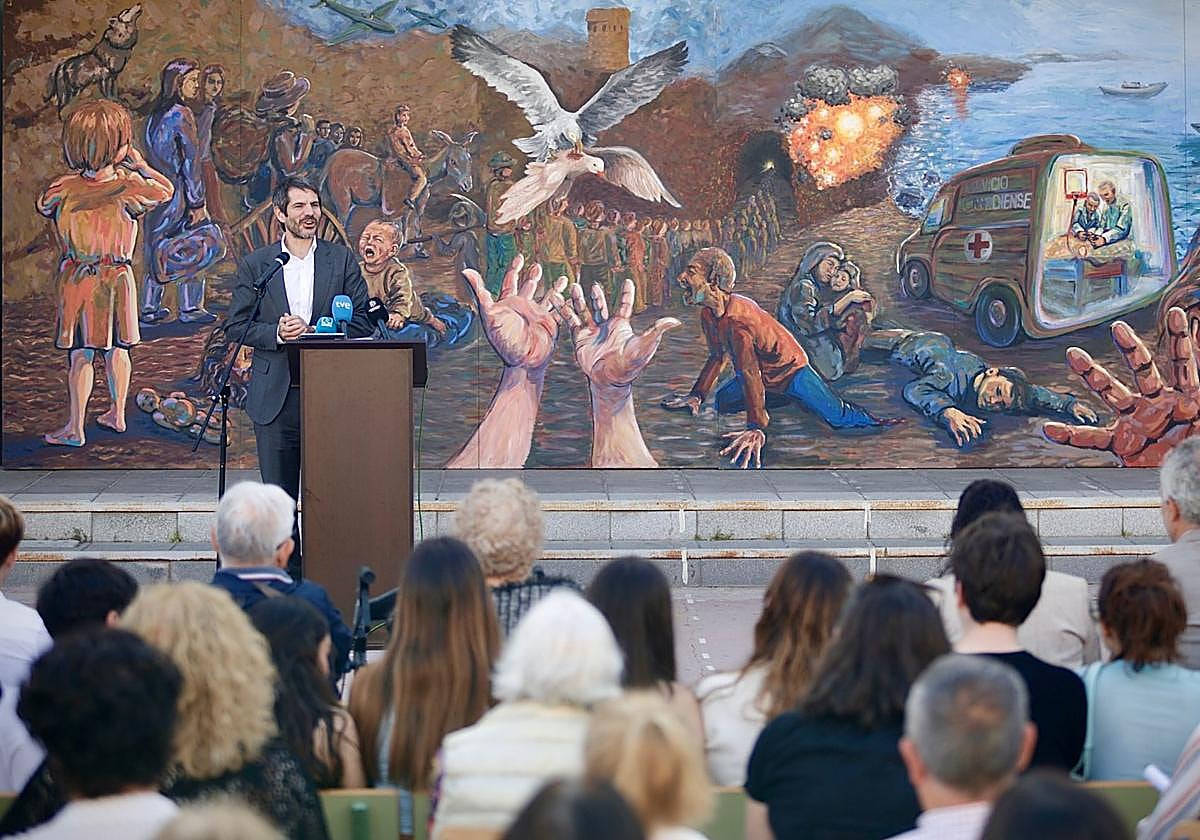
Because of its large format and what it depicts, it is reminiscent of Picasso's Guernica, but in colour. Instead of cubism, surrealism and expressionism, ... the creators of the mural inspired by La Desbandá, one of the darkest episodes of Spain's Civil War, the students of the Ben Al Jatib secondary school in La Cala del Moral, on the eastern Costa del Sol, opted for realism.
The events it narrates were bloody, terrible: cannon fire and bombardments against the civilian population that fled Malaga and the rebel troops as they entered the city in February 1937, hoping to reach the relative safety of Almeria. Many travelled on foot with nothing more than the clothes on their back and the few items they were able to take with them as they abandoned their homes.
References
The mural shows the ambulance of Norman Bethune, a Canadian doctor who was in the International Brigades and who helped the people who suffered the attacks; the impact of a shell in one of the Cantal tunnels, not far from where the school now stands and the metaphor at the centre of the composition: a seagull attacks a white dove, the symbol of peace.
There is also a woman next to a crying baby and a walking girl. She could well have been Armonía Lamas, a survivor of La Desbandá who was just four years old when her family fled. Lamas was the protagonist of the mural's inauguration ceremony, which was officially presided over by the Minister of Culture, Ernest Urtasun, together with Miguel Briones, education spokesperson at the Andalusian regional government and Belén Gutiérrez, the councillor for culture at Rincón de la Victoria town hall.
"This girl has to say her name is Maria, otherwise she can't go out".
Armonía, with relief, said that, in reality, her memories of La Desbandá are minimal, as she was very young. This does not mean that the experiences of those days have not always been with her, from what her mother told her and from what she herself experienced afterwards.
When she took the floor amidst applause, she explained how her family had to leave Ronda, from there, to San Pedro de Alcántara, then to Malaga city, from where the headed along the east coast and eventually made it to Valencia. She spoke of the time she was looked after by strangers until she was reunited with her family, and anecdotes such as how she had to hide her name, as she is not named after a saint and sounde "red" a refernec to the Republican movement. "This girl has to say her name is Maria, otherwise she can't go out," Armonía recalled.
The grandchildren
One of the artists, Rubén, said: "The grandchildren are not looking for revenge, nor resentment; only memory," adding: "I am here thanks to the arms of someone who put my grandmother in a van". Schoolteacher Antonio Gallero sad, "It has been a hard adventure, but a wonderful one."
"It is a restorative and healing conversation and a lesson for the whole of Spain".
Urtasun congratulated all those who made possible what he described as "a restorative and healing conversation" and "a lesson for the whole of Spain". He went on to say, "It is one of the events that has moved me most since I have been a minister."
To finish, a group of students and teachers, the Coro Lorquiano, performed a live original composition, dedicated to La Desbandá and entitled '200 kilometres of misery', by Juan Carlos Ordóñez. The third stanza of this piece reads: "The exodus flows without end, the wind shouts its pain, fear is all around, no one knows where to flee".
![[]](http://static.vocstatic.com/voc26/latest/assets/images/favicon/surinenglish/apple-touch-icon-57x57.png)