
Nature
Mountain goats bid farewell to summer with further night-time visits to Canillas de Aceituno
Rocío Ortiz has once again documented the night-time visits by Duke and other animals that make their way down from La Maroma to the Malaga province village
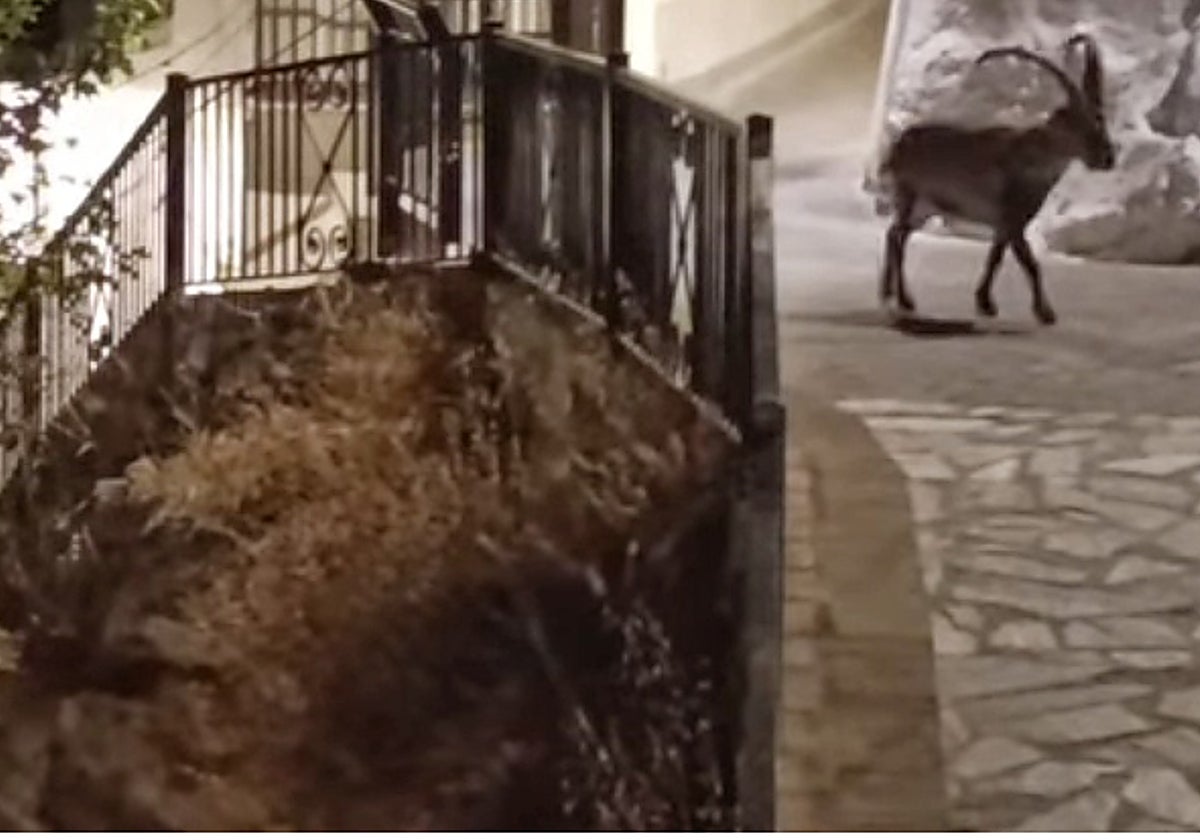

When the streets of Canillas de Aceituno in Malaga province's Axarquía area are practically deserted and the temperatures begin to cool down in the ... September evenings, some visitors appear who are already becoming a familiar sight to local residents.
The mountain goats, or Spanish ibex, have started to come down into the village in the early hours of the morning, in search of vegetation and quiet spots.
The scene has once again been captured by Rocío Ortiz García, a local resident who enjoys photographing the natural world and the traditions of her village. It is the same woman who, over the last two summers, has documented the night-time forays of several goats through the upper part of the village and has even given them names.
The one she recognises most easily is still Duke, a large male that Rocío has been observing since the summer of 2025 . “When dawn breaks over Canillas de Aceituno, the village’s most special and majestic neighbour arrives,” says Ortiz, who describes how the animal descends from the area around La Maroma and makes its way through the streets when there is hardly any human activity.
Duke is once again walking through the upper part of Canillas de Aceituno, this time accompanied by another, younger goat in the early hours of the morning
On one of his most recent appearances, Duke was accompanied by another, younger specimen. Ortiz explains that the adult initially walked past one of the trees where he usually feeds and remained alert while the second animal approached. “It came to a sudden halt, standing upright, staring intently and waited patiently,” she explains, describing a sequence she was able to follow from a short distance with her camera.
The younger animal eventually made its way to the oak where Duke had grazed on previous visits. Rocío interprets Duke's movements as a form of guidance for the younger one. "Every movement served as a guide; the younger one copied every gesture," she explains.
Millón Cave
This is not the only scene that Ortiz has managed to film over the last few weeks. A few days earlier, she also spotted Spirit – the name she gave last summer to another young mountain goat that had begun to accompany the adults along Calle Convento and the surrounding area. On this occasion, she saw it feeding near the so-called Cueva Millón while another male remained perched high up.
Rocío believes that these sightings offer a glimpse of behaviour that normally goes unnoticed by those who walk through the mountains during the day. “Being able to witness these moments is a fleeting gift that nature bestows only upon those who know how to observe in silence,” says Ortiz. For her, Duke and the other animals are now part of the night-time landscape of Canillas de Aceituno, which has a registered population of just 1,900 humans.
Local residents started to notice the goats' frequent visits during the summer of 2025. During those initial forays, the animals mainly approached a mulberry tree, a loquat tree and other vegetation situated next to the houses to feed during the quieter hours of the day.
The Tejeda and Almijara mountain ranges, where La Maroma rises to an altitude of 2,069 metres, are a natural habitat for the ibex
The geographical explanation is obvious. Canillas de Aceituno lies in the foothills of the Sierras de Tejeda, Almijara and Alhama Natural Park, an area of over 40,000 hectares straddling Malaga and Granada provinces. The Andalusian regional government itself points out that these mountain ranges constitute one of the main habitats for the Spanish ibex and that the species is currently undergoing a period of expansion in the area.
La Maroma also dominates the entire landscape from its height of 2,069 metres, the highest point in the natural park and in the province of Malaga. The mountain goat is one of the most iconic species in the protected area, and its historical importance was such that its presence led to the creation of the Tejeda and Almijara National Game Reserve in 1973.
In the early hours of the morning
The frequent visits illustrate the narrow boundary between the Axarquía village and the mountains. While this is a striking sight for many local residents, the regional government recommends not feeding wild animals or leaving food scraps that might attract them to inhabited areas, a measure designed to prevent the animals from altering their natural behaviour patterns.
Meanwhile, Rocío Ortiz continues to keep watch in the early hours of the morning, on the lookout for any movement amongst the rocks, trees and streets in the highest part of Canillas. “They don’t just inhabit the mountains; they walk among us,” she sums up. Duke, Spirit and the other goats continue to show the coexistence between the populated areas of the Axarquía and the wildlife of La Maroma.
![[]](http://static.vocstatic.com/voc26/latest/assets/images/favicon/surinenglish/apple-touch-icon-57x57.png)