
Health
27 years of suffering and a rejected request for euthanasia for Torre del Mar man: ‘I can’t take it any more’
Following a workplace accident in 1999 and 36 operations, 49-year-old Javier Santana from the eastern Costa del Sol town is dependent on fentanyl and is calling on the Andalusian health service to arrange an urgent referral to a specialised pain unit in Valladolid
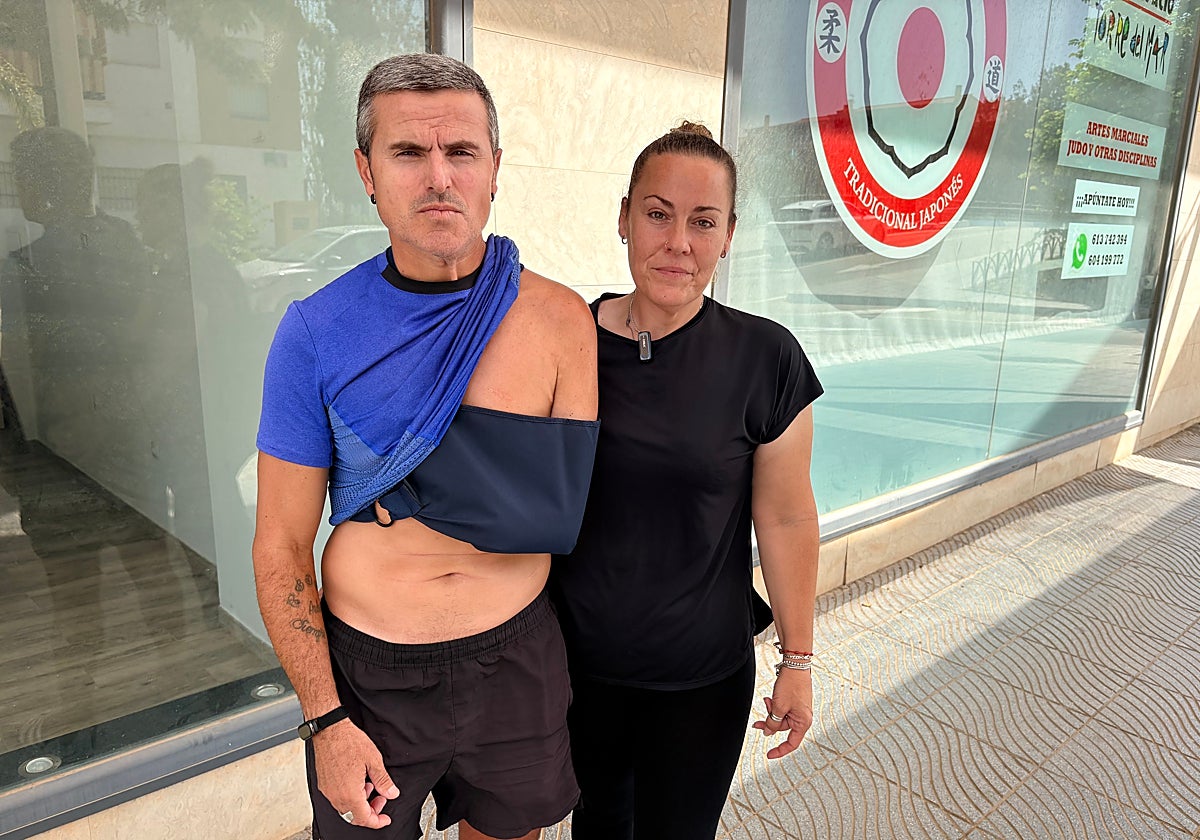

Javier Santana, a 49-year-old resident of Torre del Mar on the eastern Costa del Sol has been living with pain since 1999 that “ ... has become unbearable”. “I can’t take it anymore,” he says, after receiving notification that his request for euthanasia, made in April, has been rejected. The reason? Doctors believe there are still treatments he could undergo to alleviate the pain he is suffering.
A workplace accident on a building site crushed his left hand in October 1999, when he was just 22 years old. After months of being unable to move, he was diagnosed with reflex sympathetic dystrophy (RSD), or Sudeck’s syndrome, a rare condition that causes disproportionate pain, swelling and loss of mobility in the affected limb.
In 2003, his arm was partially amputated below the elbow, but he continues to suffer severe pain and relies on fentanyl several times a day "just to survive". Fentanyl is a potent synthetic opioid used in medicine as a painkiller to treat severe pain and as an anaesthetic. It is between 50 and 100 times more potent than morphine, which is why its administration requires strict medical supervision.
Javier Santana has been recognised as having a total incapacity and a 62 per cent disability. “They fitted my plaster cast incorrectly and that triggered Sudeck’s disease,” he claims. He received around 100,000 euros in compensation after fighting a legal battle for over a decade against the Andalusian Health Service (SAS).
After 27 years of pain, an amputation and dozens of treatments, Santana requested euthanasia, but her request was rejected
A local initiative, backed by the Torre del Mar mayor’s office, funded several private treatment programmes in Barcelona and Paris, among other places, but without a satisfactory outcome for Santana, in the early 2000s. “I’m still in excruciating pain,” he says, having tried nerve blockers, neurolysis, capsaicin, acupuncture, homeopathy and a pain relief pump.
In April, Santana requested euthanasia, a “very difficult” decision. His request was rejected on the grounds that there were still treatment options available, although he claims to have tried them all. “I’m at a loss, outraged and devastated. How can the health system deny me a right that is mine and prevent me from putting an end to the harm they have caused me?” he asks.
His wife supports him ‘whatever he does’
The Spanish Law 3/2021 provides for assisted dying in cases of incurable diseases or chronic and debilitating conditions. It requires medical assessments and oversight by a regional commission. Santana's doctor in Torre del Mar objected and a consultant issued an unfavourable report, which Santana appealed against. “I have nodules, my elbow is in a bad way after so many years, the reality of my life is that there are no treatments to cure me, there is nothing. The pain and suffering are increasing all the time, and I simply cannot go on like this,” he explains.
His wife, Silvia Burrezo, with whom he has three children aged 26, 21 and ten, would prefer him to carry on living, but she will support him "whatever he decides" if he is eventually granted euthanasia. ‘I’d like them to help him carry on living, but I’m going to support him because I’ve been fighting alongside him for 27 years and I know the suffering and pain he’s been enduring; he’s on fentanyl 24 hours a day and thousands of medications that are uncontrollable and he can’t bear it any longer,” she says. Santana takes part in adapted running, cycling and swimming. “I haven’t actually competed, but I have had exercise routines; however, it’s getting harder and harder for me because of the terrible pain I have in my arm,” he says.
He is now relying on public healthcare in Valladolid. The family are asking for him to be referred there and for a healthcare professional from Malaga to be trained in the technique. “I’m not in a position to keep travelling there," he explains. He also has fractures to his elbow and humerus, which makes his daily life even more difficult.
He is prepared to return to the pain unit at Malaga city's Hospital Civil before submitting another request for euthanasia. “I’m 49 years old and I’ve spent more than half my life in this agony. I can’t take it any more,” he says. “If I keep quiet, everything we’ve been through so far will have been for nothing; I feel as though I’m being taken for a ride, because they’re telling me to go back to the pain unit, where since 2018 they haven’t given me any new treatment, just the capsaicin patches, and I simply can’t take it any longer,” he insists.
“Dystrophy or Sudeck’s syndrome involves damaged nerves and they’ve always approached my case from the perspective of my arm or armpit, hiding behind treatments that have nearly cost me my life,” he says. “I’m at a dead end,” he insists. Supported by his wife and three children, the family is asking the SAS for an urgent appointment and a referral to Valladolid. He does not rule out taking legal action if the new treatment fails and they continue to refuse him euthanasia.
“We’re going to keep fighting until the very end, because he deserves to be granted this – whether he decides to go through with it or not, as it will be his final decision – he’s asking for something that the law protects, just as we are fighting to ensure he receives the treatment in Valladolid, we will fight for him to be granted euthanasia, so that when the day comes that he can no longer carry on, he can rest in peace,” says Silvia. Javier admits to having suicidal thoughts, but believes that suicide is “for cowards”.
Santana has not ruled out making a further request for euthanasia or taking the matter to court, while calling for urgent access to the treatment in Valladolid
The non-invasive therapy the family wishes to access is led by Federico Montero Cuadrado, coordinator of a unit that combines pain neuroscience, exercise and functional rehabilitation at his practice within the public health system in Valladolid. The family is considering appealing against the refusal of euthanasia with the association Derecho a Morir Dignamente (right to a dignified death - DMD). “I have contacted them and they find the contradictions and responses from Seville absurd, saying that I have an illness that I am suffering from but that, at the same time, it is not an illness,” he says.
Santana rejects the idea that the fentanyl medication is to blame: ‘They’re pressuring me to give it up, because as there’s nothing to cure me, they don’t want it to be one thing or the other; I can’t just sit here like a broken doll trying out different treatments. Now it turns out that the only problem is the fentanyl, after the illness has cost me a plaster cast and 36 surgical operations, and I’m on high doses of fentanyl – when it’s actually a rescue dose, which you take when you’ve got a patch on; I’ve never used one, I only take it orally.”
“Thanks to fentanyl, I’ve been able to stay alive; after getting used to it for 20 years, they want to take it away from me and it’s the only thing that keeps me going out of everything I’ve tried. If they cut my dose, how are they going to ease my pain?” he asks.
DMD recorded 1,284 requests for euthanasia in Spain and 565 cases granted in 2025, along with 364 deaths before the bureaucratic process was completed.
![[]](http://static.vocstatic.com/voc26/latest/assets/images/favicon/surinenglish/apple-touch-icon-57x57.png)