
History
The men who carried people across the river on their backs: the forgotten trade of a Malaga village
Historian and researcher José Antonio Ponce brings together in a new documentary memories of the former 'vadeadores', the men responsible for carrying people across the River Vélez in the Axarquía until a bridge was built in 1972
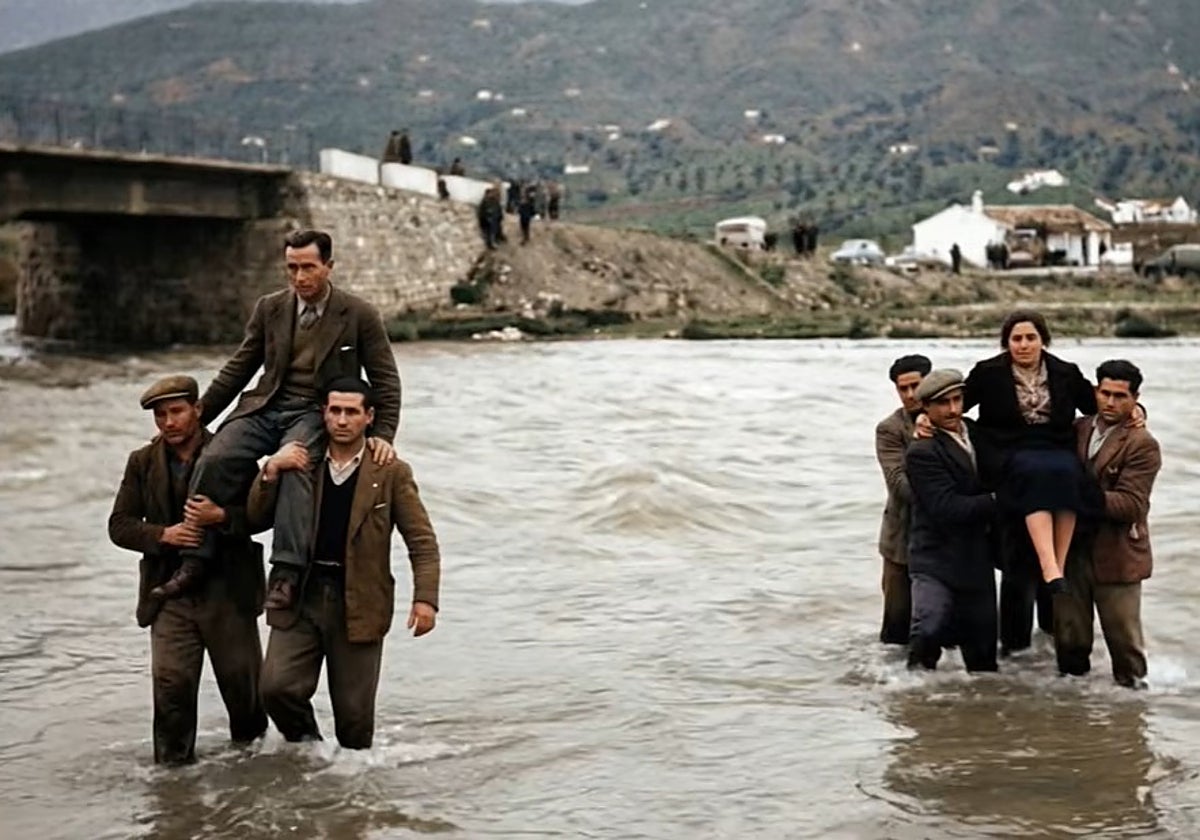

There was a time when crossing the River Vélez in the Axarquía area of Malaga province was not as simple as walking across a bridge. ... When the rains came and the water level rose, many residents of villages like Benamocarra and Iznate had to rely on the men who waded into the water to carry them on their backs to the other side.
The men were known as ‘vadeadores’ and this forgotten trade is now being brought back to life through a documentary by local historian and researcher José Antonio Ponce in his new documentary, entitled 'Los vadeadores de Benamocarra: los hombres que desafiaban las aguas del río Vélez' (the Vadeadores of Benamocarra: the men who braved the waters of the River Vélez’), published on his YouTube channel ‘Historias de Málaga’. The film brings together testimonies and stories from a time when the lack of infrastructure shaped daily life for much of the inland Axarquía.
For decades, the inhabitants of Benamocarra, Iznate, Almáchar and El Borge had to use the riverbed to travel to Vélez-Málaga, the main commercial and administrative centre of the Axarquía. In summer, the crossing was relatively easy, but when it rained before La Viñuela reservoir had been built, it was often impossible to cross.
According to Ponce Almáchar and El Borge secured a road link in 1955, while Benamocarra had to wait until 1972 for a bridge to be built to improve its transport links. Until then, visiting the doctor, buying food or carrying out any administrative tasks could prove hazardous.
It was precisely this need that gave rise to the work of the river crossers. They were local residents, mostly from Benamocarra, who knew the river’s behaviour well, its currents and the places where it was least dangerous to cross. José Vigo Berenguer, one of the key figures interviewed by Ponce for his work, recalls that there were at one point around twenty men working, responsible for carrying people on their shoulders or on their backs when the water rose. There was no set fare; each person paid what they could or what they thought was appropriate and for the vadeadores it was a way of earning a little money in years when job opportunities were scarce.
Accounts from vadeadores reveal how they transported people and the sick across the riverbed, with no fixed fare and at their own risk
Another of the testimonies collected by Ponce is that of Manuel Zamora, who recalls the difficulties of a trade for which physical strength alone was not enough. One had to know how to swim, recognise changes in the river’s course and maintain one’s balance while carrying a passenger. Zamora also emphasises the spirit of solidarity that characterised the work: those who had money would pay, but people who could not afford to pay were also given help. On occasions, these crossings were the only way to access healthcare.
Particularly moving is the account given by Joaquín Lucena, who spent nine winters working in this trade. He recalls whole days spent with his clothes soaked through, warming himself by a bonfire while waiting for new passengers to arrive. At the end of the day, his colleagues would pool the money they had earned and share it out between them.
One of the experiences that made the greatest impression on him was the night-time transfer of a seriously ill woman. Five men took part in the rescue: one lit the way with a lantern while the other four carried the stretcher. They managed to reach a vehicle that was waiting to take her to a hospital in Malaga city. The woman survived and in gratitude gave them 300 pesetas (about 1.80 euros today), which they shared between the five of them.
Storms
The situation became particularly dire during storms. The documentary identifies one of the most difficult periods as the autumn of 1963, when prolonged rainfall left Benamocarra virtually cut off and caused difficulties in the supply of food and medicines. The mayor at the time even appealed to the governor of Malaga to demand a solution.
Work on the long-awaited bridge finally got under way, although the project suffered a major setback in February 1969, when a flash flood destroyed it. The temporary footbridges installed afterwards were also unable to withstand the rains in September of that same year, meaning that local residents had to continue relying on the vadeadores’.
The priest José Barroso played a prominent role in that campaign; he arrived in Benamocarra in October 1963 and remained in the town for nearly six years. Aware of the difficulties faced by the local residents, he brought the situation to the attention of his friend, the Malaga-based journalist Alejo García, to whom he provided photographs of the vadeadores transporting people across the river. The publication of that story on the front page of a Madrid newspaper helped to raise awareness of the problem.
Years later, the priest himself would recall that, following the publication of the news, the administrative procedures for building the bridge were speeded up considerably. This episode is also recorded in a compilation of the local history of Benamocarra published in 2011. At the entrance to the current bridge there is also a ceramic plaque, installed when Ponce was mayor of El Borge, commemorating this achievement by the parish priest.
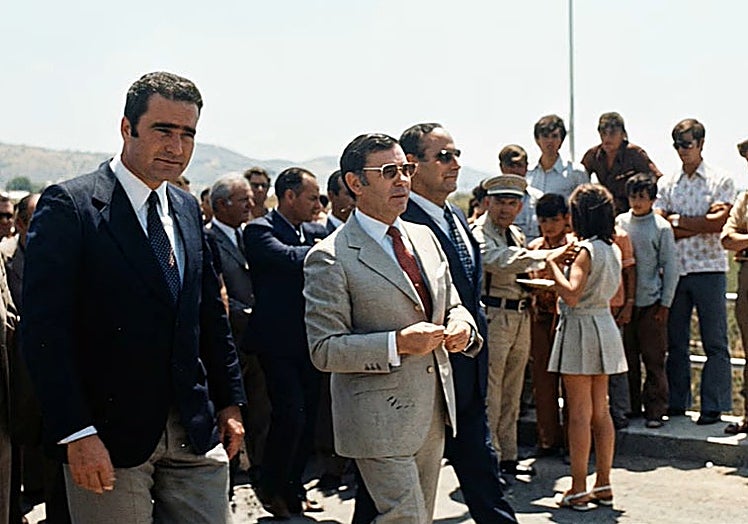
The definitive solution came in 1972, when the new bridge over the River Vélez was opened. According to the documentary produced by Ponce, the ceremony was attended by the civil governor, Víctor Arroyo; the president of Malaga's provincial authority, the Diputación de Málaga, Francisco de la Torre (the current mayor of Malaga city) and the then mayor of Vélez-Málaga, Alfonso López.
The opening of the bridge put an end to a prolonged period of isolation and led to a significant improvement in transport links with Vélez-Málaga. Behind them lay years of complaints, flooding and hardships for the inhabitants of these inland municipalities of the Axarquía.
Pressure from local residents, José Barroso’s photographs and the press helped to build a bridge that put an end to decades of isolation
As Ponce recalls, improvements to transport links continued over the following decades, until the road connection to Almáchar and El Borge was also completed in 1996.
More than half a century after the bridge was opened, the figure of the vadeadores continues to form part of Benamocarra’s collective memory. The town even has a street named after them. José Antonio Ponce’s documentary uses artificial intelligence tools to bring to light names, experiences and situations that help us understand what life was like in the Axarquía before the arrival of modern infrastructure. Men such as José Vigo, Manuel Zamora and Joaquín Lucena represented, for many years, much more than simply a way of crossing the river: they provided a lifeline for their villages in times of need.
