
XL: The Long Read
80 years of flight attendants – fasten your seatbelts: anecdotes, challenges and what really goes on in the toilets...
Marriage requests, a disoriented traveller, a pig running through the corridors… eight decades in the trade in Spain are enough for a lifetime of anecdotes about working at an altitude of ten thousand metres
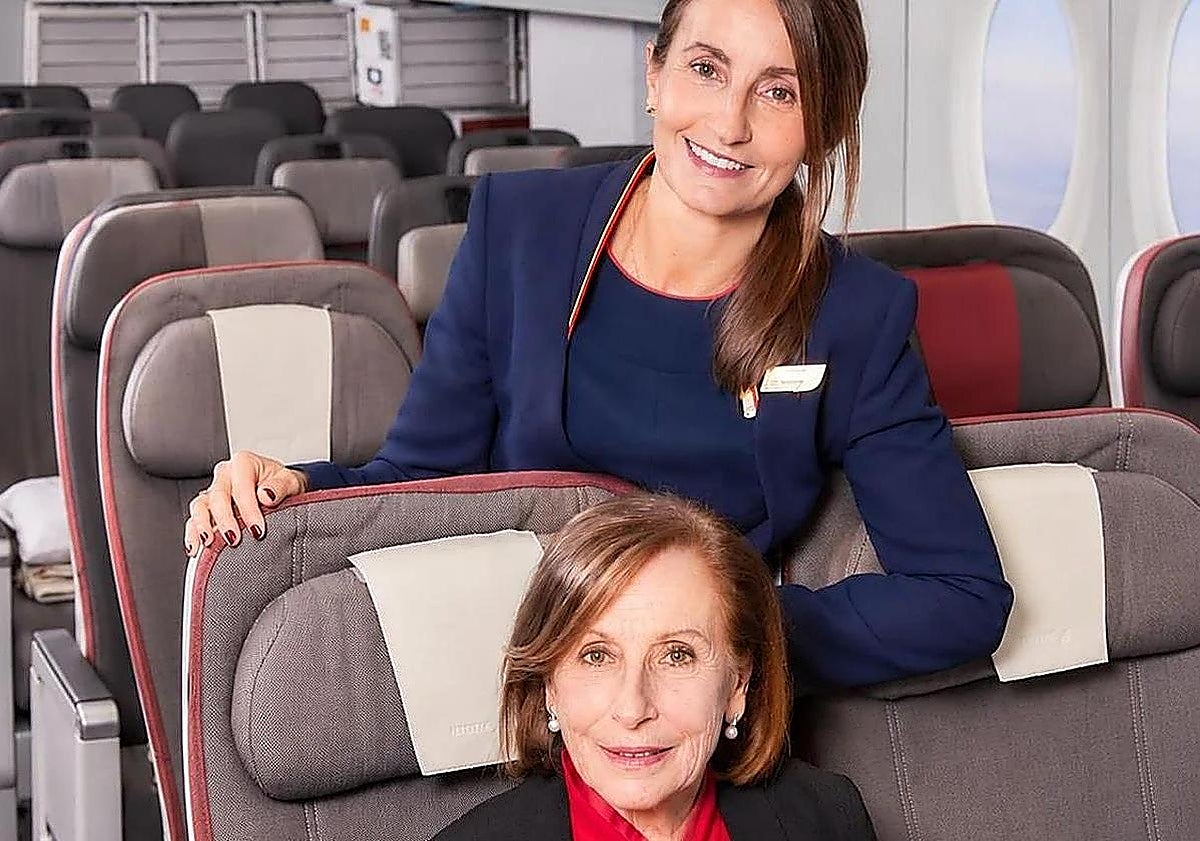
José Antonio Guerrero | Photography: Pedro Walter
Whenever Lourdes Arregui put on her uniform, her daughter Itziar knew it was time to say goodbye. The Iberia minibus would come to pick up ... her mother to take her to Barajas, and in the little girl’s mind, the uniform and her mother’s absence became permanently linked.
“Mum, don’t get dressed for the minibus,” Itziar would say to her. Lourdes flew with Iberia for 38 years, from 1968 to 2006. She clocked up 25 million kilometres – the equivalent of travelling to the Moon and back 30 times, or circling the Earth 670 times.
Itziar, aged 47, has been a flight attendant for 20 years, the last ten of which with Iberia, but the two never worked together on a flight: when Lourdes retired, Itziar was just starting out with the airline.
Mother and daughter are united by their love for a profession that has just celebrated its 80th anniversary in Spain and, as well as ‘jet lag’, they share eyes as green as the Northern Lights, which have soothed the nerves of many passengers up there.
Lourdes began flying in a small Fokker with just two pilots and herself as the only other crew member. They flew routes between the Canary Islands and a route they called ‘El Caribillo’, with connections to the mainland and stopovers in Sidi Ifni, the Moroccan city that belonged to Spain at the time.
On one occasion, a mechanical fault forced them to disembark, and at the very same airport a man spotted that feisty twenty-something and asked the captain how many camels he wanted for her. ‘He wanted to swap me for fifteen camels,’ she recalls with a laugh.
Then came the transatlantic flights (including the Jumbo) until her retirement as a senior cabin crew member – in charge of the cabin crew – on board an Airbus A340. She flew to New York, Santiago de Chile, Lima, Buenos Aires… and back again.
She’ll never forget that return flight from South Korea with the Spanish national team players after they’d been knocked out of the 2002 World Cup. “They were all really downhearted. That flight was absolutely heartbreaking.”
A native of Oñati in Guipúzcoa, born in 1946 and a Basque speaker, Lourdes studied international secretarial studies in Bilbao and, upon graduating, went to Paris to perfect her French, and later to London to learn English – something very unusual in Spain in 1967.
It was in England, in fact, that the light bulb went on for her when a classmate said in class that she wanted to speak English so she could become a flight attendant. “I’d idealised that profession. I’d never considered it before, but right then I said to myself: ‘If this girl can do it, so can I’.”
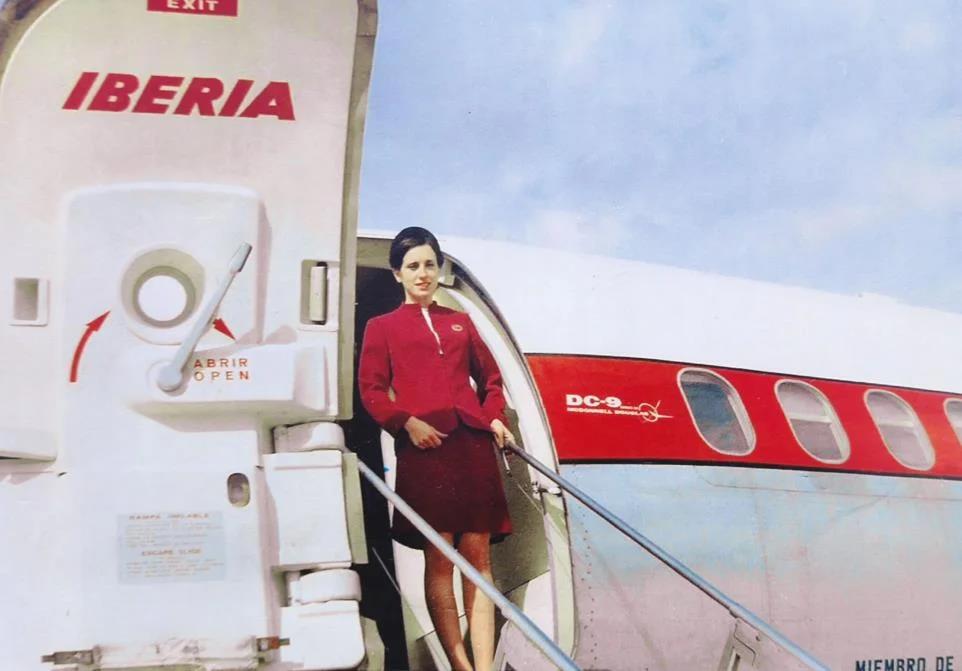
Back in Spain, she worked at the reception desk of the Monte Igueldo Hotel in San Sebastián, and six months later she joined Iberia as a flight attendant, becoming part of a select and small group where women spoke foreign languages, travelled abroad, earned a fortune and wore haute couture uniforms (she started in Pertegaz’s royal red and retired in Adolfo Domínguez’s midnight blue), drawing admiring glances wherever she went.
In those days, passengers wore suits and ties, almost as if they were going to a wedding (“nowadays there are young people who get on board in swimming trunks and flip-flops,” notes Itziar), and at the northern airports they were welcomed with a hot broth and an assortment of pintxos. “We were like a family,” sums up Lourdes.
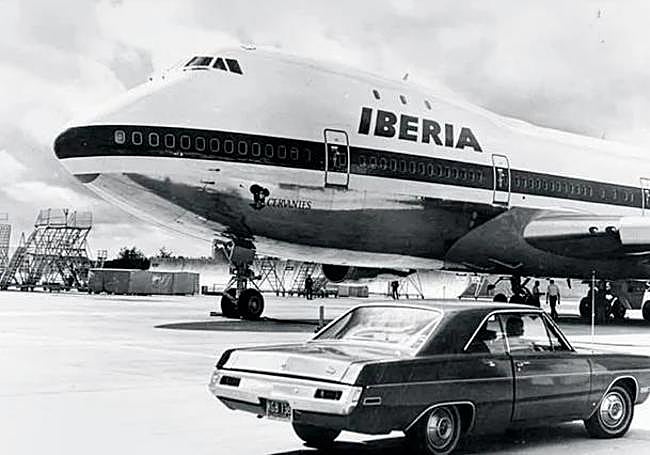
THE JUMBO LOBSTER MENU
There was a time when there was something even better than flying first class: flying in ‘Gran Lujo’ – written in capital letters because the exclusivity of the services was unrivalled. Proof of this was the menu served to the privileged passengers of the legendary Jumbo (the enormous Boeing 747 that Iberia stopped operating in 2006), who occupied the ‘Gran Lujo’ cabin, situated in the ‘hump’ of the aeroplane, that upper deck which became its hallmark. On a flight in the 1970s between Santiago de Chile and Madrid, the ‘Gran Lujo’ passengers were treated to a menu of no fewer than 30 courses, including turtle soup, lobster medallions and roast leg of lamb. A chef carved the sirloin steak in front of these VIPs, whilst a security guard kept watch over the portions of beluga caviar, which were then served with vodka and crushed ice.
That life, of course, came at a price. Lourdes brought up her four children (all of whom now work for Iberia, two of them as pilots) whilst criss-crossing the skies. Maternity leave lasted barely forty days, and phoning home from the other side of the world was an ordeal.
On trips to Buenos Aires, she could be away for six days and would spend hours glued to the hotel phone trying to get through to her family. "I found it really hard being separated from my children. With each one, I thought about giving it all up."
Even so, she didn’t: “I’m glad I didn’t. I’ve got to know loads of cities, cultures and people from every continent.” She also says that one of the hardest things about her job was the nights, the constant time changes, and the jet lag on the way there and back. “It took its toll on your body because you’d change time zones four or five times a month. It left you completely knackered.”
Her secret formula for not collapsing from exhaustion was “trying to sleep”. “My obsession was to rest whenever I could,” she says. “Back in my day, we used to sleep on the plane, sitting in a sort of tiny cubicle.” Nowadays, aeroplanes have compartments with bunks for the crew and their corresponding statutory rest periods to ensure they’re ‘alert’ in the event of any emergency.
Although Itziar associated the Iberia minibus with her mother’s departure, she doesn’t feel any trauma. “When my mother was at home, she devoted herself entirely to us. All her time was for us,” she explains. Now it is she who ‘suffers’ the goodbyes.
She has two children, aged 11 and 12, and being apart is still hard, although technology helps her cope better. “I can talk to them at any time of day, but even so, you’re on a fourteen-hour flight, you’re going to the other side of the world and you find it tough,” she admits.
On 24 December, they landed in Lanzarote. “The Canary Islands? But I was supposed to be going to Rome for Christmas Eve,” one passenger said to Itziar
Itziar, who has been a senior cabin crew member for four years, mainly flies to Latin America and the United States. She followed in her mother’s footsteps, who in turn had followed in the footsteps of those first female flight attendants who made their debut on 15 October 1946 on an Iberia flight from Madrid to Buenos Aires – a 36-hour journey with several stopovers.
Those four flight attendants were Ana Marsans, Marichín Ruiz de Gámiz, Pilar Mascías and María José Ugarte.
Today, that flight is a direct one and takes thirteen hours. Of course, a lot has changed, but, just as it was yesterday, safety continues to be the focus of the cabin crew’s five senses – the official title for flight attendants. Above all, cabin crew are trained to respond to emergencies, evacuate an aircraft, deal with a fire or administer first aid.
Itziar experienced this first-hand recently in São Paulo: minutes before take-off, a passenger with heart problems became very anxious and said she didn’t want to fly. The senior cabin crew member alerted the captain, spoke to her, reassured her, managed to calm her down, and they were finally able to take off. “Empathy is what sets us apart… When a passenger boards an Iberia flight, they feel at home, and I think that’s down to the way we treat people and because we always try to help in any way we can,” says Itziar.
That ‘whatever it takes’ attitude involves helping passengers in unusual predicaments such as the one that arose on the morning of 24 December on a flight to Lanzarote. “When we landed, a man said to me: ‘The Canary Islands? But I was supposed to be going to Rome! I can’t believe it. My whole family is waiting for me to celebrate Christmas Eve’.” Itziar, together with Iberia’s ground staff, went out of her way to ensure the man reached Rome on time. She succeeded.
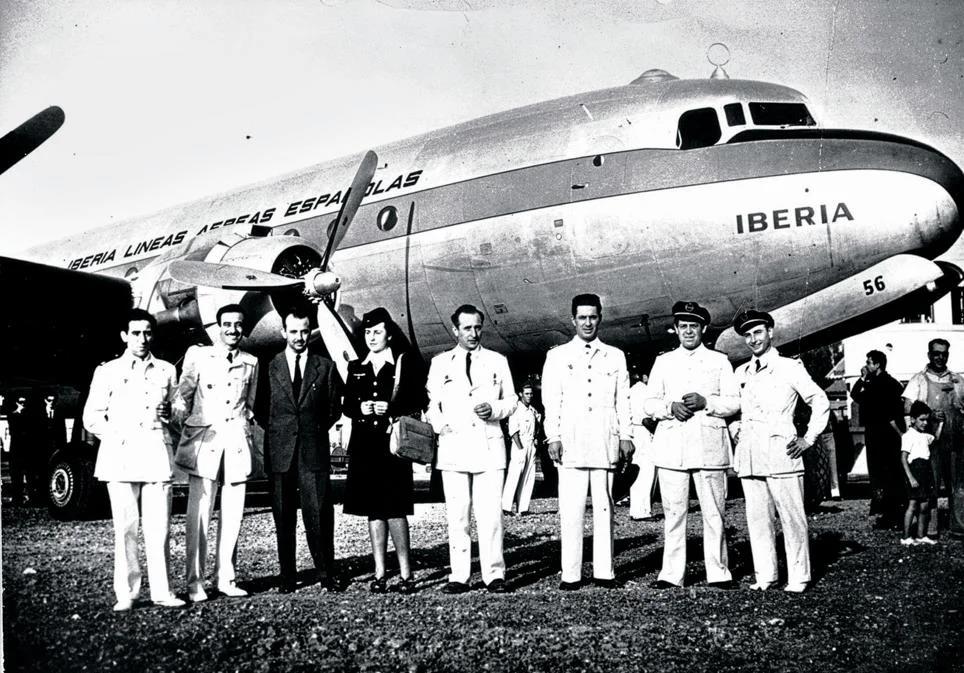
HOSTESSES TO TREAT YOU LIKE A KING
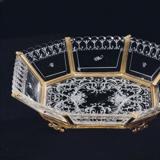
At first, the role performed by flight attendants didn’t even have a name. A few options were considered, such as ‘aeromoza’, ‘camarera’ or ‘mayordoma’, but it was Iberia’s first managing director, César Gómez Lucía, who chose the term ‘azafata’. Historically, the term referred to the ladies-in-waiting at court who were responsible for safeguarding the ‘azafate’ (pictured), a small basket in which the queen’s jewellery was kept. By reviving this elegant archaism to describe the women who looked after passengers on board, Gómez Lucía sought to convey the idea that travellers should be treated like royalty.
Both mother and daughter cherish stories and encounters on board with people they admired. “I was absolutely thrilled to meet Pau Gasol and Marian Rojas Estapé,” says Itziar. And Lourdes recalls when she used to fly Julio Iglesias to Miami… “before he had his own plane, ha ha ha.”
And, whilst we’re on the subject, one can’t help but ask them about the – urban legend? – of sex in the toilets. “It’s never happened to me,” says Itziar. And her mum chimes in: “I’ve seen couples going into the loo, but whatever might have gone on in there… I don’t know and I don’t care.”
The two flight attendants have had to deal with the nerves, impatience or bad temper of certain passengers. The one who complains because the person next to them is snoring, the one who gets upset by a crying baby, or the one who protests because the person in front has reclined their seat and is pressing against their knees… A lot can happen on long-haul flights.
“An aeroplane can be a hostile environment; everyone boards with their own problems. Some people get nervous, and we try to turn the situation around so they feel as comfortable and at ease as possible,” says Itziar.
You also have to deal with situations that aren’t covered in any emergency manual. Francisco Rueda, a senior cabin crew member since 1988, head of Iberia’s 4,062 cabin crew members (67 per cent of whom are women) and an expert on the company’s history, recounts a ‘mess’ that was resolved with elegance.
A flight attendant found a set of false teeth in a toilet and, in order to find the owner, had to do so without drawing attention to herself. ‘She had the idea of walking slowly down the aisle with a smile on her face, and everyone smiled back at her… but there was one person who didn’t, and she, very discreetly, whispered in their ear: “Excuse me, you’ve lost something.” And that’s how she sorted it out.’
Today it would have been more difficult because, as Itziar points out, passengers only have eyes for their screens. But when faced with turbulence, strange noises or any sudden movement of the fuselage, we all still seek reassurance in the flight attendant’s gaze. She conveys confidence and calm. And safety. And that hasn’t changed in 80 years.
SOLE BOEDO, 90 YEARS OLD AND AIR HOSTESS BETWEEN 1959-1966
Now in her 90th year, Marisol, ‘Sole’, from Boedo, retains the poise and natural elegance of that young woman from Iberia who met Franco on a DC-4, saw a pig escape down the aisle of a Bristol, and turned her stopovers in New York into an opportunity to enjoy the opera at the Metropolitan. For seven years, between 1959 and 1966, Sole explored the world whilst in Spain women barely ventured out of the house.
Sole admits that she became a flight attendant purely by chance – a stroke of luck that turned her life upside down… ten thousand metres up in the air. Sole was born in La Coruña in 1936, although she had been living in Madrid since she was six.
Her father, a lawyer, had passed away. Having just turned 20, she was attending classical ballet classes and one day, whilst waiting for the tram, she bumped into a former school friend who told her she was preparing to sit her flight attendant exam. Sole had no idea about that world, but she was suddenly filled with excitement and asked curiously, ‘And what do I have to do?’ ‘Speak languages,’ her friend replied.
She set about learning English and, within six months, had learnt it so well that she even translated a book. She had already learnt French at secondary school, so she set about perfecting it. She sat the Iberia exam and passed it.
She joined Iberia in 1958 and made her first flight in 1959, aged 23. In 1966 she got married, and due to the employment regulations of the time (which required compulsory leave of absence upon marriage), she hung up her uniform.
Those seven years were enough for her to accumulate memories that wouldn’t fit into a suitcase, let alone hand luggage. Some of them were certainly surreal. On a domestic flight, aboard a Bristol (a British twin-engine propeller plane), she made a minor oversight: she left open a door connecting the aisle to the area where luggage – and, on certain occasions, animals – were transported… and the animal on that particular day was a pig.
The thing is, the little pig decided that wasn’t where it belonged "and escaped into the passenger cabin," Sole recalls, bursting out laughing. Suddenly, the passengers saw an animal running down the aisle and were startled. The laughter only began once they’d managed to return the unexpected passenger to its pen.
It wasn’t the only time her job put her nerves to the test. On a flight between Madrid and Barcelona in 1963, she was assigned to look after Franco. Iberia had placed several aeroplanes and their crews at the dictator’s disposal. Sole was on the DC-4, a propeller-driven aircraft, older than the jet aircraft available at the time.
To everyone’s surprise, the general chose her plane of all things. According to the flight attendant, Franco distrusted jet aircraft because he had no way of knowing if one of their engines had stopped working. Propeller-driven aircraft, on the other hand, allowed him to check this visually. And what was he like as a passenger? “Very normal, very proper,” says Sole, who explains that she was so nervous she cannot remember whether she actually served him water or coffee.
The flight attendants of the 1960s were the object of admiration. And Sole, with her slender figure (she is 1.74 metres tall), her command of languages and a huge salary for the time, was the very picture of modernity in a Spain that was still rather grey. “We earned a lot of money. Depending on the number of flight hours, I could earn up to 20,000 pesetas a month – more than a doctor or an engineer,” she says.
Her work took her to London, New York, Mexico City, Buenos Aires, Rio de Janeiro, Santiago de Chile, Caracas… where her stays, between flights, could last several days. In the Venezuelan capital, she stayed at the Club Puerto Azul, an exclusive seaside resort with a beach, golf course, marina and restaurants. For security reasons, they were not allowed to leave the premises.
But it didn’t seem as though they were missing out on anything either. “We lived like royalty,” she sums up. And whilst Caracas was all about relaxation, in New York, as a music lover who adores classical music, she would treat herself to the opera at the Metropolitan.
Between flights, Sole received a rather unusual marriage proposal. “Miss, I want to marry you, and the pilot can marry us right now,” a Mexican passenger blurted out to her over the Atlantic Ocean on the way to Mexico City. And, although more than 60 years have passed, she still laughs at the incident.
Now, at the age of 90, she exercises daily, meditates and studies neuroscience. She also attends regular acupuncture sessions, a practice she has maintained for almost half a century, as she explains, to conserve her energy.
With that same energy, Sole didn’t hesitate to slip into the current Iberia uniform, designed by Teresa Helbig, and pose for this feature (it fitted her like a glove) on a floor of Iberia’s headquarters in Madrid, where cabin crew undertake their training in flight simulators.
When Iberia’s CEO and Executive Chairman, Marco Sansavini, wanted to meet her, he recognised her as part of the airline’s history. And she is. Sole belongs to a generation of women who put on a uniform and set off to travel the world at a time when many other Spanish women were barely allowed to step outside their front door unaccompanied.
She did so by chance, whilst waiting for the tram on her way to a ballet class. Then came the Atlantic, the Metropolitan, Franco… and that runaway piglet dashing through the clouds.
