
Culture
The Titanic’s Malaga passenger and other untold stories: immersive exhibition recreates the legendary sinking
The ship docks at Espacio Sohrlin with an experience that allows visitors to step inside the cabins, listen to the orchestra and relive the shipwreck through virtual reality and the metaverse

“Whilst we’re talking, look: there’s the ‘Diana’ at the bottom of the sea,” says Juan Cruz Ercoreca as he shows a photograph ... of a figure half-buried amongst the wreckage. He shows the image right next to an identical sculpture - the same size and by the same sculptor - displayed in a glass case. It is the so-called Diana of Versailles, a piece from Ferdinand Barbedienne’s foundry that once adorned the first-class saloon above its marble fireplace. Objects such as this one reflect the luxury of life on the Titanic and offer a glimpse of the journey aboard the ‘unsinkable’ ship as depicted in The Legend of the Titanic. The most iconic ship in history docks at Espacio Sohrlin with an immersive exhibition that allows visitors to walk along its deck, step inside its cabins and relive the critical moment when the iceberg struck the hull. It will run, for the time being, until 5 January (general admission, 19.90 euros; family pack, 14.50 euros per person).
The exhibition uses new technologies to immerse visitors in the voyage. From virtual reality headsets to an immersive room with projections on the walls and floors, right through to the metaverse, this is the most comprehensive experience offered by this project developed by MAD Artes Digitales. But it all begins in Southampton, in a recreation of the harbour from which the Titanic set sail on 10 April 1912. During the presentation, ladies in long velvet dresses and gentlemen in top hats strolled around the area; members of three historical re-enactment societies (Antics Recreadors 1900, Retrofuturista Nautilus, Recreación Histórica del Norte) who were accompanying the visitors as first-class passengers on this journey through time to the early 20th century.
A series of display panels reveal interesting facts about the ship’s interior (it is said that in some cabins you can still see the beds, clocks and other decorative objects) and name the key figures in the tragedy. Take Encarnación Reynaldo, a native of Marbella, who boarded as a second-class passenger with a ticket that cost her 13 pounds. It is said that she was on her way to join her sister Luisa, who lived in New York. She survived the sinking, moved to the United States and never returned to Spain. Their stories form the backdrop to a room containing artefacts from the Olympic, the Titanic’s sister ship built by the White Star Line, featuring the same décor and even the same crockery. Also on display there are some replicas used by James Cameron for his famous 1997 film, items from the collection of Juan Cruz Ercoreca.
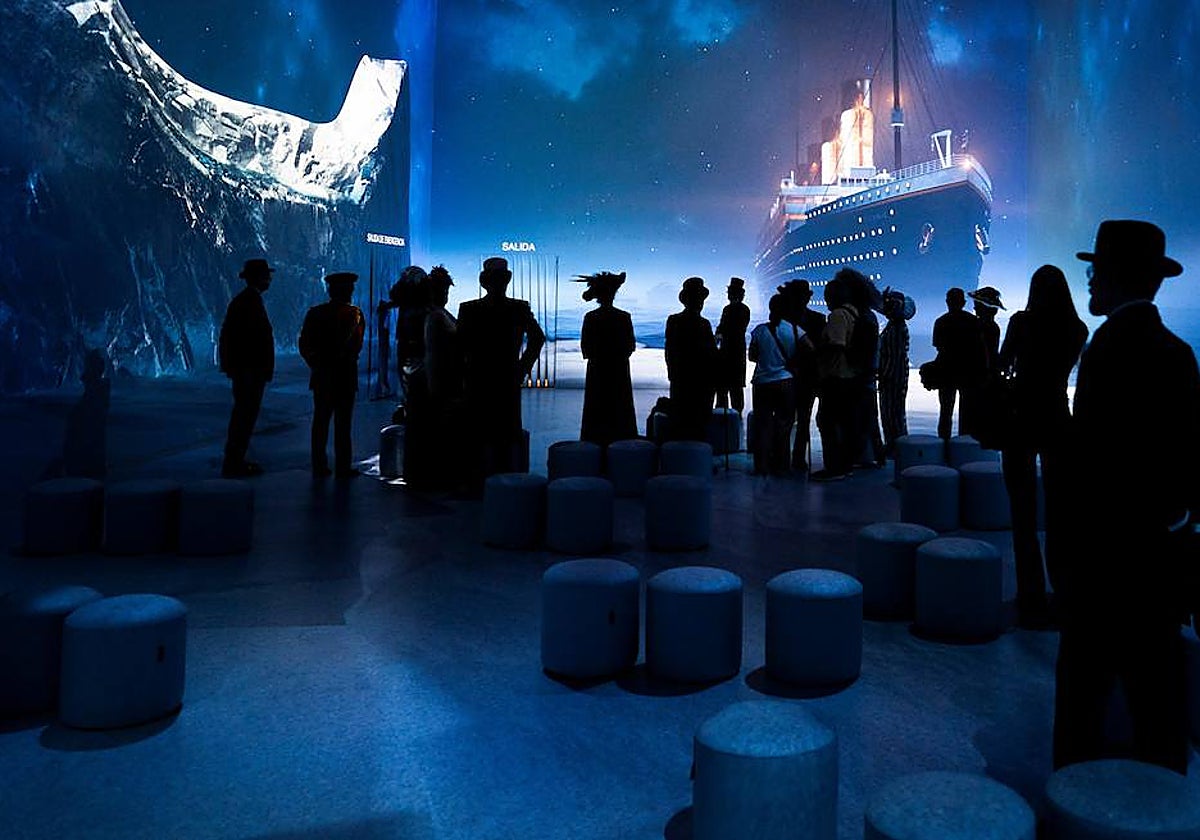
Projections up to six metres high recreate the moment the ship collided with an iceberg
But the immersive experience takes place in a 300-square-metre room, with projections up to six metres high depicting the ship’s arrival at the port, passengers boarding and the ship’s interior. It is an immersive experience lasting almost 30 minutes that reaches its climax when the Titanic strikes the iceberg and begins to list, creating the sensation that everything around you is moving too. Before that, wearing virtual reality headsets, the exhibition pays tribute to the heroes of the tragedy: the orchestra that continued to play whilst the passengers boarded the lifeboats. Some said the last song played was Closer, O God, to Thee, whilst others claimed it was Songe d’Automne. Inspired by both melodies, composer René Merkelbach has created an original piece of music that seeks to recreate the Titanic’s soundtrack.
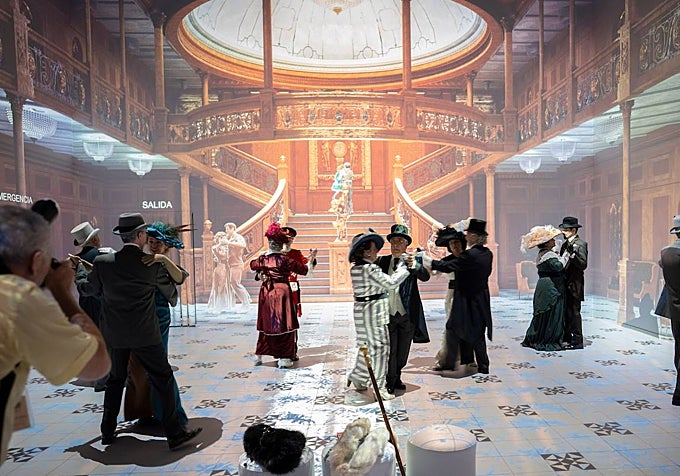
It all leads to the metaverse: a blank space in which to move freely, brought to life through virtual reality headsets. With these, visitors are transported inside the ship: they walk through the third-class corridors, enter the first-class cabins, go up to the restaurant and stroll along the deck. The virtual doors open as the visitor moves forward and encounters the various characters who inhabit the ship. It is the most immersive experience in the exhibition, the final stop on a journey suitable for all ages (recommended for children aged five and over) that lasts just over an hour. Eighty minutes to understand a tragedy which, as explained here, unfolded in just one minute: the time that elapsed between the lookout’s warning and the collision with the iceberg.
![[]](http://static.vocstatic.com/voc26/latest/assets/images/favicon/surinenglish/apple-touch-icon-57x57.png)