
Housing
Madrid lawyer: 'There are many to blame for evictions, including judges who are insensitive to the tragedy unfolding before them'
Lawyer Benítez de Lugo, who has handled more than 300 eviction cases involving vulnerable people, criticises the government for "lumping everything together" in its decrees
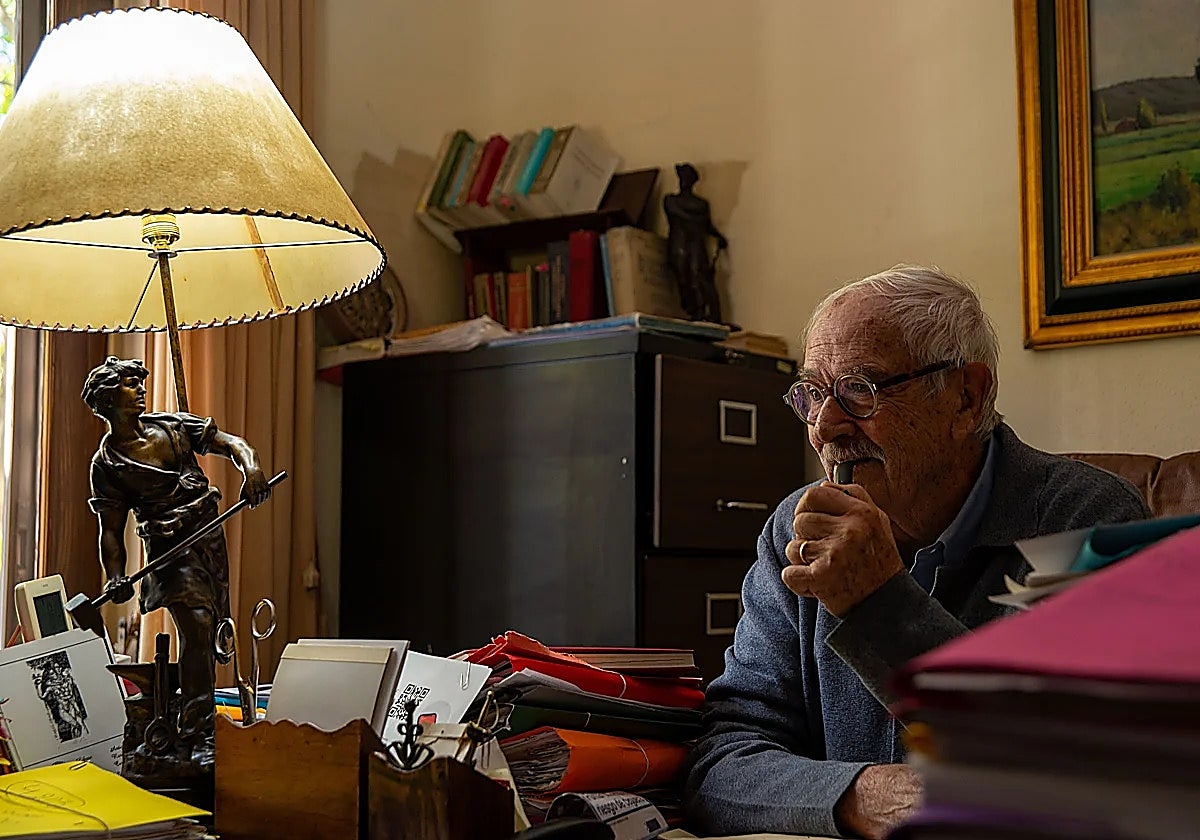

Those who have nowhere else to turn after receiving the dreaded letter, usually from a vulture fund, go to Mariano Benítez de Lugo: Madrid-based ... lawyer with over 300 eviction cases under his belt.
He peeks out from behind the piles of folders cluttering his desk and stands up to greet us, holding several sheets of paper covered in notes written in red pen. "There are four evictions scheduled for this month and we're looking at how the new decrees might affect them," he says.
An eviction is the final stage and enforcement of a court order. Among those he is trying to stop this October is that of a woman caring for her husband, who is 90 per cent disabled, and that of a family with three very young children.
He started handling eviction cases in 2013, when then Madrid Mayor Ana Botella decided to sell 1,860 social housing flats to Blackstone: a vulture fund which, as soon as the contracts expired, doubled the tenants' rent.
Against all odds, Benítez de Lugo won one of the cases before the Supreme Court, enabling four of these families to buy their homes at the same derisory price at which the investment giant had acquired them.
On a table next to his desk is a bronze sculpture of Themis, the goddess of Justice. Next to it lies the fluorescent yellow helmet he uses to get around Madrid on his motorbike, despite his wife's objections. Mariano Benítez de Lugo is 85 years old, with a 63-year career behind him.
– What is wrong with our system that an 87-year-old woman is evicted and dies in hospital?
-It's terrible. But make no mistake, vulture funds are out for themselves. They're voracious. The issue is the judge who authorised that eviction, when surely her lawyer would have argued on the grounds of her vulnerability. Nobody talks about the judges and I'd say it's a necessary part of the process.
Maricarmen's case has served to raise public awareness that there's something wrong with all this, that there are many culprits. Among them, a large proportion are the judges who, in many cases, we see acting like politicians in robes. Eighty per cent of the cases I handle involve vulnerable people and my clients are all reliable tenants who pay their rent on time. That is very important, because they do not breach the tenancy agreement.
– Many of those cases date back to 2013…
-Yes, the infamous sale on 31 October 2013. But there are several parties to blame here. Mrs Botella was to blame when she sold social housing. The vulture fund was to blame when, as soon as the contracts expired, it pressed ahead with eviction proceedings. The majority of the judiciary were to blame when they agreed to apply the contract to the letter without taking into account that it contained an unfair term, as stated by the European Commission. Ultimately, certain judges are to blame as necessary accomplices, insensitive to the human tragedy unfolding before them.
– You say that, in such cases, one is at the mercy of a "judicial lottery".
-Absolutely. In some cases, judges have been insensitive to the plight of vulnerable families, where eviction occurs because of that "paleopositivist" approach which adheres strictly to the letter of the law. In other words, "the contract contained such-and-such a term; the contract has expired; therefore, eviction". In some cases I manage to reach agreements, minimal ones, unfortunately, in which the vulture fund acknowledges the situation and signs a new contract raising the rent slightly. Or, quite simply, I manage to secure deferrals of the evictions.

– Do the new housing decrees passed by the government improve the situation?
-I believe this has been a recurring mistake on the part of the government. Firstly, because it's lumping everything together: it's producing a 96-page decree-law when the issue of evictions could have been resolved in two pages. It mixes things up, taking the opportunity to include other matters. This makes it harder for it to pass.
There are some positive aspects, such as the six-month notice period. But my main concern is the transitional provisions, which would have allowed cases already in progress, subject to final rulings, to benefit from the new wording. They haven't included that.
In other words, I have a lot of evictions pending for many people. This October I have four. They all involve vulnerable people. One of these cases, involving three young children, relates to the Supreme Court rulings that found in my favour against Blackstone. The basis for this is the urban tenancy act, which states that if you are a tenant and your home is sold, you have the right of first refusal.
They are attempting to evict a family with young children even though there is already a final judgement from the Supreme Court stating that they have the right to purchase the property.
More social housing
– So, that family have the right to buy their home, but they want to evict them because they haven't been able to buy it yet?
-They have paid the price of the property, but the court has not yet ruled to enforce the judgement. In the meantime, the eviction proceedings are continuing and it is an utterly Kafkaesque situation.
– What is the government supposed to do?
-We need more social housing, because we must find alternative accommodation for these people who are still paying their rent. The fact that there is no stock of decent housing for people facing eviction is primarily the responsibility of regional and local authorities.
The problem is that we have a ruthless form of capitalism that looks after its own interests. However, in the face of this, the legislature and the government should have taken more concrete measures to resolve the issue. What you, as a legislator or the government should have said is simply that there will be no evictions until alternative accommodation is available.
The European Court has already stated this: that housing is a fundamental right. Article 47 of our Constitution refers to the right to decent housing. This mean being able to remain in your home.
– Of the more than 300 cases you have handled, which one has had the greatest impact on you?
-It's hard to say, because so many people have left a mark on me. But a man from sub-Saharan Africa, nearly two metres tall, came and sat in that chair where you're sitting now and he started crying right in front of me. I still get goosebumps when I think back on it.
– What motivates you to carry on working at the age of 85?
-I've been working for 63 years and I'll carry on as long as my health holds out. I'm socially privileged. I've managed to run a financially sound practice and, although my income from all this is practically laughable, I can afford the luxury, so to speak, of being generous with my fees when it comes to the weaker parties in a case, who are my clients. Here I am, still going strong. I'm in good health and, as long as my mind holds out, I'll carry on working with them. Nothing unjust is alien to me and all these cases are harrowing.
![[]](http://static.vocstatic.com/voc26/latest/assets/images/favicon/surinenglish/apple-touch-icon-57x57.png)