
17 May Day of Norway
The first Normans in Andalucia: from fierce Vikings to peaceful cheese-makers
Thanks to the ‘hospitality’ of the local inhabitants, the captured Norse vikings were permitted to settle in Al-Andalus on condition that they converted to Islam and integrated into the local Muslim community
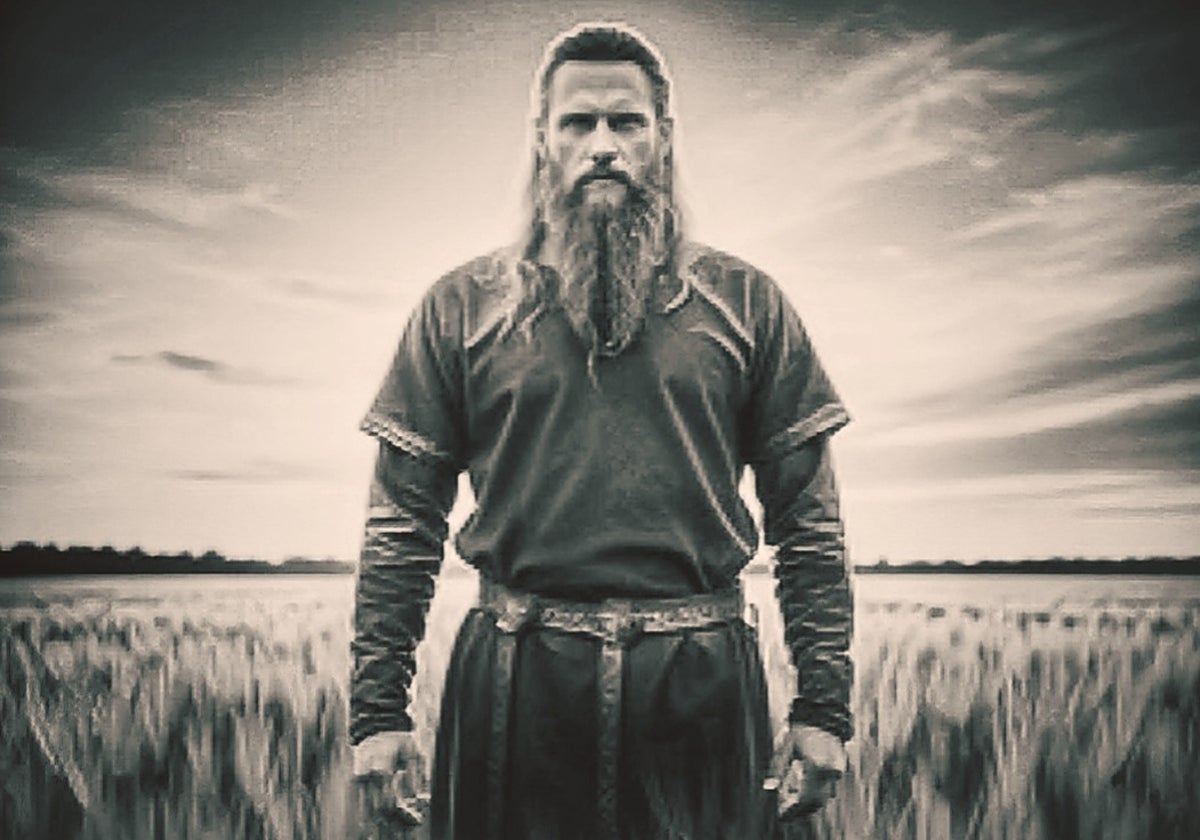
Alekk M. Saanders
Seville
It should be noted from the beginning that in the 840s, Andalucia was Muslim. As Al-Andalus, it was a part of the Emirate of Córdoba, an independent state ruled by the Umayyad dynasty. Alongside Baghdad, Córdoba was a major centre of civilisation, and Seville, known then as Ishbiliya, an important city. The emirate invested heavily in infrastructure, architecture and education, blending Roman, Visigothic and Islamic styles.
Northerners from the south
The first half of the 9th century, under the rule of Emir Abd al-Rahman II, was marked by both a cultural renaissance and political instability. It was a dynamic, multicultural society with significant growth in trade and agriculture, serving as a centre of learning in Europe. It was a time of internal unrest and frequent border wars with the northern Christian kingdoms.
However, it was not only Christians who posed a threat to the emirate. At that time, the Vikings were waging war activey, and the vast majority of them were pagans. (Mass conversion to Christianity did not take place in Scandinavia until the end of the 10th century).
The Vikings wreaked havoc across many parts of Europe, raiding prosperous towns and regions. It is believed that the Vikings who dared to raid Al-Andalus came (among other possible places mentioned by historians) from what is now Norway. According to the article ‘Nordmenn i Spania’ of the Store Norske Leksikon website, “Norwegian Vikings came to Spain in the 9th century and ravaged Seville in 844”.
The inhabitants of Al-Andalus were aware of the raids by northern peoples on Europe. They often called them ‘barbarians from the north’. From the south… the Vikings crept into the Andalusian coast during the sweltering August of 844.
They arrived by drakkars (the largest, most fearsome class of Viking longship, designed specifically as a warship for kings and jarls). After raiding Galicia and Lisbon, a fleet of approximately 80–150 drakkars arrived in Cádiz and plundered the city. In late September, the ‘red-and-black seabirds’ (as Arab chroniclers described the Viking ships) sailed up the Guadalquivir River.
Capture of Seville
It is believed that in the very beginning of October 844, the Vikings sacked and captured Seville, and even continued inland. The raid caused panic among the population and enormous destruction, including the burning of a mosque. The Vikings held the city for about 40–50 days, though they never managed to capture the main castle.
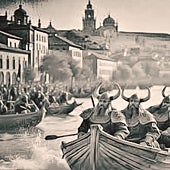
It is believed that in the very beginning of October 844, the Vikings sacked and captured Seville, and even continued inland. The Vikings held the city for about 40–50 days
Historians refer to this event as the ‘Siege of 844’ or the ‘first major Viking raid’, as they failed to hold Seville permanently. Apparently, that Viking raid on Al-Andalus was part of a larger, rapid expedition, rather than an attempt at long-term settlement.
The Emir of Córdoba, Abd al-Rahman II, assembled an army, and after a series of clashes, the Muslims managed to defeat the Vikings. The Battle of Tablada, a town south of Seville, in November 844 proved to be a turning point. Historical sources attest to heavy Viking losses (over 1,500 killed and 30 ships destroyed). In the end Seville was recaptured, and the remaining Viking troops left the city. The raid on Seville forced the authorities in Córdoba to strengthen coastal defences and step up surveillance along the Guadalquivir River.
Life in peace
Apparently, rather than returning to Scandinavia, the captured warriors remained in the lower reaches of the Guadalquivir River. The Normans didn't mind converting to Islam and so they became known as the ‘Majus’.
In the Andalusian countryside, the former Vikings took up farming: specifically livestock rearing and the production of dairy products. It can be assumed that these Scandinavian settlers became the forefathers of Andalusian cheese-making. According to some sources, Seville cheese originated thanks to the former Vikings. The claim that they became cheese-makers is corroborated by certain Arab chronicles, which mention that the Vikings settled near today’s Cavra, Carmona and Morón, where they took up farming and milk processing.
However, some researchers note that the ‘Majus cheese’ mentioned in the sources may refer, in a more general sense, to dairy products, and that specific details in the context of the Vikings are partly anecdotal in nature. It is also worth mentioning that many Vikings continued their ‘military careers’ with the Arabs and went on to serve in the emir’s guard, settling not far from Seville.
Apparently, the Vikings settled near today’s Cavra, Carmona and Morón, where they took up farming and milk processing
Thus, the event of 844 can be regarded as the arrival of the first Norwegians in Al-Andalus, which took place long before the migration to Spain in 1258 of Princess Christina of Norway, daughter of King Haakon IV Haakonsson, who was married to the brother of King Alfonso X the Wise and ultimately lived in Seville.
Incidentally, the attack of 844 was the first confirmed large-scale Viking raid on the Iberian Peninsula. Raiders returned in subsequent years, for example in 860 and 966, targeting both the Atlantic and Mediterranean coasts. They were drawn by the wealth of the Andalusian cities, which were far more developed than their Scandinavian homelands.
![[]](http://static.vocstatic.com/voc26/latest/assets/images/favicon/surinenglish/apple-touch-icon-57x57.png)