
Lifestyle
Supermarkets targeting tourists are springing up all over Malaga city centre
At least 50 establishments are already operating in the heart of the city, with many catering almost exclusively to tourists
-U20628378281dKq-1200x840@Diario%20Sur.jpg)

There are many different types of tourists, but it seems that they all end up in the supermarkets in the city centre, regardless of their ... purchasing power or their budget for a trip to Malaga. This has led to the growing emergence of such shops in the heart of the Costa del Sol capital.
While local supermarkets catering to residents in the heart of the city still survive, they have started to adapt to the needs of visitors who simply need to quickly satisfy their hunger and thirst without too much fuss.
In the space of a few weeks, a Carrefour City opened on Calle Martínez and another in the former San Agustín shop, in addition to the one that opened on Calle Nueva, which is also very close to the one that has been operating for a little longer in the Plaza de la Constitución.
The Grupo Mas company, which incorporated Maskom supermarkets at the start of the year, has opened around ten shops over the past two or three years, such as the one in Plaza del Teatro, the one on Duque de Rivas, on the Alameda de Colón, on Calle Victoria and in Cuarteles, some of which are Mas & Go shops that offer ready meals as part of their range.
-U71000403237JFM-680x476@Diario%20Sur.jpg)
Other supermarkets have also emerged: the DT chain, with branches on Calle Álamos, Paseo de Santa Isabel, Calle Martínez and Calle Sebastián Souviron. Under the ownership of a Vietnamese entrepreneur, they are clearly aimed at foreign customers and those just passing through the city, as their brightly coloured sign that says "Supermarket. Drinks, alcohol, souvenirs" shows.
Staff at the chain say that all sorts of customers pass through, including locals. In the heart of the city, there are at least 50 supermarkets across all chains, as well as mini-markets selling various trinkets.
Catering to the needs of all types of visitors
The tourist-centred approach is evident in mainstream chains, which seem to have devised special offerings for people visiting the city: from a meal deal to attractive prices for those who prefer to stock up the tourist flat fridge instead of constantly eating at restaurants.
At the Carrefour City opposite the Museo Picasso, the range of goods on offer consists of drinks, snacks, some ready-to-eat food (mainly salads and peeled and chopped fruit), as well as basic hygiene products. It isn't a supermarket for local residents. You can't do a normal shop there for a family's daily needs.
The supermarket serves its purpose: meet the basic and most urgent needs of tourists. The staff confirm that what sells best is water, particularly on Sunday afternoons, when admission to the museum is free.
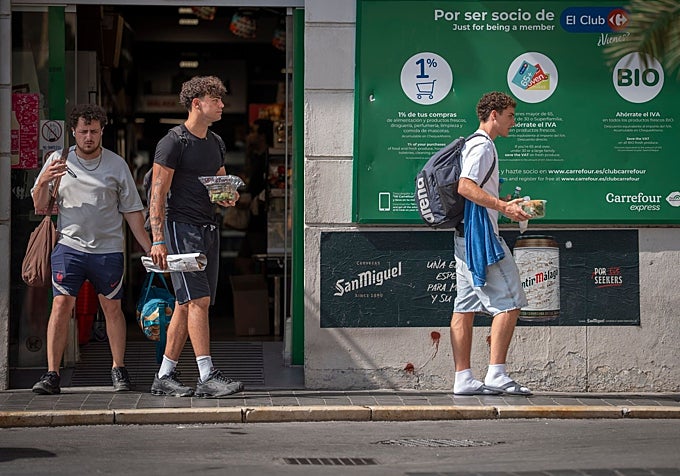
The shop on Calle Martínez also confirms that its clientele consists mainly of tourists, who either buy food to eat on the street, in the park or on a bench on Calle Larios, or make a larger purchase to take back to the holiday flat where they are staying. Local residents hardly ever go there because the prices are usually higher than in larger shops or those in other locations.
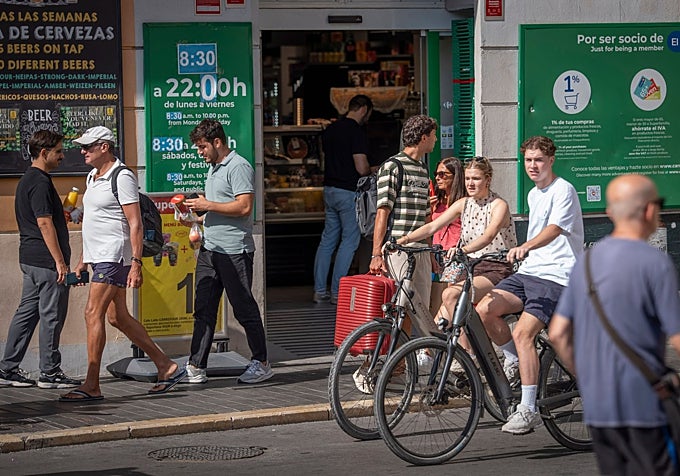
At a Maskom in the city centre, near the Plaza de la Merced, which has an area with chairs and tables for eating at the shop, an employee explains that tourists mainly come in the morning to stock up on typical beach snacks: drinks, empanadas, bread, cold meats, sweets, crisps…
He has also noticed a peak in visitor numbers in the late afternoon: these are the people making larger purchases to eat in the holiday flat where they are staying. Not surprisingly, La Merced is the area of the city (and of Spain) with the highest density of holiday accommodation. The average spend for these customers can reach 150 euros, says the shop assistant.
This Maskom, in particular, also sees residents queueing up alongside tourists on a daily basis.
Valerio and his friend, both tourists from Naples, are eating a sandwich inside the supermarket: "We've stopped here because it's close to the hotel where we're staying," they explain.
Is there a conflict on the horizon with the hospitality sector?
Industry sources explain that this is precisely one of the trends in the supermarket sector: the sale of ready-to-eat products in-store. This serves not only tourists, but also workers who have little time at lunchtime during their split shifts and cannot afford to linger over lunch at home.
Sources admit this may cause friction with the hospitality sector, as it represents competition from businesses operating in a sector authorised to sell goods to the public, but not to serve food and drink on the premises.
The norm, however, at least in the city centre, is still to pop into the supermarket to do a quick shop, because people eat elsewhere, whether at home, on the beach or in a park.
At Mas de la Plaza del Teatro, one of the shop assistants comments that while there are more locals from Malaga among their customers in winter, in summer they are mainly tourists, because the former leave the city in August and the latter come to the Costa del Sol on holiday.
"The things that sell out first are the ones in larger quantities and the cheapest. Lots of tourists then eat them on the go, like salads or sweets," says another supermarket worker.
A group of Italian girls hurry off to their flat with bottles of water and snacks. Close to them, Frida and her friends from León tell SUR: "First we went to the Atarazanas market to buy fresh produce and then here to the supermarket for the rest. We're going to be in Malaga for six days. We're 20 years old, we're on a tight budget and it costs us nothing to make a sandwich in the flat or cook something for ourselves. Today we're going to make macaroni alla carbonara."
Won't they try the local cuisine? They reply that they will and that they'll probably go to El Palo to eat espetos.
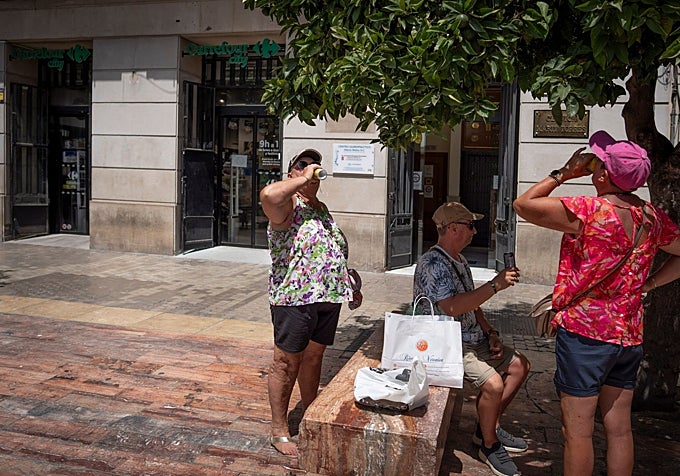
Alejandro and his friends, Colombians living in Miami, fit a different profile of tourist: they've only ever set foot in that supermarket to buy water. They've had their lunches and dinners in restaurants or tapas bars. They point out that, compared with prices in Miami, those in Malaga seem cheap to them.
Ema and Lia, both 18, from Lagos (Portugal), are sitting on a bench in Plaza de la Merced. They're tucking into some sushi they've just bought from one of the local supermarkets. At their feet are bags containing the groceries they'll be taking back to the Airbnb where they're staying. They'll only be in Malaga for three days, but this way the trip works out cheaper for them.
"We only work in the summer and don't have much money. We'll go to a restaurant, but just once," they admit.
Nearby is Michaela, from Düsseldorf (Germany), who's just buying drinks at the supermarket. A group of Czech students on a school trip buy bread and various types of cheese because they are hungry but don't have time to eat at a restaurant.
In Plaza de la Constitución, the supermarket has very conveniently placed a few benches and chairs outside for customers to enjoy whatever they've bought.
Sara and her boyfriend, from Naples, can afford to eat most of their meals outdoors. "We have breakfast very early and the bars round here open late, so we buy bread and milk at the supermarket. But for lunch and dinner we do go to a bar or a restaurant."
Testimonies from tourists and staff all point to the same conclusion: every tourist visits the supermarket, albeit with different needs.
![[]](http://static.vocstatic.com/voc26/latest/assets/images/favicon/surinenglish/apple-touch-icon-57x57.png)