
Travel
Stranded for five days
No watches, no guaranteed food and no contact with the outside world: this was the extreme experience of voluntary isolation in Indonesia for a couple from Malaga
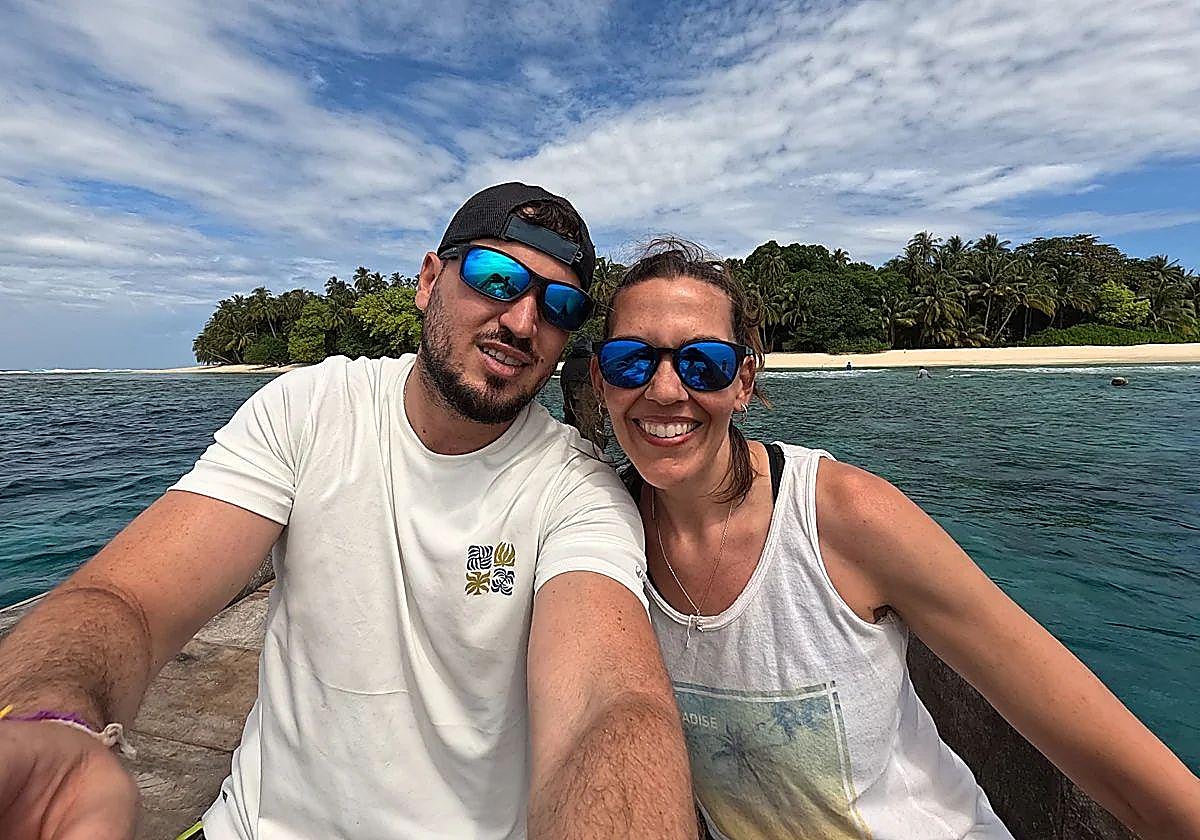

On the first night, they barely managed to build a shelter out of palm leaves. The fire was struggling to take hold. The damp was ... soaking the wood and the sun had set hours ago. Lying on the ground, amid the constant sound of the sea and the unfamiliar noises of the island, Sarah Croft and Adrián Cabezas were trying to sleep when something moved very close to them. They switched on a torch that was barely holding any charge and discovered a huge hermit crab just a few centimetres from their faces.
That scene, more reminiscent of an adventure novel than a conventional holiday, took place a year ago on the small island of Juanito, in the Indonesian archipelago.
The couple spent five days there completely on their own, without a mobile phone, without a watch, without food, and with nothing but a machete, a harpoon and a flint to start a fire. “We set off on a total adventure,” says Sarah.
Related story
The 39-year-old woman from Granada and her partner, Adrián Cabezas, a 32-year-old from Málaga, work for a technology company in Torremolinos. She manages projects. He is a software developer. They met almost a decade ago and have been together for seven years.
Their daily routine revolves around meetings, deadlines and computer screens. Perhaps that is why they eventually decided to take up a proposal that had been on their minds for years: to disappear for a few days and see how far they could get using only their own hands.
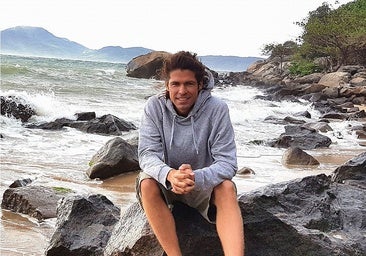
Sarah had been aware of the project from the very beginning through Álvaro Cerezo, founder of the agency specialising in isolation experiences on desert islands. The idea was shelved for years, like so many others that always seem to be postponed. Until one day when they decided to stop putting it off. “We didn’t want to keep saying we’d do it the following year,” she recalls.
A remote destination
The journey began in Kuala Lumpur and continued on to Padang, in Indonesia. From there, a car journey and an hour’s boat ride in a small wooden boat took them to the island.
When they disembarked, the landscape seemed to match the exact image anyone would conjure up when thinking of a deserted island: white sand, coconut palms and crystal-clear water. “It was just what you imagine when you think of a paradise island,” explains Sarah.
But the situation was far from comfortable. The couple had also decided to forego some of the resources that the organisation usually makes available to participants. They wanted to see what they would be capable of without outside help.
During the first few hours, they even turned down the water they were offered. They eventually accepted a single reserve supply when they realised that the heat and humidity could make dehydration a serious problem.
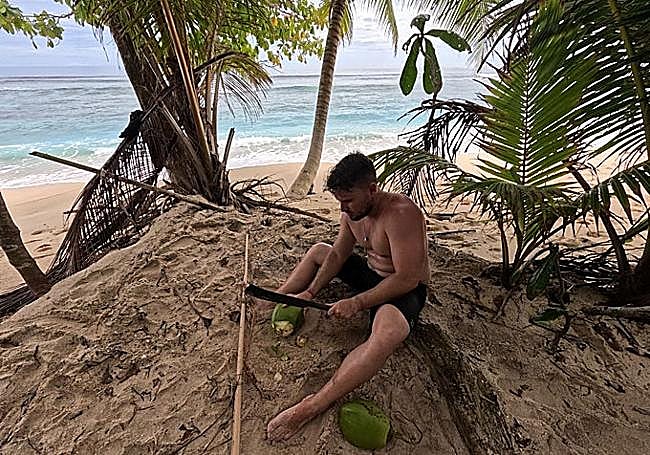
Their diet during those five days consisted of coconuts, palm hearts, small crabs and a few fish that Adrián managed to catch. The result was considerable weight loss. Sarah returned nearly nine kilos lighter. Adrián lost around five.
However, neither of them remembers the experience as a stress test. “We didn’t go hungry to the point of having a stomach ache. You knew you were hungry, but you didn’t suffer,” she says.
The days began at dawn. There were no set timetables. Time was measured in a simple way there: sunrise marked the start of the day and the early onset of darkness brought all activity to a close. After breakfast – usually a freshly cracked coconut – they would decide what to do next. Look for materials to improve the shelter. Try to catch fish. Explore the island. Keep the fire going. But there were no projects to hand in or meetings to attend.
“You set yourself goals, but without any stress,” recalls Adrián. “There was no pressure to have something ready by a specific time.”
‘In a society characterised by hyper-connectivity, the chance to disappear for a few days is a dream’
The lack of amenities was evident from the very start. They slept on the floor. The nights dragged on. Crabs scuttled across the beach as the sun went down. Sarah would wake up with bites from insects she could never quite identify. Even so, they both agree that they never felt afraid at any point. “For me, it was a tremendous sense of freedom,” she says.
This insight helps us understand why this sort of experience is attracting more and more people. “In a society characterised by constant hyper-connectivity, the chance to disappear for a few days is a dream.”
It’s not just about travelling to remote places. It’s about putting one’s usual obligations on hold for a while and seeing what remains when all the trappings fall away.
Sarah recalls that, on their return, many everyday concerns no longer seemed so urgent. Opening the fridge and choosing any old food felt like a luxury to them. That feeling lasted for several months.
“Then you get back into the routine,” she admits. “Life pulls you back in again.” Even so, something remains. Perhaps because during those ‘extraordinary’ five days they discovered they could live on far less than they had imagined.
A year on, they still look back on that experience, certain that they will do it again. They won't be considering a more comfortable version, nor will it be on the same island, but they will do it again.
And perhaps that is the essence of what they found on that remote beach in Indonesia: five days without a timetable, without mobile coverage and without certainties which, far from wearing them out, left them wanting more.
![[]](http://static.vocstatic.com/voc26/latest/assets/images/favicon/surinenglish/apple-touch-icon-57x57.png)