
Culture
Malaga-based young artist turns his own eviction into art
Ángel Pérez Meca has transformed a fine arts storeroom into a 37-square-metre studio flat using the textiles he designed while his family was being evicted from their home
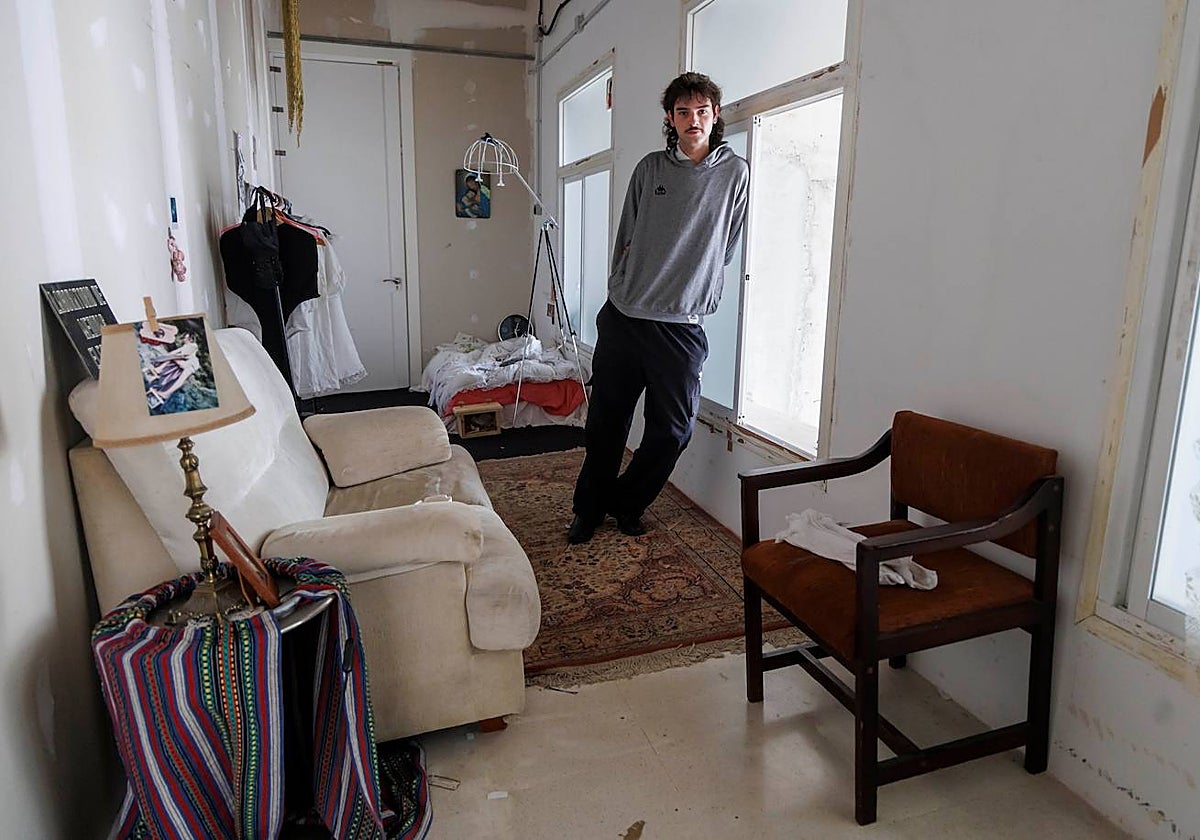

'Studio for rent: 37.31 square metres' reads the sign. Anyone interested can go to the Faculty of Fine Arts at Malaga University, enter ... its virtually empty exhibition hall and look for door number 31. What is usually a small storeroom, hidden from visitors, will, until 18 December, be Ángel Pérez Meca's "home": a mini-refuge where his fashion designs sit alongside a sofa, a bed and a desk.
Through this decontextualised home, the young artist reflects on the housing crisis and, at the same time, channels the pain of his own eviction.
Four years ago, his mother received the first notice to vacate the flat where she lived with her twin sons in Baza (Granada). It caught Ángel by surprise, while he was in the middle of moving to Malaga to study fine art. "I no longer had a home there and I found myself here with little prospect of finding one."
Related story
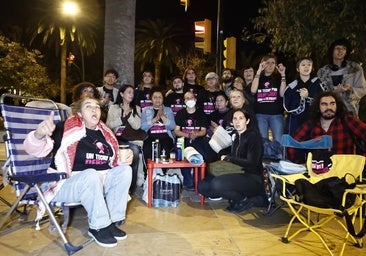
From that moment on, the threat of eviction, the anxiety of finding somewhere to live and the support of his network permeated all his creative work. "My way of dealing with it was to create clothing collections that expressed how I felt about that problem," Pérez says.
In 'Studio for rent: 37.31 square metres', the young artist subverts the faculty's exhibition space. Usually filled with paintings and sculptures, Ángel Pérez Meca completely clears the space of artworks and, instead, fills the storeroom with his own pieces. Using the materials and objects he retrieves from clearing out that storeroom, he creates an installation in the shape of a flat.
"I've created this while respecting the spaces within a house: its roof, its security cameras, its separate rooms and the staircase leading upstairs," he says, pointing to the art installation, which features wooden planks, old televisions and furniture that has been gathering dust for some time now.
That is the only thing visitors will find upon entering the room, along with a text co-authored by Ángel Pérez Meca and Isabel Gómez, a fellow lecturer, displayed on the wall. "This room / I don't have it / I can't find it / This painting I don't paint / This / all of this / that I have / that I want to do / with my hands / with my friends / where do I do it? / where do I carve it?"
This is the idea that gives meaning to the exhibition, curated by Eugenio Rivas and Carmen González Aneas: What scope does an artist have to create when they do not even have a guaranteed place to live?
Memory textiles
Hanging from that installation are the keys that grant access to the 37.31-square-metre studio. "It works like an estate agency. Every so often, I'll come and show the flat round. Because this is my home and I decide when to show it," the young artist explains.
Inside, Ángel Pérez Meca has arranged his fashion designs across the various rooms. These textile pieces preserve the memory of his home and his town. They were made using his grandmother's Alfa 482 foot-powered sewing machine.
The first collection is made from duvets and sheets from his home and from the lace his aunt used to dress a local saint. A "blessed" fabric, Pérez says. It represents those networks of friendship that sustain and comfort us in difficult times.
The second collection symbolises his preparation for the warning of an imminent eviction. Here, the pieces take on a more aggressive quality, featuring helmet-like shapes and materials such as tyre rubber.
Rats and pigeons sneak into the flat. "They're like the city's squatters and you're always trying to get rid of them." He turns them into jewellery pieces that are worn on the body.
For his latest collection, he returns to his hometown to explore faith in the rural world, "how people end up using the saints as psychologists, with all the good and bad that entails". That's where his wooden shoes with a nail come from. "If Christ were wearing heels today, they'd look like this," Pérez says. You can wear anything, "but it's not at all practical".
Bits and pieces from home
Sewing comes naturally to the young artist. "I started with fabrics I'd inherited from my aunt and the scrap my grandmother had left over from making a curtain, that typical bag of scraps that every family has," Pérez says.
His grandmother taught him how to use the treadle sewing machine that his grandfather had to fix every now and then. "My mother also made dolls' dresses for El Corte Inglés when she was young. My aunt used to make the costumes for the santón and the virgins. Whenever neither my grandmother nor my mother knew how to do something, I'd go up to my aunt's house to ask her and she'd explain it to me using a napkin," he explains.
That sense of community and neighbourliness also permeates his artistic vision. For the first time in a long while, the windows of the warehouse overlooking the faculty yard are opened to allow, behind some curtains, this exchange from the outside in, featuring talks and workshops on housing and fashion. The situation has not improved since Pérez started this project: what he pays for a room today is the same as what he started out paying for a whole flat.
"I'm glad that someone is finally taking responsibility through art, because through poetry we can address political issues in a powerful way," Eugenio Rivas, an artist and lecturer in fine art, says. He applauds the courage of a young generation of artists who reflect current issues in their work.
"They're fighters, they're determined and they have a tremendous strength that they're often unaware of," Rivas says. Ángel and Carmen look at each other. "It's easier for us to get together to stop an eviction at eight in the morning than to go for a beer," they agree.
