
Malaga nurse sets up charity to help children with sickle cell anaemia in Equatorial Guinea
Soledad Sautoho Napa has worked at the Regional University Hospital for 38 years and spent more than five years as a healthcare aid worker in her homeland before setting up Unamia in 2021

Soledad Sautoho Napa, known as Sol, may have spent 38 years working as a nurse in Malaga, but she has never forgotten her roots in ... Equatorial Guinea. Now 64, she set up a charity called Una Mirada Atrás (Unamia) to help children in her homeland with sickle cell anaemia, among other projects.
Sautoho lives in the Eugenio Gross neighbourhood of Malaga city and works in the Interventional and Spasticity Clinic within the Rehabilitation Department at Malaga Regional University Hospital, which is based at the Hospital Civil. She has been part of what was formerly known as Carlos Haya Hospital since 1988.
She was born on 17 March 1962 in Rebola, a small village on the island of Bioko, just nine kilometres from Malabo, the capital of Equatorial Guinea. She came to Spain aged 19 following the death of her father in 1978.
"I have an uncle here who was like a father to me, Sautoho Bioko. He was the one who gave me and my two brothers the opportunity to leave Guinea to help our mother and give us the chance to do something more," she told SUR.
She lived in Zaragoza, where she trained as a nursing assistant, before marrying at 23 and moving to Malaga. She completed a course to become a specialist laboratory technician and joined the Materno, Malaga's maternity hospital, in January 1988, shortly after finishing her studies.
She later had her eldest son and began studying nursing at the Provincial Council's nursing school. "I did my degree with a baby and while working," she says.
She now has three children and a grandchild, and says the parts of nursing she enjoys most are "helping people, listening and caring for them", seeing the profession as "a service".
She began working as a qualified nurse in 1991 and has since worked in numerous departments, including six and a half years in Oncology.
In 2010, the Foundation for the Development of Nursing selected her to work as a healthcare aid worker in Equatorial Guinea. "It was like, wow! Going back to my homeland and doing my bit," she says.
She then spent more than five consecutive years there after Ayuda en Acción recruited her in 2011. She initially worked as a project co-ordinator in Malabo and later stayed on independently, without NGO backing.
"I said to myself, well, I'm staying in my homeland. When my time with Ayuda en Acción came to an end, it was like a turning point. I'm more useful here, I'm going to stay because I can help. In Spain I'm just one of the crowd, but here I'm Sol," she says.
She worked at the Clínica de la Esperanza in Malabo as nursing co-ordinator and also co-ordinated the new blood transfusion centres, with a particular focus on encouraging people to donate blood.
“In Spain I’m just one of the crowd, but here I’m Sol,” says the nurse, who spent more than five years working as an aid worker in her home country
It was during this period that the idea of doing more for people in her homeland began to take shape. In 2016, she brought a young girl with a cleft lip to Malaga. She spoke to the prime minister and the Guinean government paid for the girl's travel and operation at Parque San Antonio. They later did the same for two or three other Guinean patients.
"My children told me that everything I was doing was taking a huge toll on me and that I had to stop. I told them I would, but God knows that wasn't true," she admits.
Unamia is established
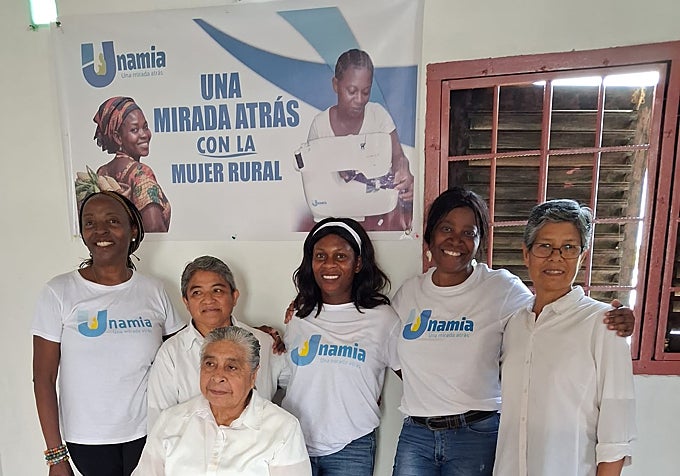
That was how Unamia came into being in late 2021. Since then, the organisation has carried out several projects in Guinea, including a workshop aimed at empowering young single mothers in rural areas and various initiatives supporting people with chronic illnesses.
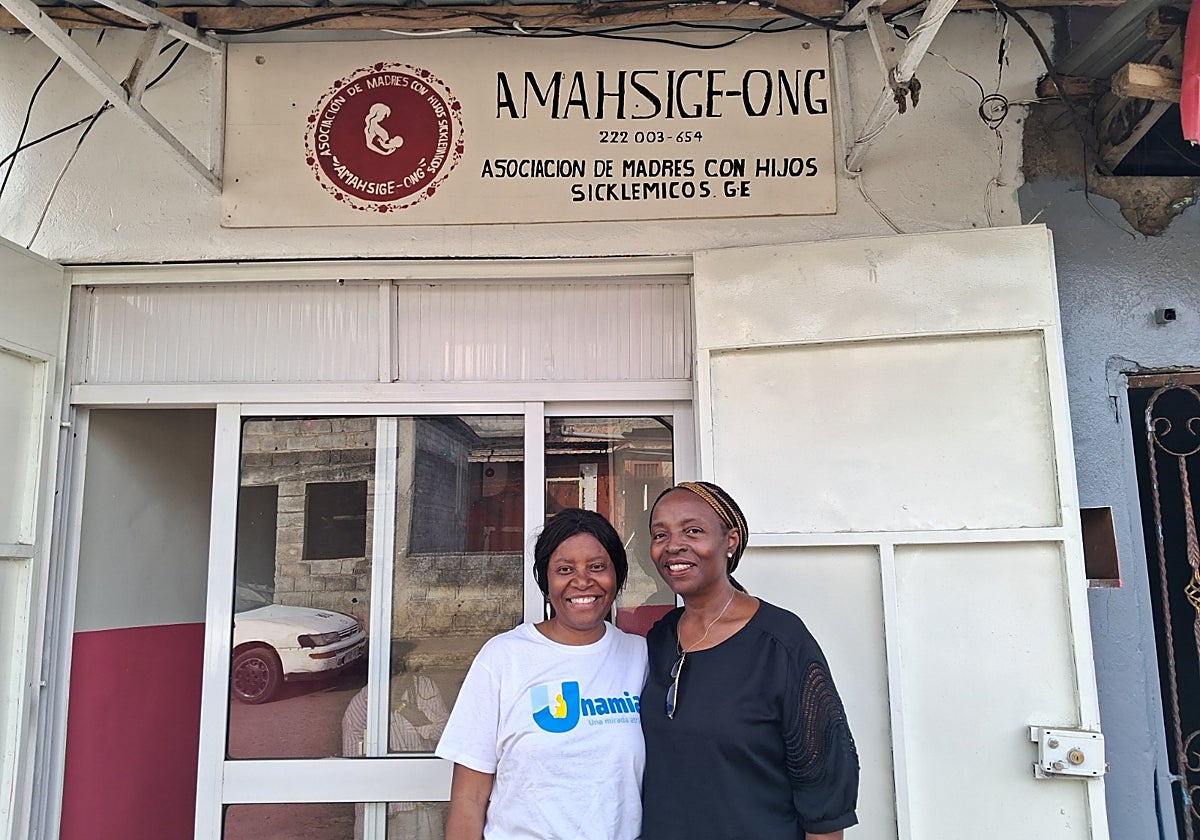
Now, however, it is taking on its first major project. A few months ago, Sol met a nurse called Esther Vázquez, who had spent two years in Guinea "and also came back looking back". Vázquez put her in touch with AMHASIGE, an organisation made up of the families of 20 children with sickle cell anaemia.
"Unamia means 'a look back'. It's my look back after 45 years, joined by my three children, my nephew and my friends. It's the look back of those of us who have gone abroad, got an education and grown, and now want to give something back, because ultimately you have to be grateful and give back what you've achieved," she says.
Sickle cell anaemia is a genetic condition affecting red blood cells. It causes them to develop an abnormal shape which can sometimes block blood vessels, leading to severe pain, infections and anaemia.
Because the condition is chronic and hereditary, children need ongoing treatment. For their parents, this can mean a considerable financial burden from medication, vaccines to prevent infections and blood transfusions, as well as repeated hospital admissions.
The families supported by AMHASIGE have limited financial resources. Unamia has already bought medication and made an initial donation using money provided by the Malaga nursing association. However, the organisation wants to raise its profile and expand its work.
Recently, it held a raffle which raised more than 300 euros. The money was used to buy further medication and vaccines, with the cheapest vaccine costing 70 euros.
Medicines
Its immediate priority is therefore to raise funds for medicines for parents whose financial situation "isn’t exactly rosy". Basic treatment includes hydroxyurea, folic acid, paracetamol and metamizole for pain relief, as well as vaccines to prevent infections. Ideally, the medication and vaccines will be bought in Guinea.
Unamia also receives support from Ana Isabel Rodríguez Jiménez, a paediatrician at the Materno hospital, who advises healthcare professionals in Guinea and answers mothers' questions.
The charity has a WhatsApp group with the mothers, who send their questions to the organisation, which then passes them on to the doctor. A second group has also been set up bringing together doctors in Guinea and Spain, Sol and Unamia vice-president Estrella Oyó, allowing for "a continuous exchange of information".
Unamia also plans to launch an awareness campaign because, according to Sol, there may be many families who have a child with the condition without knowing it.
Anyone wishing to support or join the organisation can visit www.unamia.es, call 643 064 847 or email info@unamia.org.
Unamia supports 20 children with sickle cell anaemia and is raising funds for medicines and vaccines
The organisation has also received support from the Figón de Juan restaurant, Madrid-based company Comercio Cerca, La Inopia beach bar in Benagalbón and hardware shop Material Alternativa. Two nurse friends of Sol, her colleague Esther Vázquez and doctors Francisco Rodríguez Jiménez, Luciano Ceballos Liñán and Ana Isabel Rodríguez have also contributed.
Sol thanks all of them for their support, as well as Asterio González Quereda, "who was like a father to me", and Sister Magdalena Catalán, the director of the care home where she lived for several years before returning to Malaga.
And she has not forgotten her uncle, Sautoho Bioko. It was thanks to him that the dream could become reality.
![[]](http://static.vocstatic.com/voc26/latest/assets/images/favicon/surinenglish/apple-touch-icon-57x57.png)