
Culture
Malaga cello prodigy Álvaro Lozano conquers the classical world
The 20-year-old musician has just finished fourth in one of the world's most prestigious competitions
Alberto Gómez
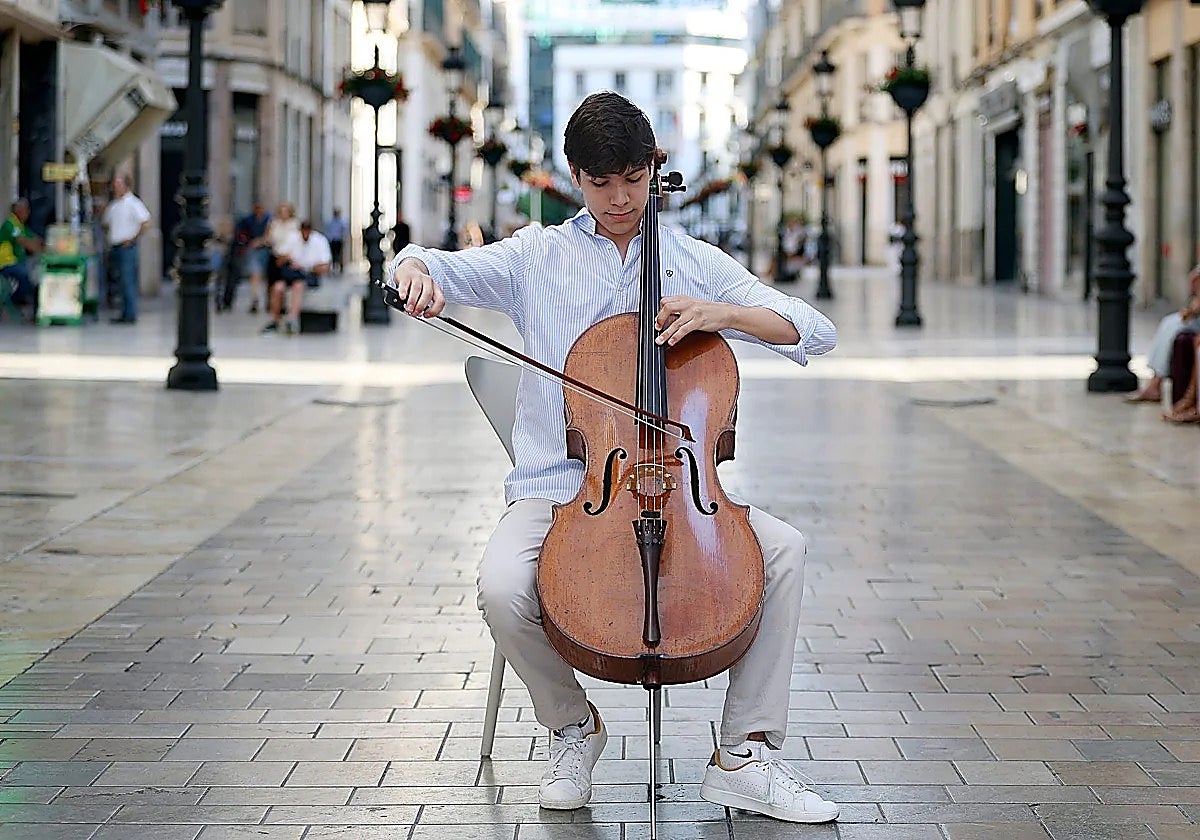
The day before our interview, he hesitates when we suggest photographing him with his cello in the middle of Calle Larios. Too hot, too crowded... Hardly the safest place to handle what is essentially a museum piece. What might seem like the early signs of diva behaviour has a perfectly good explanation: the instrument is almost three centuries old and belongs to Jorge Pozas, one of Spain's most respected luthiers.
Álvaro Lozano (Malaga, 2006) knows the responsibility he carries on his shoulders. The cello travels everywhere in an enormous hard case that he wears like a backpack, almost bigger than he is.
"It's an incredibly delicate instrument. Whenever I fly, I buy it its own seat on the plane. I could never check it into the hold. The risk of damage from knocks or sudden temperature changes is just too great. You can't put it in the overhead locker either. We've all heard horror stories about instruments coming out in pieces. Airlines don't mind as long as you pay for the extra ticket, so we fly together, me in one seat and the cello beside me," he says with a laugh.
At just 20, Lozano ranks among the brightest young talents in Spanish classical music, although he accepts the label with more shyness than conviction. He grew up between the Malaga neighbourhoods of Huelin and El Limonar, two very different places that shaped his character, balancing the freshness of youth with the discipline his craft demands.
Only a few weeks ago, his name began circulating widely in European musical circles. He finished fourth at the Queen Elisabeth Competition in Brussels, a contest that musicians regard as the ultimate test of a performer's maturity, both for the extraordinary difficulty of its repertoire and the immense psychological pressure it brings. To top it all off, he returned to Spain with the audience prize.
More than 180 cellists from around the world submitted recordings for the competition. Only 64 reached the live rounds. That became 24, then just 12 finalists, with every eye fixed on them. Standing on the stage of Brussels' Palais des Beaux-Arts, before a jury scrutinising every note, the real challenge lies in keeping your composure and mastering your emotions.
"Finishing fourth in a competition of that standard is something I never imagined. You practise every day because you want to improve, but until you're actually there, you never really know how far you can go," Álvaro says.
The award that means the most to him, however, is the audience prize. "That's the one that really gives meaning to what we do. Without audiences, concert halls would be empty and we wouldn't have careers. For people in Brussels to choose me, someone from abroad, was an incredible honour."
The competition also brought recognition from some of the biggest names in the cello world. "Getting messages and phone calls from musicians you've admired since you were a child, congratulating you, is amazing. It makes you feel you're on the right path," the young musician states.
The Lozano family car
Music was part of everyday life at home. He grew up in a family where classical music (or, as he prefers to say, Baroque music) provided the soundtrack to daily life. His father plays bassoon with the Malaga Philharmonic Orchestra, while his mother teaches the cello.
"While my school friends travelled to school listening to Shakira or Bad Bunny, our family car was filled with Bach and Beethoven. Reggaeton definitely wasn't on the playlist," he jokes.
Playing music has always felt completely natural to him. "I started when I was eight and I never really considered doing anything else because nothing makes me happier than playing. My parents supported me from the very beginning, but they never pushed me into making a career of it. They always made it clear that the decision was mine. In fact, my brother studied music too, but gave it up a couple of years ago when his interests changed."
He began his training at Malaga's Manuel Carra Conservatoire. At 17, he moved to Seville, where he spent three years studying with Pavel Gomziakov at the Barenboim-Said foundation, before joining Madrid's Reina Sofía School of Music in 2023, where he is now completing his final year.
The cost of pursuing art
The journey has been far from straightforward. Behind every conservatoire lies a financial reality that often determines who can pursue this kind of education. Tuition at the Reina Sofía costs more than 45,000 euros a year, far beyond the reach of most working families. Access depends largely on a system of private sponsorship designed to support exceptional talent. Álvaro certainly has that.
"The school works through a network of private donors. Nobody pays those fees themselves. You audition and, if you're accepted, a foundation funds your scholarship," Álvaro explains. The Malaga foundation has once again included him among the 15 musicians it sponsors.
But tuition fees are only part of the cost. Masterclasses, festival entry fees, travel, hotels and living expenses all fall to the student. Then comes the instrument itself, which can cost as much as a house. Once again, sponsorship makes all the difference.
"My parents could never have afforded a career like this. The financial commitment is enormous," Álvaro says.
Having a top-quality instrument is another hurdle. The 1771 cello that helped him shine in Brussels would have been beyond his reach without the loan from his luthier. "An instrument of that calibre changes everything. It allows you to compete on equal terms in an international circuit where everyone else is playing extraordinarily valuable instruments."
Four instruments under one roof
Life in Madrid bears little resemblance to the image of the solitary artist. He shares a flat with three fellow students from the conservatoire. Four musicians under one roof might sound like every neighbour's nightmare.
"But it actually works well. We have one golden rule: we always practise at the school, where we spend between eight and ten hours a day. By the time we get home in the evening, we just want to relax or do something else," he says.
It may sound surprising, but silence plays a vital role in a musician's life. "We spend the whole day performing or studying scores, from Baroque music through to the 20th century. We need to switch off and spend a few hours without hearing music."
To unwind, Álvaro turns to jazz, soul, flamenco and traditional Spanish songs. On his Spotify playlists, Ella Fitzgerald, Dionne Warwick and Rocío Jurado sit comfortably alongside the great classical composers.
A physical profession
He also makes time for the gym. Spending up to ten hours a day with a cello demands as much care for the body as for the instrument.
"The physical strain is enormous. The body simply isn't designed to hold that level of muscular tension for ten hours a day. Going to the gym is essential for me. An injury would be disastrous. If a joint fails or you develop serious tendonitis, your career comes to a halt," Álvaro says.
All that preparation faced its greatest test in Brussels. Competition rules require the 12 finalists to spend the week before the concerto final in complete isolation. Organisers take away their phones and computers, leaving them cut off from the outside world so they can focus entirely on learning a newly commissioned contemporary work, handed to them only a week before they perform it from memory.
"It's an extreme situation. The mental pressure is intense," he admits. To keep anxiety at bay during the long hours away from his instrument, he turned to reading.
"My family gave me a book about Shostakovich just before the competition, and it couldn't have come at a better time because I was performing his concerto in the final. Reading about his life and understanding the world he lived in changes the way you play his music. Once you know the composer's story, you understand what's behind the score. It really helped me during that week," the young musician says.
Looking ahead
Although he finished the academic year with excellent marks, balancing his third-year studies with preparation for Brussels proved difficult.
"The competition came right in the middle of term, so I missed quite a few classes. Afterwards I managed to catch up and get everything done." Now, as he prepares for his final year, he already has a clear idea of the career he wants.
When he talks about the future, he doesn't mention famous concert halls or major awards. Like many people his age, what he wants most is stability.
"Since Brussels, I've been offered lots more recitals and concerto appearances, which is incredibly exciting. But I wouldn't want to do only that. I'd also like to play chamber music and teach. There are so many different paths in music, and I love the idea of combining them. Above all, I want working conditions that allow me to be happy and to keep enjoying the cello," Álvaro says.
A summer without holidays
The summer ahead will be anything but a holiday. His diary is packed with concerts, leaving him only a few days in Málaga before he packs his bags once again.
Far from seeing that as a sacrifice, he smiles. "For a professional musician, having a full diary is always good news. The real problem would be not having any concerts."
When the interview ends, he places the cello carefully back into its case, just as carefully as he took it out. He checks every fastening, swings it onto his back and heads off.
In a few days, he'll board another flight to Madrid. Once again, the cello will occupy the seat beside him. He will do what he has done ever since he was eight years old: open a score and start playing.
Browse community profiles and regional people news
![[]](http://static.vocstatic.com/voc26/latest/assets/images/favicon/surinenglish/apple-touch-icon-57x57.png)