
People
Murcia mathematician behind one of the Millennium Prize problems: 'We need to rethink how recognition is awarded'
Luis Martínez Zoroa, whose colleagues are calling for him to receive the Nobel Prize of Mathematics, and Diego Córdoba are still struggling to take in the uproar after OpenAI solved one of the outstanding theoretical challenges
Rubén García Bastida
Murcia
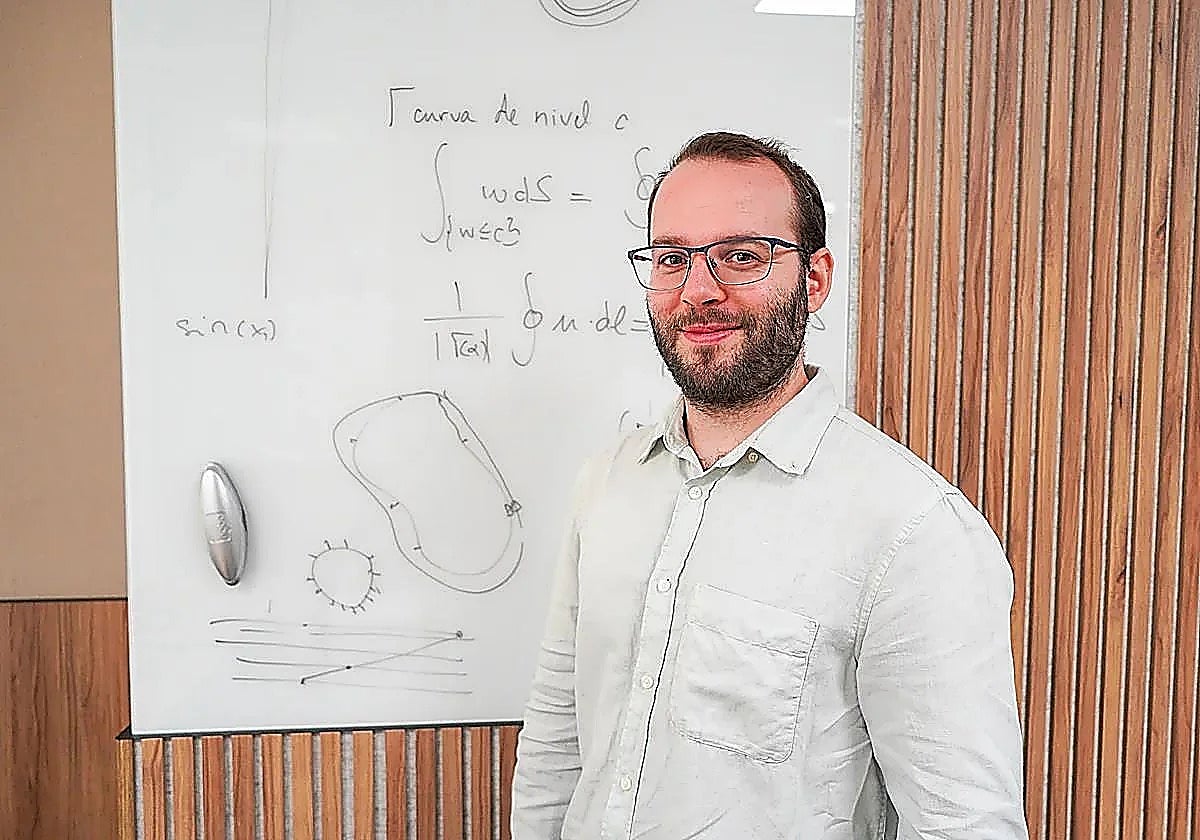
Murcian mathematician Luis Martínez Zoroa, 32, is still struggling to believe what has happened to him.
Several of his colleagues have called for him to ... be awarded the Fields Medal, often called the Nobel Prize of Mathematics, for his contribution to solving one of the seven Millennium Prize Problems: the Navier-Stokes problem, which concerns the equations governing fluid flow.
Even more overwhelming has been finding himself unexpectedly at the centre of one of the biggest controversies in mathematics research in recent years.
OpenAI claimed to have solved the problem without initially acknowledging that its work had drawn on ideas developed by Martínez Zoroa and his research partner, Diego Córdoba. The company later amended its announcement to include a brief acknowledgement, sparking an intense international debate within the mathematical community.
"Until now, if you searched for my name on Google, the first thing that came up was that I won the National Mathematics Olympiad in 2012 when I was a secondary-school student in La Flota," Martínez Zoroa says. "So yes, this is quite a leap."
The first thing he did on Tuesday morning, after learning that a solution to the Navier-Stokes problem might be close, was go to CUNEF University in Madrid to teach his usual Mathematics I classes.
"The students, of course, had no idea. The subject I teach is relatively basic mathematics and the students come from other fields," he says. Meanwhile, he could barely stop thinking about what was happening.
"I was thinking: How on earth am I going to concentrate with all this going on in my head?" He had heard the news just hours earlier from his mentor and research colleague Diego Córdoba of the institute of mathematical sciences (ICMAT), who also has roots in Murcia.
"When I woke up, I had loads of messages from him saying: 'Call me, call me.' I spoke to him and he told me that Tristan Buckmaster, a researcher at New York University, had published an approach to what we had been trying to prove. He said Buckmaster had given us credit and spoken very highly of our strategies," Martínez Zoroa says.
Buckmaster's announcement set everything in motion. In his publication, as well as describing his own progress, he accused OpenAI of plagiarism.
He said that representatives of the company headed by Sam Altman had contacted him and told him they were about to publish a solution to the Navier-Stokes problem. According to Buckmaster, it was based on the same approaches developed by Martínez Zoroa and Córdoba that he himself had been using in combination with AI.
He suggested that OpenAI was seeking to take credit for the breakthrough by exploiting its access to extremely advanced AI models before he, and by extension, his competitor, Anthropic, could do so. Buckmaster's research partner, Levent Alpöge, works for Anthropic.
Then, shortly after 7pm, OpenAI made its announcement. By that point Martínez Zoroa was already at home and had decided to put his phone down and switch off for a while.
When he picked up his phone again, everything had changed. There was an endless stream of messages telling him that OpenAI had solved the problem.
Neither of the two breakthroughs would have been possible without the research Martínez Zoroa and Córdoba have carried out over the past seven years. That work culminated in Luis's 2023 thesis, which already contained "the preliminary ideas that led to all this".
In 2024, the two mathematicians published a paper presenting the more advanced version of the method on which the subsequent work was based. "I was already very happy with what we had done. We just kept working," Martínez Zoroa says.
He acknowledges that "Buckmaster's version came very close to solving it, really. But when OpenAI saw that all the pieces of the puzzle were there, it went for it, taking advantage of the computing power it has. And that's very difficult to compete with".
When Luis arrived at ICMAT on Thursday, where he also spends one day a week supervising doctoral students, there was no one there who was unaware of the whirlwind surrounding him.
"They're all mathematics researchers there. Everyone was congratulating me. Above all, they were asking whether I was very tired and how I was coping," Martínez Zoroa says.
The questions were less about the achievement itself than about the international controversy surrounding OpenAI's actions.
For Luis, the issue is not who will receive the one-million-dollar prize attached to solving the Millennium Prize problem. "If you wanted to make a lot of money, becoming a mathematician would be a terrible career plan," he jokes. "That's not why I'm here. And I wasn't counting on it either."
"Statistically, achieving something like this is incredibly difficult. There are seven problems, we've solved two in 26 years, and one of them has been solved by AI," Martínez Zoroa explains.
What concerns him is the direction scientific research is taking as major private AI companies become increasingly involved, driven by commercial interests.
The events surrounding Navier-Stokes have left the research community deeply unsettled. "Clearly, the mathematical community and other fields of research are going to have to adapt to this new reality," Martínez Zoroa says.
"We need to change the way we recognise the different parts of the research process, giving greater weight to all the steps along the way rather than just the final one. That would help discourage the kind of behaviour that can occur when someone has access to resources that allow them to take ideas from another project, complete the final steps and then take the credit from the rest of the research community," Martínez Zoroa says.
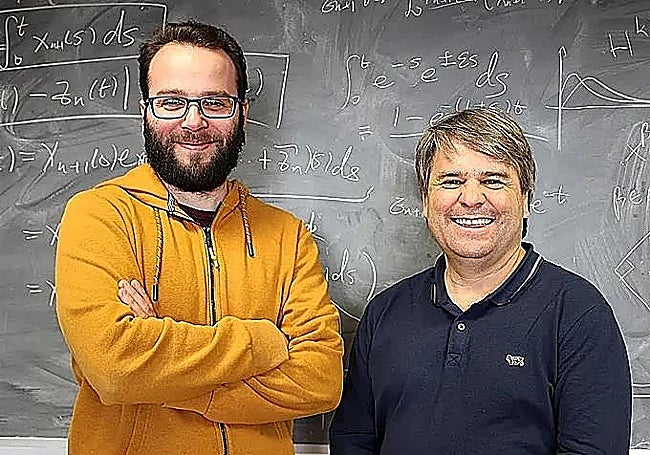
The eight Murcian surnames behind the discovery
Both Luis Martínez Zoroa and Diego Córdoba come from Murcian families with strong traditions in mathematics and research.
Martínez Zoroa is the third generation of his family to pursue the subject. His late grandfather, Procopio Zoroa, was a mathematics professor at the University of Murcia (UMU), where he was part of the research group on probability and statistics.
His mother, Noemí Zoroa, has followed the same path. She is still a practicing mathematics professor at the university and heads the same research group.
Their conversation after the story exploded in the media was not, however, about equations. "It was more like, 'Wow, this is really strange.' Because it's something I never expected and neither did my parents. And certainly not on this scale," Martínez Zoroa says.
Diego Córdoba is also the son of a distinguished mathematician from the Murcia region, Antonio Córdoba Barba. A professor, researcher and chair of mathematical analysis at the University of Madrid, he was born in Puente Tocinos and received an honorary doctorate from UMU in 2017.
He is the director of ICMAT, which belongs to the CSIC (Spain's national research council), where Diego teaches and conducts his research.
Another young mathematician from Murcia has also joined this Madrid-based circle of talent: José Antonio Lucas Manchón, one of Luis and Diego's doctoral students.
"He's from Lorca. We've really formed a little group of Murcians here," Martínez Zoroa says.
He sounds exhausted after several extraordinary days, during which he has received requests for interviews "even from US media". "I'm completely exhausted, to be honest. I feel like I could really use a holiday after all this."
![[]](http://static.vocstatic.com/voc26/latest/assets/images/favicon/surinenglish/apple-touch-icon-57x57.png)