
Community
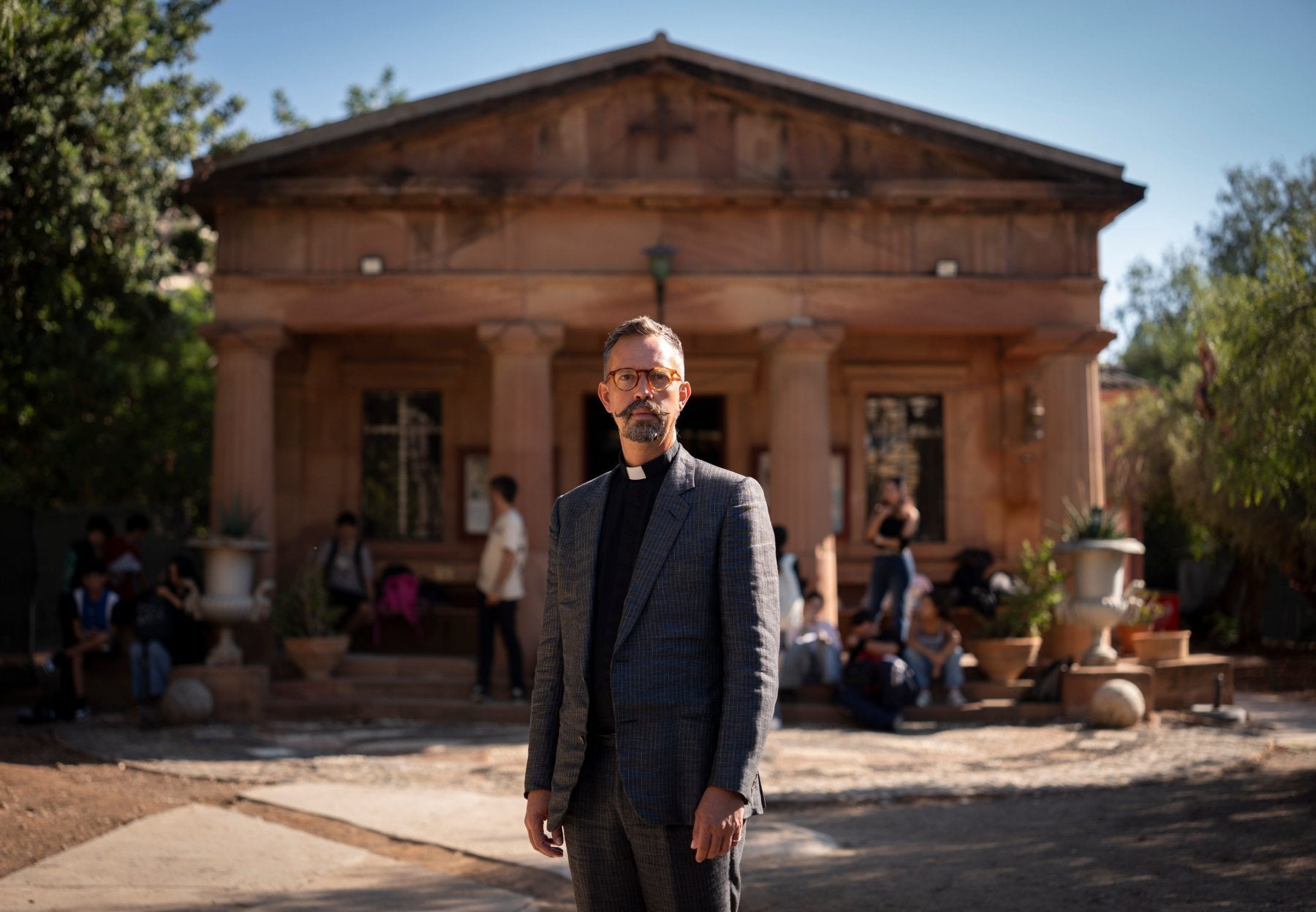
Father Louis, the welcoming priest at St George's who is keeping the inclusive tradition alive
The Reverend Louis Darrant has been playing a leading role in Malaga's protestant community for six years; he talks to SUR about his church, his love for sardines and flamenco and being openly gay
Ana Pérez-Bryan
Malaga
Before the English Cemetery came to be in 1831, dying in Malaga without being Catholic was a problem. Official cemeteries were reserved exclusively for the Catholic faith and the laws of the time prohibited a Christian burial for those who professed another religion. They were considered heretics and, therefore, unworthy of eternal life in consecrated ground.
When this happened, the body was taken to the beach and buried at night, in secret, wrapped in a cloth. The bodies were placed upright in a deep hole dug in the sand and always faced the sea. The fate of those 'heretics' unfolded in two macabre ways: either they were swept away by the sea or, in the worst-case scenario, they were devoured by the dogs or vermin roaming the beach.
Until, that is, a British consul posted in Malaga, named William Mark, said “Enough is enough”.
“In our religion, it is not your identity that matters, but the person you are -loved by God”After two and a half years in Vinaroz, Father Louis arrived at the chaplaincy in Malaga: “This is a huge adventure”
Mark managed to secure permission to set aside a small plot of land on the outskirts of the city where members of the British community - who by then had already done far more for Malaga than many of those who claimed that sacred ground was for them alone - might find peace and eternal (and dignified) rest. And so the English Cemetery was born, and so came to an end the brutal practice of casting out those who were different.
Diversity
Almost 200 years later, the historic cemetery on Avenida de Príes remains a joyful reflection of a diversity that was respected in life but not in death. Members of all religions - not just the Anglican faith - were laid to rest there. The absence of any desire for retribution was such that even Catholics rest in its graves.
That small patch of land - now swallowed up by the city's most expensive buildings - remains intact as the best way to lead by example and consign the labels of this world and the next to purgatory.
And almost 200 years later, the historic St George's church, which stands at the centre of the cemetery, is another example of an inclusive mix. This is partly - largely - thanks to the conviction that its priest, Father Louis, adheres to strictly: “Life is difficult enough as it is without the Church making it any more complicated for us.”
Sardines and white wine
Among the official titles held by Father Louis Darrant are those of Senior Chaplain of St George's Anglican Church, representative of the Anglican community in Malaga, and Area Dean of the Church of England's Southern Spain, Gibraltar & Morocco Cluster.
He arrives for the interview with impeccable punctuality - as a Spaniard would expect from a Brit - and his manners, like his clerical collar, fit the prototype of an English lord to a tee. Moustache and all. Peeking out from his impeccable pinstripe suit are a pair of fuchsia-pink socks, and his perfectly manicured nails feature a discreet touch of varnish.
Father Louis, born in London 49 years ago, is more into sardine 'espetos' and white wine, or a 'venta' in Los Montes, than afternoon tea; he lives in the Lagunillas district of Malaga city and loves to lose himself in cafés and bars “to listen to the locals”.
Holy Week and the music of the bands fill “his soul”, and ever since he was a teenager he has channelled his passion for dancing through pasodoble and sevillanas classes. Now, he is also learning to play the flamenco guitar. He sings too: “I'm the bass singer in the Torremolinos LGBT choir.”
“Yes, I'm gay. Openly gay,” he adds, just in case there are any doubts. It's not as though he goes about carrying a placard, but neither does he hide it in a country where non-heterosexual priests tend to conceal their homosexuality and where the Catholic Church does not allow priests to marry or have sexual relations. No exceptions.
“In our religion, your identity doesn't matter; what matters is the person you are, loved by God,” explains Father Louis, aware that this identity would make the headlines in the Spanish press and might even feature in sermons.
Even in this respect, his story and that of the English Cemetery run parallel. Far removed from labels.
“We Anglican priests have a certain freedom to shape our own way of life,” he continues, delving straight into the exceptions. Because in the Church of England, for the time being, a gay priest could not marry another man, but he could live with him. In fact, Father Louis had a partner “for years; he was English too - a very special person”.
Not now, but he isn't closing the door on a new relationship. Nor does he close the door of his church: “Here we don't ask where you come from or what you believe in. We simply welcome people. It's essential that everyone feels safe,” he maintains with the pride of someone who feels part of the legacy of Mark, the consul who stopped asking about everyone's origins in order to bury them.
Stray sheep
In fact, Father Louis is the perfect embodiment of that inclusive vocation. “I am a very traditional priest who reads Saint Teresa of Ávila and Saint John of the Cross, but who also enjoys going to Pasaje Begoña,” (a symbol and cradle of LGBT+ rights in Torremolinos).
In fact, he came out when he already had one foot in the sacristy. Raised in a family with no ties to the Church, he studied Theology at the University of Aberdeen in Scotland and, after his time at the seminary, was ordained as a priest.
“On the very day I turned 26,” recalls the Reverend, who knew he was gay even before his 18th birthday. “I remember the natural doubts, the complications... I asked the monks how I could go about it.” The answer came swiftly and was as healing as an Our Father: “You just have to be yourself and stay true to your commitment; build a community and learn from others. You'll never be alone.”
And that's exactly what he did. First at a parish in central London and, a few years later, in Spain. Because Father Louis loves Spain. “My parents lived in Estepona and I've always felt very close to this place,” he says with a huge smile. “I'm trying to improve my Spanish, but I'm making very slow progress.”
So far, he has been speaking to his Spanish interviewer with the help of his churchwarden and friend, Caroline Warren. For deep reflections, he prefers English. When talking about his happy life in Spain, he speaks in Spanish. He sings it too. His favourite song: Gracias a la Vida by Violeta Parra, a Chilean icon who also had to face the strict morals of the time and the gossip of the day.
Malaga adventure
“Living here is a huge adventure, a dream,” continues Father Louis, whose first posting was in Vinaroz (Castellón). As soon as he heard there was a vacancy, he applied and was offered the post.
“But I was prepared to come to Spain even without the certainty that I'd have a parish. That's when they told me: 'Louis, you're a priest; you can't work in a bar or be a tour guide!” he laughs. During the pandemic, he was offered the post in Malaga and didn't hesitate.
“In five years, he's literally turned this church on its head,” Caroline interjects, summing it up. She, just like the cemetery, just like Louis, has also shattered the stereotypes. Because Caroline is the churchwarden of an Anglican church, even though she's Catholic. And that's that.
“The important thing is to remain open to the experiences of people who are not like you; and from there, to care for, guide and support them,” adds Father Louis in a reflection that could well be part of his Sunday sermons. And, why not, part of life itself. “In reality, spirituality and politics are closely linked: the Church must not only pray for the poor; it must ask itself why there are poor people and do something to prevent it.”
From that standpoint, Father Louis goes even further in his attempt to explain what really matters in this world: “This is open to everyone, just like a pub.”
And that includes people of all faiths, gays and divorcees, and anyone who comes here willing to join a community. Here, the lost sheep are welcome because they are “in the presence of God”. Just as Mark welcomed all in 1831. And anyone who doesn't understand that... is free to go in peace.
