
Gardening in southern Spain
Metrosideros excelsa, a perennial tree that cares for wounds
Also known in its native New Zealand as Pōhutukawa, this the plant of the month of June at the Jardín Botánico-Histórico La Concepción in Malaga
Denise Bush
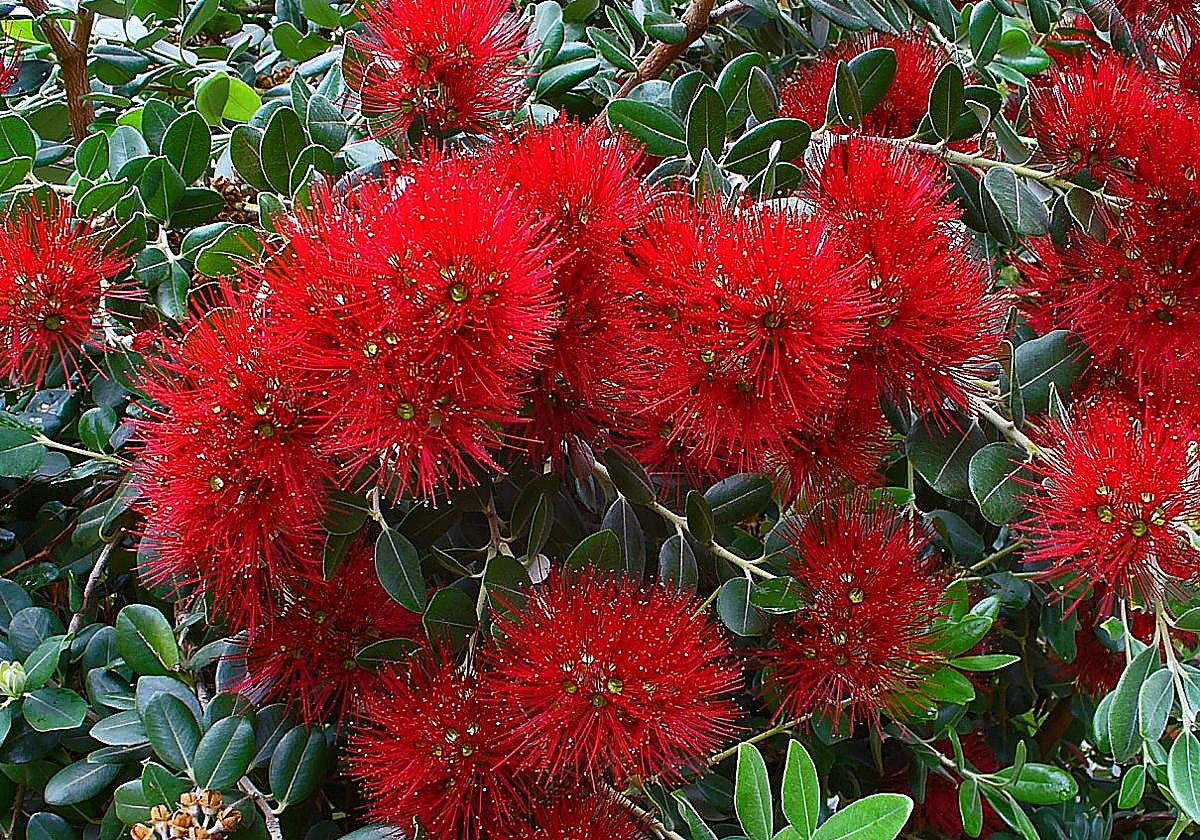
Metrosideros excelsa, known in its native New Zealand as Pōhutukawa, is the plant of the month of June at the Jardín Botánico-Histórico La Concepción in Malaga.
A member of the Myrtaceae family, which consists of around 60 species of trees and shrubs, Metrosideros excelsa is native to New Zealand, Australia, Polynesia and Malaysia. It is a perennial tree with a dense crown, a short trunk and leathery, glossy blue-green leaves which look silvery on the undersides due to tiny white hairs. There are attractive variegated forms also available. It has gnarled, twisting branches and the bark peels away in strips. Mature specimens can develop aerial roots.
The genus name derives from the Greek word 'metra', meaning 'centre' or 'heart', and 'sideros', meaning 'iron', a reference to the exceptional hardness of the timber, which gives the tree its common name of iron tree. In New Zealand it is also known as the Christmas tree, as it flowers there between November and January. In southern Spain it flowers from spring, producing clusters of small flowers with masses of bright red stamens that look like fluffy brushes.
Related story
-
 Denise Bush
The tree is semi-tropical but will tolerate light frost, and is well suited to coastal gardens as it withstands strong winds and salt-laden air. It requires full sun to produce its characteristic red blooms and is drought tolerant for short periods.
The soil should be allowed to dry out between waterings to prevent root rot. When mature it can reach around 20 metres tall, but can be kept pruned and shaped into a dense hedge. Pruning is best carried out in late winter or early spring, just before new growth appears.
Propagation by seed is possible but the seedlings, which are fleshy, are very vulnerable to cold and wet and the success rate is low. More reliable methods are layering lower branches or taking semi-ripe cuttings in summer.
Both the bark and leaves are rich in tannins which make them astringent and useful for the care of wounds. Traditionally, the bark has been used in infusions to treat diarrhoea, sore throats and digestive complaints.
The young leaves can be made into a tea used to relieve bleeding gums and mouth infections. The plant also has antimicrobial and anti-inflammatory properties and topical applications are still used to treat weepy rashes, insect bites and sunburn.
![[]](http://static.vocstatic.com/voc26/latest/assets/images/favicon/surinenglish/apple-touch-icon-57x57.png)