
Culture
Malaga-based orchestra Moderna blends jazz, symphonic music and flamenco and turns it into melodic 'madness'
Israel Fernández, Sandra Carrasco and Lela Soto join more than 50 musicians in Tete Leal's new project, which premieres this Tuesday at the Cervantes Theatre
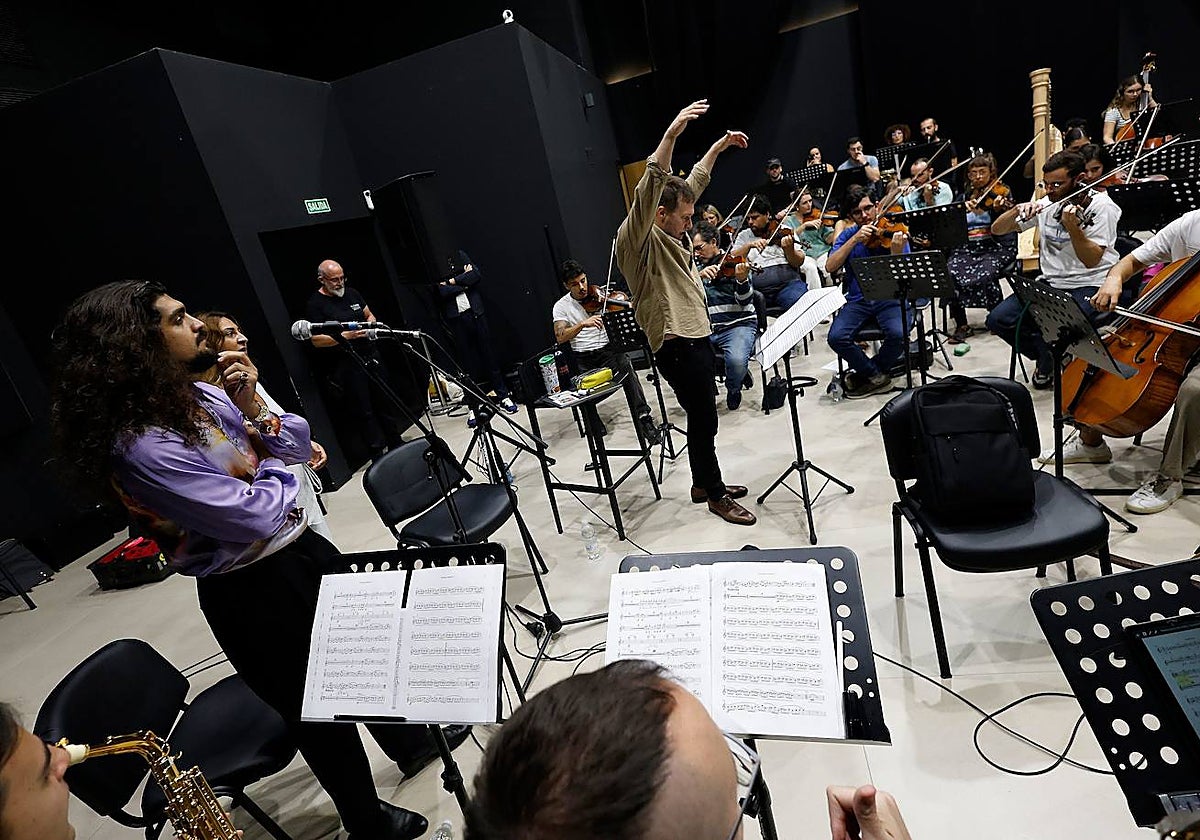

Tete Leal's mind is a musical Tower of Babel. "You've got a lot on your plate at the moment," someone says to him ... as they walk past. The rhythm blends in his mind with the tempo of some pieces and the swing of others. It all sounds at once and fits together in a way that's hard to explain.
Around 50 musicians from different backgrounds make up Moderna: an orchestra that blends jazz, symphonic music and flamenco. Leal is the glue that holds this whole scene together. He is a saxophonist, conductor and composer capable of speaking each of these languages with astonishing fluency.
Related story
"What we're doing here is simply blending who I am as a musician," the Malaga-born artist says during a break from this "madness", which makes its debut at the Teatro Cervantes on Tuesday, 6 October.
Tickets are almost sold out, with three major flamenco singers taking part: Israel Fernández, Sandra Carrasco and Lela Soto.
"For me, it's a gift. You never know what a song can become," Fernández says, visibly surprised after rehearsing his bulería Platero with the orchestra.
The song was born from a moment of inspiration with Ralphie Choo, in a very organic arrangement built around voice, guitar and percussion. "Hearing it played by an orchestra like this, with a Big Band and so many musicians, is a beautiful thing," Fernández says.
The meeting point is ELCAMM, Malaga's centre for modern arts and music, which Leal has directed for years. The air conditioning is turned up to full, yet he still has to wipe the sweat from his forehead. He lives and breathes music, and his energy is infectious.
At the conductor's stand, Leal claps his hands, stamps his feet, gestures with his hands and face, and gives precise instructions to his musicians. He never stops moving. He cannot. In front of him are three ensembles in one. To the right, the brass section; to the left, the strings of a symphony orchestra; and in front, the flamenco guitars and percussion.
Some musicians stick closely to their scores, while others do not use them at all. "Each one has their own language and you have to speak to each of them in theirs. It's a bit chaotic because this is new for many of them," Leal says.
For him, however, it feels perfectly natural. He trained in classical music but soon found himself drawn to jazz. He has led combos and Big Bands, played saxophone alongside flamenco artists and ventured into Brazilian music.
"To fuse things together, you have to know all the worlds you're bringing together. You have to immerse yourself in each one individually and then collectively," he says.
That is why he felt the time was right to do it now, when he feels he has mastered each of the genres he works in. Ultimately, there are not that many differences between them, Israel Fernández says. "We humans are the ones who separate them, but music has one soul," the cantaor says.
For the musicians, the project has been quite a challenge. "Mixing the two worlds is difficult and creates controversy because they have one way of doing things and we flamenco musicians have another," percussionist Sergio Fargas says. He has a message for audiences: "People should come and see this because it's crazy."
Viola player Elena Ruiz agrees about the difficulty from the other side of the divide. "We're very used to reading sheet music, while they just go with it. It's incredibly enriching because everything comes together. In the end, the music always finds its own way."
At the count of "one, two, three; one, two, three", the magic begins. The strumming of a flamenco guitar blends with the percussion and the power of the brass section. When all the instruments come together, the piece reaches another level, almost epic in scale, with an impact that hits you.
They have repeated the same verse over and over until they manage to bring the voice in at precisely the right moment. And when they finally get it right, everything falls into place and the whole ensemble applauds.
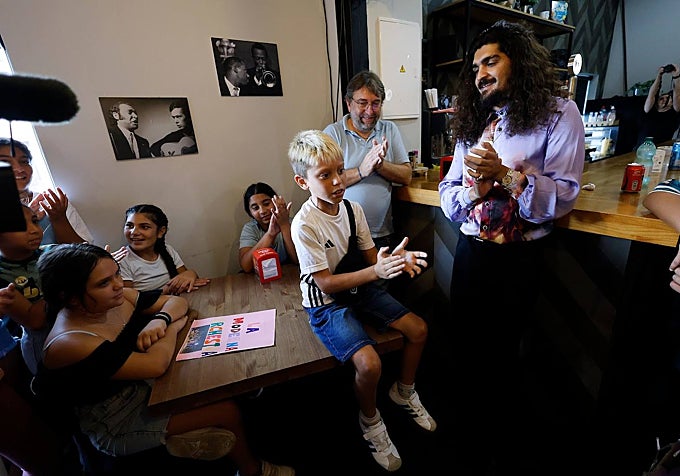
Almost 1,000 people will discover the Moderna at the Cervantes on Tuesday evening, but some have already heard it ahead of the premiere. On Monday, students from María de la O school in Los Asperones attended a rehearsal with the Red Cross. They saw how an orchestra is prepared and spoke to the artists.
The initiative aims to tackle the marginalisation children in the neighbourhood face and promote flamenco as part of their Roma culture.
"What would you be if you weren't a cantaor?" the pupils asked Israel Fernández. "A guitarist," he replied.
With music in their blood, the children then turned the ELCAMM café into a flamenco party, with young Juan Pedro singing. Inside the rehearsal room, the musicians introduced them to other sides of the art of jondo.
This is Moderna's first session, but the journey does not end here. Conceived as an interdisciplinary creative laboratory, with more than 70 professionals involved in the project, Moderna aims to explore new musical territory while keeping music at the heart of everything it does.
Tuesday's debut at the Cervantes is just the first chord in a story that promises to keep playing.
![[]](http://static.vocstatic.com/voc26/latest/assets/images/favicon/surinenglish/apple-touch-icon-57x57.png)