
Mónica comes home
A love story etched on a chimney on a Malaga beach
Three decades after José Carlos painted his girlfriend Mónica’s name at a height of almost 100 metres, the couple return to La Misericordia beach, looking back on the origins of an urban legend that time has been unable to erase

Malaga is a city with two lighthouses. Both are named after women. In the harbour, there is the Farola, and on La Misericordia beach, there is a tower - which is not actually a tower but an old industrial chimney - known by everyone as Mónica.
The name can never really be erased from the bricks, despite the refurbishment in 2007 that wiped the walls clean. Anyone who calls themselves a ‘Malagueño’ knows the story from memory: the legend of Torre Mónica, a love story that left its mark on the city 33 years ago.
And although the old lead factory in Los Guindos no longer bears those six white letters on its brickwork, it still has a place in the sentiment of an entire city.
Related story
-U13853178738tRm-366x256@Diario%20Sur.jpg)
The catalyst for this story is a ‘silly row’. One of those teenage arguments that, when you’re 16, seem like the end of the world. The protagonists themselves - José Carlos Selva and Mónica Vallejo - recount the story to SUR as they stand alongside the chimney, their tower.
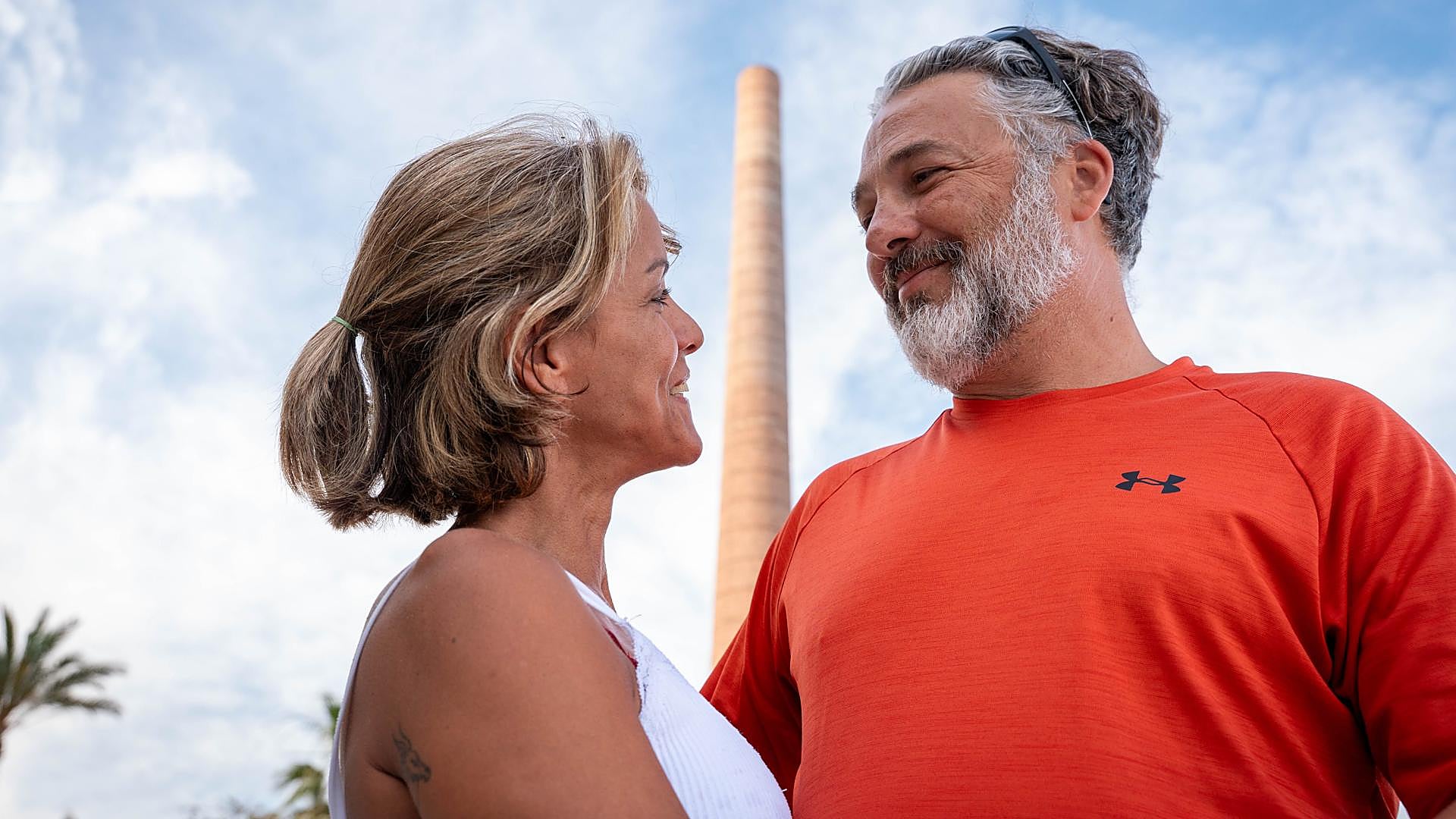
Yes, they’re still together. More in love than ever, and with three children. A love as strong as that towering brick giant that they close their eyes and see from Tenerife. That is where the couple decided to make a life for themselves at the age of 18 and is still their home, although their love remains anchored to the beach of their youth.
They come back to Malaga whenever they can. “We grew up here. This shore is our shore, and whenever we come to Malaga, a visit to our tower is a must.”
They don’t let go of each other’s hands while they talk. Time has stood still here. They stand before the heritage of an entire city, yet it belongs to them more than to anyone else.
"If I had permission from the city hall I would paint it again, of course, but today it's part of the city's industrial heritage"
José Carlos Selva
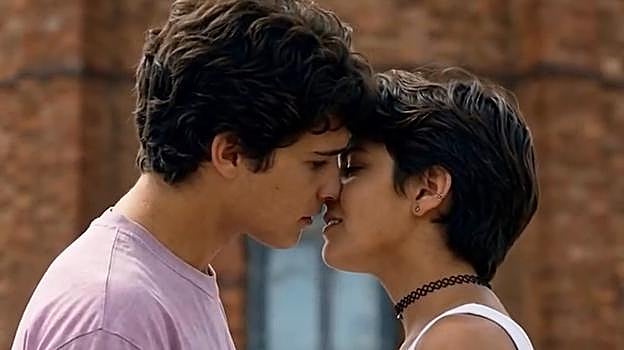
It was 1993. They were studying together at the Mare Nostrum secondary school.
“We were just kids - we were 17 [José] and 16 [Mónica],” they recall, gazing at the massive brick structure that towers over the whole beach. They’d only been together for a year, and after a little row one Friday afternoon, she went home in a huff.
“I can’t even remember why we had a row,” adds Mónica.
José Carlos wasn’t your typical boyfriend. A thrill-seeker, back then he wasn’t just into climbing; he and his friends in Bonaire, where he lived, would use the chimney to pull off their “stunts”.
“We’d abseil, face down, face up… We were a bit mad back then,” he confesses with a laugh. So, to apologise to his girlfriend, he ruled out flowers and decided to tell her from high up - very high up, as high as the tower’s 106 metres at the time. Years later, during the renovation, it was lowered to 96 metres due to the risk of collapse.

That Saturday night, the operation got under way. Nothing was left to chance. The plan was as simple as it was risky: it involved climbing to the top of the chimney and then abseiling down on ropes to paint the letters.
“If you stood there on the edge, you could feel the wind stirring the chimney,” he recalls as he counts out those steps one by one. He mentions his accomplice in this adventure, his friend Roberto. He doesn’t want him to be the forgotten figure in this story.
“We both climbed up. While I was hanging there, getting the ropes ready to abseil down, he was passing me the buckets of white paint,” notes José Carlos. Mónica had asked him that very afternoon if they were going out. He replied, “No, I’ve got plans.”
And what plans! He was painting the letters by torchlight from ten o’clock in the evening until two in the morning. Halfway through the descent, he realised he’d miscalculated the amount of paint needed and, on the spur of the moment, changed his initial ‘Mónica Te Quiero’ (Mónica I love you) - there’s even a sketch of it - to a resounding and succinct ‘Mónica’.
"I couldn't believe what he had done"
The next morning, José Carlos turned up at Mónica’s house, in the Vistafranca neighbourhood, on his Vespino.
“Hop on, I’m going to show you something,” he said. She remembers perfectly the journey to the ‘tube’ - as they used to call the structure that stood among the ruins of the abandoned foundry, amid rats and scrap metal.
“I could see the name from a distance. I couldn’t believe what he’d done,” she says.
“At first I didn’t say anything; I played it cool… But of course we made up straight away. And sure enough, that afternoon I took all my friends to the beach to show it off.”
Mónica’s identity would spend years in anonymity for the city as a whole, but in her neighbourhood it was an open secret.
“The neighbours knew perfectly well who’d painted it: Look what José Carlos did for Mónica!” they laugh. Nevertheless they kept the feat secret for a year, until one day at the beach when José Carlos’s mother was shown the famous graffiti.
“When my husband confirmed it was him, my mother-in-law nearly had a fit: ‘Are you mad to have climbed up there?!’” recalls Mónica.
Urban legends
For years, this feat gave rise to a host of urban legends that Mónica kept coming across on internet forums: “They said the person who did the graffiti was a drug addict, that he’d killed himself.”
There were even fake claimants coming forward to take credit for it. But the trigger for her to come forward came when Malaga city council restored the chimney in 2007.
Seeing the name being removed and reading statements “from politicians” who played down the significance of the name, dismissing the act as “childish behaviour” and suggesting that the couple “might not even still be together”, she flew into a rage. She decided to send a letter setting the record straight, which put an end to the mystery. “I am Mónica, from the tower.”
Today, José Carlos looks Mónica in the eye and confesses that, for her sake, he would go back up there with his pots of paint this very day, but he also adds cautiously: “If I had permission from the city council, of course; these days this is part of Malaga’s industrial heritage and must be respected. Back then, it was nothing more than an abandoned factory.”
Today it is a clean, immaculate, soulless brick chimney, but in José Carlos and Mónica’s minds that name remains, intact. They look at it, embrace each other, and kiss as if they were reliving that Sunday morning in 1993.
Returning to Malaga is an emotional recharge. The paint may have been removed, but not their love story. Because the chimney is now - and will always be... Torre Mónica.
![[]](http://static.vocstatic.com/voc26/latest/assets/images/favicon/surinenglish/apple-touch-icon-57x57.png)