
Spain solar eclipse 2026 guide to protecting your eyes during the phenomenon
Two ophthalmologists offer advice on how to safely observe the eclipse

The last total solar eclipse that Spain saw was over a century ago. The phenomenon is set to return in two weeks, attracting thousands of ... people who don't want to miss this spectacle.
The phenomenon has become a lucrative business for the hospitality sector. Secretary of State for Science Juan Cruz Cigudos predicts that it "will bring thousands of tourists to rural Spain".
There is a whole world of package holidays available to experience this event. According to consultancy firm CoverManager, with three months to go, "restaurant bookings had already soared by 880 per cent and accommodation bookings by 80 per cent".
Related story
With the buzz building up as the date approaches, ophtamologists have issued some advice concerning safety. The consequences of ignoring it could be "serious" and even "irreversible", as ophtamologist Laura Galletero Pandelo says.
In 1999, 70 people required medical attention in the UK after watching that summer's solar eclipse, according to reports from the time.
Forget about X-rays
The first thing to bear in mind is that you mustn't look up at the sky with your eyes uncovered. If you do look directly at the sky, you need to take precautions.
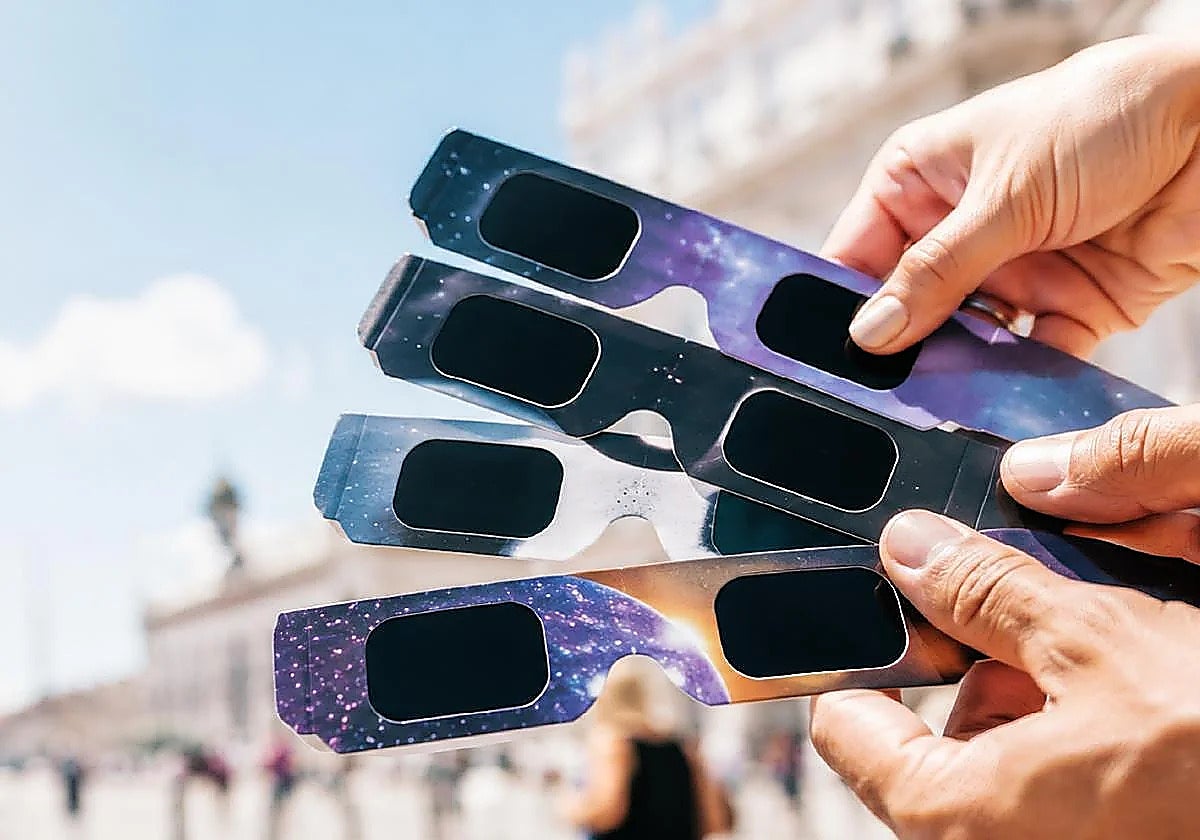
How? According to the clinical surgical institute of ophthalmology (ICQO), the safest method is to wear approved glasses.
"They have certified solar filters that ensure you won't damage your eyes."
If you have a pair or are planning to buy some, they must have the ISO 12312-2 with the CE mark label. "It's very important to check the label, because you may come across sunglasses that are supposedly approved but actually aren't," Galletero says.
Any other accessories or homemade alternatives are out of the question: no old X-ray films, no photographic negatives, no tinted glass…
Don't take any chances with welder's goggles either: "Some say that No 14 filters should be safe, but they'd have to be in perfect condition, without any scratches and with a valid certificate."
The 'pinhole' trick
Another way to view the eclipse is indirectly with a 'pinhole' projector. Take a cardboard box, make a hole in it and, standing with your back to the sun, "watch the phenomenon projected onto the ground". Even when viewing the eclipse indirectly, it's important not to watch continuously.
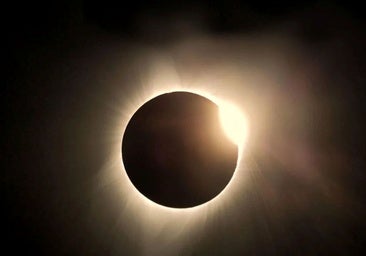
A total solar eclipse has two phases: a partial phase, during which the moon gradually covers the sun and which can last for several hours, and the total phase, which will last no more than three minutes.
"It's important to take regular breaks," ICQO ophthalmologist Sergio Eguiza says. "And don't assume it's safe just because it's cloudy."
Experts also warn against looking at the eclipse through telescopes, binoculars or cameras unless they are fitted with professional solar filters. "These devices increase the risk of phototoxic damage to the macula because the reduced glare makes people look at the sun for longer, increasing exposure time."
Magnifying the sun's image can also make retinal damage more severe.
The eye really can be burnt
These precautions exist for one reason: the sun really can burn your eyes.
"The light reaches the retina, causing inflammation and damage, we could describe it as a burn, to the photoreceptors, which are the retina's nerve cells," Galletero says.
The damage is irreversible.
The most common symptom is a central scotoma: a permanent dark spot in the middle of your field of vision.
Other reported symptoms include: reduced visual acuity; chromatopsia, which affects colour perception; photophobia, or increased sensitivity to light; and metamorphopsia, which causes straight lines to appear distorted.
Some symptoms may not appear until up to 12 hours later.
"If you notice blurred vision, flashes of light, dark spots or any other changes to your sight, seek medical attention immediately," Eguiza says.
Children face an even greater risk
Parents should take extra care when children watch the eclipse.
"Their optical system, the cornea and the lens, is still completely transparent and hasn't fully matured," Galletero says. "That means there's even less margin for error."
Children also tend to have fewer refractive errors, giving them a greater ability to focus light, which increases the risk of retinal damage.
"If they're wearing certified eclipse glasses, keep a close eye on them and make sure they don't take them off, even for a moment," Eguiza advises.
![[]](http://static.vocstatic.com/voc26/latest/assets/images/favicon/surinenglish/apple-touch-icon-57x57.png)