
Health and wellness
Does the time of day we train really matter that much?
Experts in sleep, physiotherapy, sport and hormones answer the million-dollar question on how to organise our exercise routine
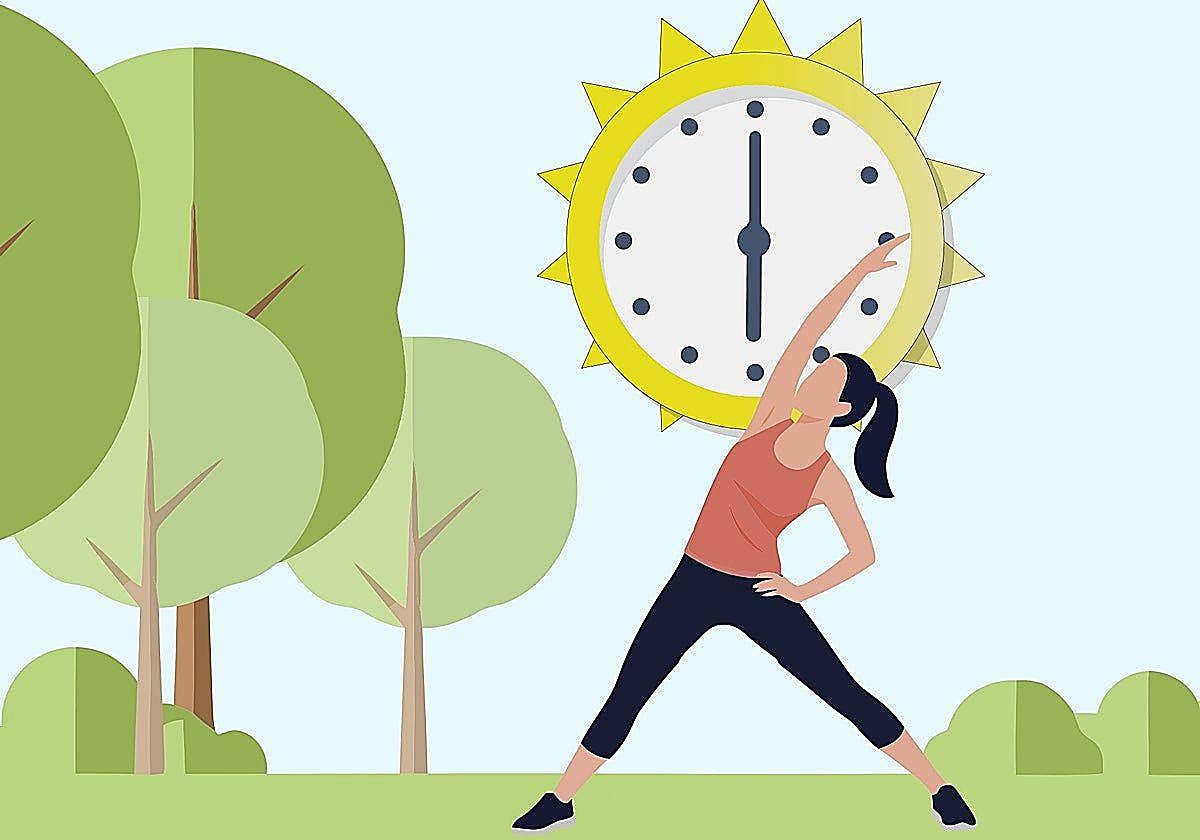

Experts say that the key to not feeling too lazy to do something is to do it without thinking. In other words, don’t give ... your mind a chance to come up with excuses. And exercising is one of those things for which we always find excuses. ‘I’m tired’, ‘the fridge’s empty’, ‘I’ve got a meeting’… It’s all just excuses. To stop us procrastinating, those same experts recommend we build a habit: set ourselves a daily routine, as far as possible, and stick to it. After 21 days - according to one theory - it’ll become second nature. Right. So, what’s the best time to train if we have a choice? You could say this is one of those million-dollar questions. With the help of four experts, we’re going to try to answer it.
Chronobiology: consistency is key
María José Martínez Abad, coordinator of the Chronobiology working group at the Spanish Sleep Society, answers the question without hesitation: “There’s no such thing as a perfect time. You have to aim for consistency.” And this consistency comes from sticking to two things. “The most important thing is regularity”- not jumping from one schedule to another, nor going all out one week and then not setting foot in the gym the next. This ties in very well with the idea of forming a habit that we were talking about earlier.
The second issue is more personal: chronotype. I’m sure you’ve heard that there are ‘larks’ and ‘owls’. Well, although scientifically speaking it’s a bit more complex, it’s all about respecting our natural rhythms: "A morning person isn’t the same as an evening person. If you want to optimise your performance or how you feel, it makes sense to train at the time of day when your body is most ready." That said, let’s not be too rigid about it – we have a life beyond sport and need to balance the two.
And then there’s a third factor we need to consider: rest. However much of a night owl we might be, if training interferes with our sleep, well, that’s a red flag. Although not all training sessions will do that – we’ll look at that a bit later.
Endocrinology: make sure you get enough rest
Hormones also play a part: “They form part of the picture, although they are not the decisive factor,” says Emilio Soto, a member of the Endocrinology, Nutrition and Physical Exercise Group of the Spanish Society of Endocrinology and Nutrition (SEEN). Once again, "the best plan is always the one the patient can stick to over time". With this in mind, we can now get down to business and, provided we have the freedom to do so, make a choice.
Exercising in the evening, up until 8pm, is associated with better results "in controlling blood pressure, triglycerides, glucose and vascular function". However, exercising in the morning is, for example, slightly better “for shifting the sleep-wake cycle and for achieving faster changes in body composition during the first few weeks”.
That said, the evidence for all this is ‘limited’, so we cannot conclude that doing the opposite is worse. In fact, the specialist gives a very clear example: that of glucose control. "There is no magic time to manage your glucose spikes; what there is, is a very clear strategy. Exercise increases glucose uptake by up to five times during the activity and improves insulin sensitivity for 24–48 hours afterwards. Furthermore, in the first two hours after exercise, this effect occurs independently of insulin.”
What you mustn’t skimp on is rest and sleep: "Chronic poor sleep does have real metabolic consequences" and ultimately leads to "weight gain over time". So it’s best to avoid very intense exercise late in the day. Save the spinning and HIIT sessions for another time.
Physiotherapy: a sustainable habit
Did you know that your body temperature varies throughout the day? It’s lower in the morning than in the afternoon. But how much should this influence your choice of time at the gym? Aser Donado Bermejo is a member of the Governing Board of the Professional Association of Physiotherapists of the Community of Madrid: “The higher temperature in the afternoon may slightly improve performance. It makes the muscles more elastic, the joints more mobile and the nervous system more active. As a result, we feel more agile, stronger and the effort feels easier.”
However, he does not believe that we should base our decision solely on this either. He recommends that we take three factors into account: "Consistency, dosage and adaptation". More important than finding the perfect time is training "regularly", at "an intensity and workload suited to our abilities" and at a time "that fits in" with the rest of our routines. The word that best sums this up is ‘sustainability’.
– But they say your back is weaker in the morning...
– When we get up in the morning, the intervertebral discs contain slightly more fluid, which can make them a little more sensitive to certain movements. However, this is often over-interpreted and does not mean that training in the morning is dangerous.
Sport: what’s right isn’t always perfect
And now, let’s head to the gym… with Álvaro Puche, who holds a degree in Physical Activity and Sport Sciences and is a personal trainer. “From a purely physiological perspective, there is a slight advantage to training in the afternoon: between 4 pm and 8 pm.” At that time, our body temperature is at its peak, “which improves nerve conduction, muscle elasticity and energy metabolism”. Added to this is the fact that “levels of cortisol, a catabolic hormone, and testosterone, an anabolic hormone, are favourable”.
There you go, you’ve chosen a time slot. Well, not quite. That slight advantage isn’t decisive either. Mornings have two other advantages that are by no means negligible: "They won’t schedule a meeting for 7am, but they might well schedule one for 7pm. And if you value socialising a bit, you’re more up for it in the morning." And one final tip from an expert: “Sometimes the right choice isn’t the perfect one.”
![[]](http://static.vocstatic.com/voc26/latest/assets/images/favicon/surinenglish/apple-touch-icon-57x57.png)