
Health
Spain's Health Ministry sets new goal with provision of abortion pill through the public healthcare system
Minister Mónica García announced that she would push for the inclusion of medical abortion in the range of primary care services

Madrid
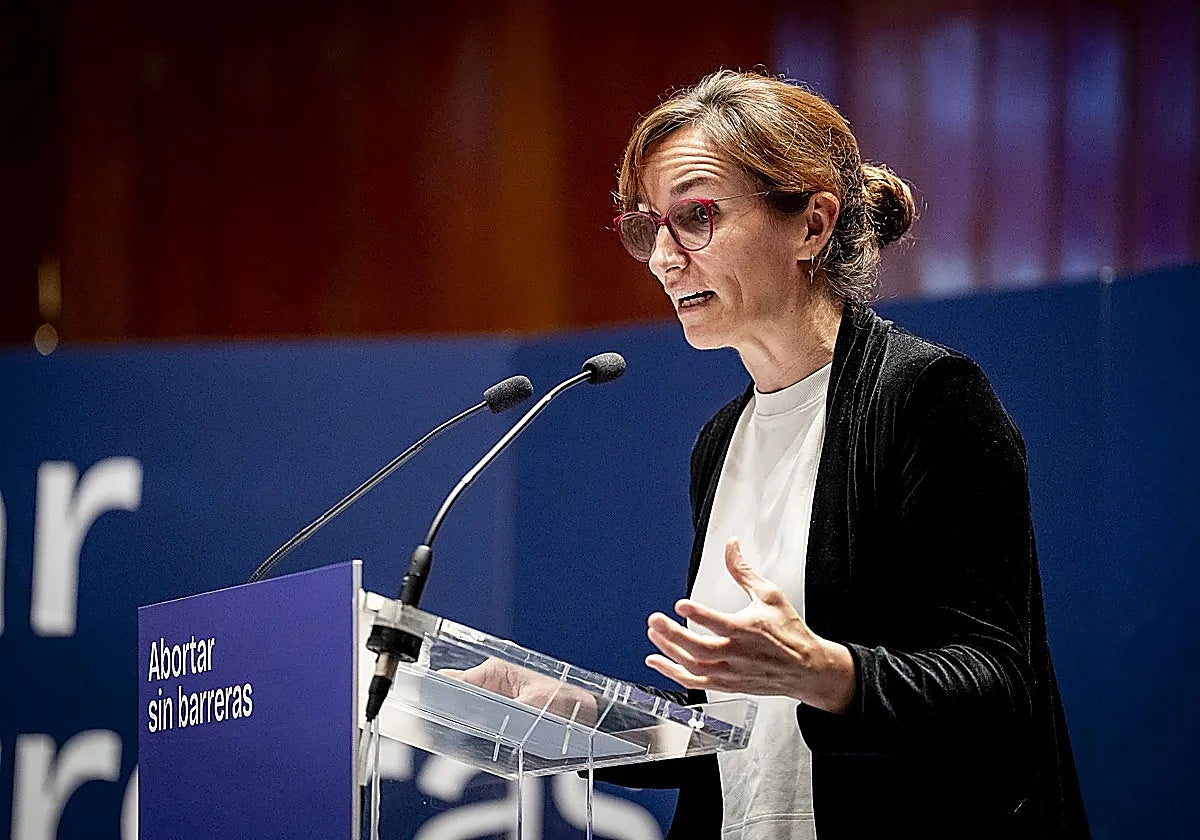
The Spanish government will "promote" the voluntary termination of pregnancy using medication. This would allow women to access the drug mifepristone at health centres, "when ... appropriate for their situation", as Health Minister Mónica García announced on Monday at a pro-choice event.
This involves initiating the procedures to amend the drug's information leaflet and include it in the standard portfolio of services. "We want women who choose this method to have clear information, trained professionals and support before, during and after the procedure," García said.
"To make this measure possible, the Ministry of Health will amend the royal decree governing the authorisation of healthcare centres," the ministry stated in a press release. "It will also begin the process of amending the product information leaflet for mifepristone, one of the medicines used in medical abortion, to allow its use outside the exclusively hospital setting. Furthermore, it will update the national health service's portfolio of services to expressly include it within primary care."
The drug the Ministry of Health has chosen is used to induce an abortion up to the ninth week of pregnancy, with an oral dose of 200mg.
The pharmacological method is common in those regions where public healthcare centres handle requests for termination. For example, in Cantabria (86% of the time), Navarre (76.5%), La Rioja (68%) and Galicia (68%), because it involves "less logistical complexity".
"By contrast, in regions where the service is mainly provided by private centres, such as Andalucía and Madrid, the surgical method predominates, being used in 86% and 94% of cases, respectively," the ministry explained.
Mifepristone is a medicine that the WHO (World Health Organization) considers "essential" and which should be available at an affordable price. It works by blocking the receptors for the hormone progesterone. By blocking its action in the endometrium, it prevents the pregnancy from progressing.
A study by the Ministry of Health states that, "according to the most up-to-date scientific evidence, the method that has proven to be the most effective and safest is the combination of mifepristone and a prostaglandin analogue (primarily misoprostol)". The latter drug has "lower efficacy" than the one the department of health is now set to promote, but it is less expensive.
The second dose of medication should be taken one or two days after mifepristone, at a dose of 800 microns, either orally or vaginally.
In Spain, mifepristone is marketed under the brand name Mifegyne, in tablet form. It is not available over the counter in pharmacies, unlike the morning-after pill, and it requires a doctor's prescription. It is for hospital use only, according to the Spanish agency for medicines and health products. Until now, it has not been supplied or prescribed in primary care and this is the change that García wishes to achieve.
It is also supplied at private clinics specialising in abortions, where it is not sold as individual tablets but forms part of the voluntary termination of pregnancy, at a cost to the health system or the individual of around 400 euros. These private centres also usually provide misoprostol and carry out follow-up care.
Eight out of ten
For the ministerial order to be effective, the ministry must work with the regions and doctors. "We have approaches that work and professionals who know how to do it," said García.
"We want women to know where to go, be able to make informed choices and have a team they can turn to throughout the process. To save you a trip, to know who to call if you have a query and to feel that there is a team that knows you and supports you," the minister stated.
According to official figures, "almost eight out of ten voluntary terminations of pregnancy were carried out in private clinics" in 2024. Although García stated that some regions already provide the majority of this service in public healthcare centres, while others do not even keep a register of conscientious objectors.
"No woman has to prove that she is suffering for her decision to be legitimate," García stated.
According to the Ministry of Health, the drug is 96% effective. "A successful procedure leads to the complete expulsion of the gestational sac, meaning that the woman does not require any further medical treatment. A 'failure of the method' is an incomplete abortion, which requires subsequent aspiration (around 4%) or a continuing pregnancy (around 1%)," the study states.
Factors influencing this include gestational age, dosage, route of administration, the interval between taking the first and second medicines and the doctors' experience.
The debate is back on
The debate on medical abortion has been on the table since at least 2021, involving former Minister of Equality Irene Montero and former Minister of Health Carolina Darias.
As then, so today, around 85% of voluntary terminations of pregnancy were carried out in the private sector, although the state bears the cost.
The latest figures from the Health Ministry show that in 2024 there were 106,172 voluntary terminations of pregnancy, with an increase of nearly 7% among those under 20, totalling 11,699 cases. State-subsidised or private clinics carried out 78%, which is 7% fewer than five years ago. The public sector took care of 22,563 (21%) abortions.
When Minister García presented these figures in October 2025, she proposed as "key measures" the introduction of a register of conscientious objectors, the creation of "non-objecting teams", "the standardisation of abortion as just another service, through standardised protocols, specific training and coordinated care pathways" and "promoting the pharmacological method within the public healthcare system due to its effectiveness, safety and ease of implementation, following the model of regions such as Cantabria, Navarre, Galicia and La Rioja".
Almost a year later, she announced that she would take this step forward.
![[]](http://static.vocstatic.com/voc26/latest/assets/images/favicon/surinenglish/apple-touch-icon-57x57.png)